Bond syndication is a sale in which an issuer appoints a group of banks to organise and distribute a primary offering of bonds. A tap, or reopening, is an issue of additional principal under an existing bond series. A reopening can itself be syndicated. For a position or supply model, the key question is whether the new bonds enter the existing tradable line and when. For a cash forecast, the question is what the buyers pay on settlement. World Bank issuance guide, TreasuryDirect on reopenings.
How the sale works
In a marketed syndication, lead managers give investors initial price or spread guidance and collect orders through bookbuilding. The issuer and banks use the order book to settle on the size and pricing, and the banks coordinate allocations. A new line gives the issuer room to choose a new maturity or coupon. A tap lets the issuer raise money at an existing maturity and use that bond’s secondary-market price or yield as a pricing reference. Concentrating more debt in one line can support liquidity, which still depends on how much of the issue actively trades. World Bank issuance guide, Step 5, UK Debt Management Office on reopening its benchmark gilt.
A tap can start with one investor asking for more of an existing bond. Lime Petroleum reported such a sale in February 2025, arranged through a broker after an institutional investor approached the issuer. Rex International Holding announcement.
The U.S. Treasury uses auctions for scheduled reopenings, keeping the original CUSIP, coupon or spread, payment dates and maturity. The added tranche has its own issue date and can sell at a different price. The UK Debt Management Office used a bank syndicate for its September 2026 reopening of the 5⅜% Treasury Gilt 2056. The £4.25 billion face amount was set to join the existing gilt under ISIN GB00BT7J0241. Both sales add to an existing line, with price and allocations determined through different processes. TreasuryDirect buying guide, UK DMO result, UK DMO offering circular.
A USD 40 million tap and a USD 40.9 million invoice
Suppose a fictional fixed-rate bond has USD 100 million outstanding. The issuer sells USD 40 million of additional face value, all interchangeable with the original bonds at settlement, with no concurrent redemptions. The line grows to USD 140 million outstanding.
The buyer’s clean price is 101 per USD 100 of face value. The bond pays a 5% annual coupon in two equal instalments. Assume the tap settles after 90 of 180 days in the coupon period on a 30/360 basis, with the buyer entitled to the full next coupon. That adds accrued interest of USD 1.25 per USD 100, half of the USD 2.50 coupon instalment. The dirty price is therefore 102.25, and the buyers’ gross cash payment before fees is
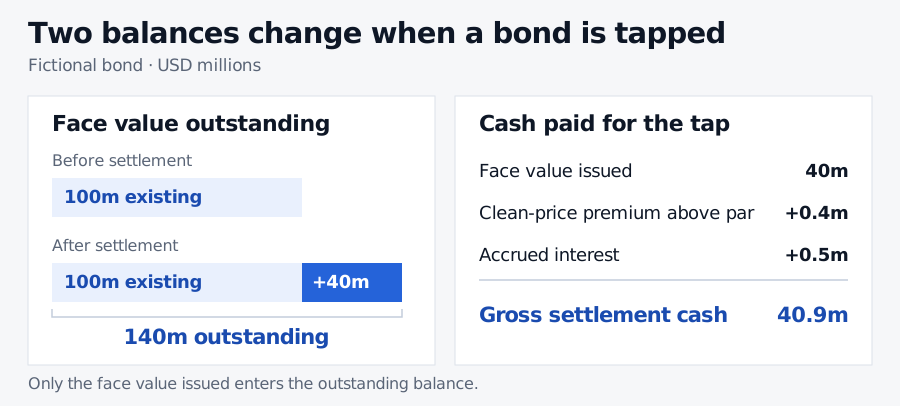
The outstanding balance increases by the face value sold. The settlement cash also includes the clean-price premium and accrued interest.
The USD 0.5 million of accrued interest paid up front offsets the pre-settlement part of the next USD 1 million coupon on the tap. The actual accrued amount depends on the documented settlement date and first coupon entitlement. The September gilt circular, for example, specifies the accrual start, settlement date and full next coupon. For a worked example of the general cash-price calculation, see the lesson on Accrued Interest, Compounding Conventions, and Curve Fitting. The preview is public and the full lesson requires membership. UK DMO offering circular, Interest, SelfMadeQuant lesson.
When can the two tranches trade as one?
Compare the original terms with the tap’s pricing supplement or final terms. Check the obligor, currency, payment rank and guarantees, coupon and schedule, maturity and any early redemption rights. Then verify the settlement date, clearing system and delivery identifier. Fungible bonds are interchangeable for trading and delivery. If a tranche starts under a temporary identifier, track it separately until the documents and settlement instructions confirm consolidation. Xerox’s 2025 add-on, for example, specified temporary CUSIP and ISIN codes for its offshore Regulation S tranche. UK DMO offering circular, General and Interest, Xerox Form 8-K, Item 7.01.
A single legal series can also contain bonds with separate identifiers for tax reasons. A qualified reopening under the applicable U.S. federal tax rules treats the add-on as part of the original tax issue, including its tax issue date and issue price. The qualifying tests can depend on timing, yield or original issue discount. The tap still has its own actual settlement date and market price. Brookfield Finance’s prospectus supplement provides for one contractual series and calls for a separate CUSIP or ISIN if later notes lack U.S. federal income tax fungibility. Track legal series principal and tradable supply by identifier separately until the offering and clearing records establish which bonds can be delivered against the same position. 26 CFR § 1.1275-2(k), Brookfield Finance supplement, Reopening of the Notes.
Sources
- World Bank, Issuing International Bonds, Step 5.
- UK Debt Management Office, September 2026 gilt reopening result and final offering circular.
- Rex International Holding, Lime Petroleum tap announcement, 19 February 2025.
- TreasuryDirect, Treasury Reopenings and Buying a Treasury Marketable Security.
- Brookfield Finance, Prospectus supplement, Reopening of the Notes.
- U.S. Treasury regulations, 26 CFR § 1.1275-2(k), Reopenings.
- Xerox Holdings, Form 8-K, Item 7.01.