Bookbuilding is the process of collecting investor orders and indications of interest to help set the price and allocate securities in an offering. The lead banks, called bookrunners, consolidate submissions for the issuer or seller. For an analyst, the useful number is how much eligible interest remains at the proposed terms relative to the amount on offer. As the terms change, so can the amount the book supports. An issuance book gathers interest for one deal. A secondary-market limit order book contains orders available for matching under a venue’s rules. ECB advisory report on debt issuance, §3.3.3 · SEC investor bulletin on IPOs
What the price limit means
- Syndicated bond. Investors typically request an amount of face value. If the deal is quoted as a yield spread over a benchmark, an investor can specify a minimum acceptable spread. Tightening guidance below that minimum takes the order out of the eligible book unless the investor revises it. For a fixed set of promised cash flows and an unchanged benchmark yield, a tighter spread means a lower yield and a higher bond price. World Bank guide to domestic syndications, §§3.2.2–3.2.5
- Equity IPO. The book may record a quantity of shares and a maximum price per share. An indication with a price cap drops out above the cap. The underwriting syndicate uses the book alongside valuation and market conditions to recommend an offer price. An accelerated bookbuild compresses the process for a follow-on offering or an existing shareholder’s block sale. A block sale of existing shares sends the proceeds to the seller. FCA IPO allocations study, §3 · SEC investor bulletin on IPOs · BAT block trade launch and completion announcement
A book can be covered at one price
A fictional issuer offers USD 100 million in bond face value. Investor A indicates USD 60 million at up to USD 100 per USD 100 face value. Investor B indicates USD 30 million at the same limit through two banks. The banks verify that both submissions represent the same ticket. Investor C indicates USD 70 million at up to USD 99. Assume no revisions or withdrawals between the two price scenarios.
The raw book adds up to USD 190 million. At USD 99, all three investors are within their price limits, so the reconciled book shows USD 160 million of eligible indications.
At USD 100, C’s indication drops out. The eligible total falls to USD 90 million, or 0.9× indicated coverage. The offer size is unchanged.
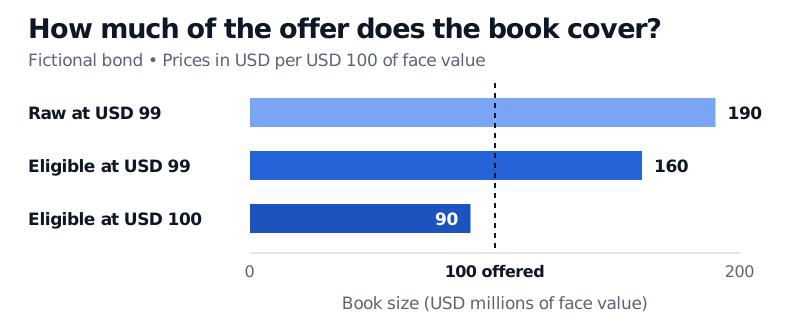
Removing the duplicate changes the book at USD 99. Raising the price then takes one investor’s entire indication out of the book.
From the book to an allocation
Bookrunners reconcile submissions by investor and mandate. If two banks report the same investor, they check whether the entries represent the same instruction or separate orders. They also track revisions, withdrawals and conditions. Hong Kong’s Securities and Futures Commission, for example, directs overall coordinators of covered offerings to take reasonable steps to find and eliminate duplicate orders. ECB advisory report, §3.3.3 · Hong Kong SFC Code of Conduct, §21.4.4(a)
An indication signals interest and may be nonbinding even at the stated price. A submission can enter the allocatable book once it is live, meets the final terms and satisfies any required confirmations. When it becomes binding depends on the offer’s terms and confirmation process. An allocation is the quantity assigned to the investor. In a deal with excess demand, the issuer and bookrunners can scale orders back by different amounts under the allocation policy, for example to spread the issue across more holders. Deal-specific cornerstone commitments can reserve part of an IPO. Coverage alone gives neither an investor’s fill nor the amount of demand likely to carry into the secondary market. Prime Medicine IPO free writing prospectus, Participation by existing stockholders · Hong Kong SFC Code of Conduct, §21.4.4(c)
The UK Debt Management Office’s September 2025 syndicated gilt launch illustrates which figures to keep separate. The bookrunners tightened guidance from 8.25–8.75 basis points over the reference gilt to 8.25. The book closed with GBP 141.2 billion in nominal orders. The DMO then announced a GBP 14 billion nominal issue and later set the cash price at GBP 98.972 per GBP 100 nominal. The spread, the total orders, the amount issued and the cash price each describe a different part of the transaction. UK Debt Management Office, 2 September 2025 syndication result
Sources
- ECB Debt Issuance Market Contact Group, Advisory report on debt issuance and distribution in the European Union, §3.3.3 on syndicated order collection and reconciliation.
- World Bank, Domestic Syndications, §§3.2.2–3.2.5 on spread guidance and debt allocation.
- SEC, Updated Investor Bulletin: Investing in an IPO and FCA Occasional Paper 15 on equity pricing and the order book.
- Prime Medicine, IPO Free Writing Prospectus on indications by existing investors.
- British American Tobacco, ITC Block Trade Launch and Completion.
- Hong Kong SFC, Code of Conduct for Licensed or Registered Persons, §21.4.4 on book consolidation and allocation.
- UK Debt Management Office, September 2025 Syndicated Launch of the 4¾% Treasury Gilt 2035, pricing and notes to editors.