An underwriting syndicate is a group of banks or broker-dealers that work together to distribute a securities offering. In a firm-commitment deal, each member agrees to buy a specified portion from the issuer or selling shareholders, subject to the agreement’s closing conditions. The members then distribute the securities to investors. Dividing the purchase lets the banks share the funding and resale exposure. In a deal model, separate what investors pay, what the banks agree to pay the sellers and what the issuer actually raises. Karman IPO underwriting agreement, § 2 and Schedule I.
Who runs the deal and who takes the risk?
Lead bookrunners coordinate bookbuilding. They collect indications of demand, use them in pricing discussions with the issuer and coordinate investor allocations. That book can include interest from cornerstone or anchor investors, whose commitments depend on the deal. The underwriting agreement separately specifies the amounts each bank agrees to purchase. Representatives act for the syndicate in administering the agreement, and a bank can be both a bookrunner and a representative. SEC Investor Bulletin, Offering Price, Karman final IPO prospectus, Underwriting.
A firm commitment puts the resale risk on the banks for their committed shares if the deal closes. They may have to carry unsold shares or sell them at a lower price. In a best-efforts offering, the intermediary seeks buyers and the amount raised depends on what investors actually buy and on any closing contingency. For example, the deal may require a minimum amount to be sold before it can close. The distinction matters for the issuer’s funding forecast and for the bank’s exposure from pricing through settlement. FINRA 2026 Annual Regulatory Oversight Report, Net Capital, FINRA Regulatory Notice 16-08, Part I.
Follow the money at the offer price
In a fictional firm-commitment IPO, the syndicate buys 1 million shares at USD 9.50 each and sells all of them to investors at the USD 10 public offer price. The gross underwriting spread is USD 0.50 per share, or 5% of the public price. The whole offering has a USD 500,000 gross spread, before expenses, any selling concessions and allocations among syndicate members.
Suppose the issuer supplies 700,000 new shares and existing shareholders sell 300,000 shares. The offer is USD 10 million gross. At the purchase price, the issuer receives USD 6.65 million and the selling shareholders receive USD 2.85 million, both before their other expenses. If the issuer pays another USD 200,000 in offering expenses, it raises USD 6.45 million net. Only the new shares increase the number outstanding. If the deal also has a greenshoe option, track the option shares separately and check who supplies them.
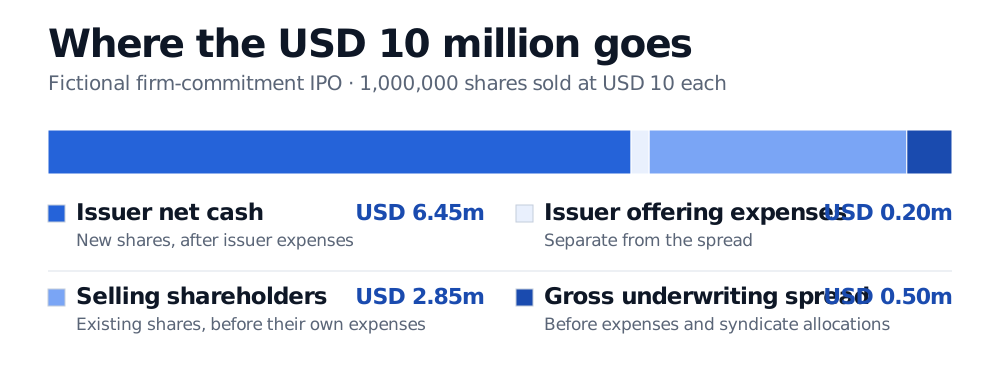
The two issuer amounts add up to USD 6.65 million after the underwriting discount and before the issuer pays its other offering expenses.
What the signed Karman agreement shows
In Karman Holdings’ February 2025 IPO, Citigroup and Evercore were the lead bookrunners and signed as representatives. Schedule I of the signed agreement lists Citigroup’s commitment at 12,974,360 shares and Evercore’s at 4,717,950, out of 23 million base shares across five underwriters. Section 2 assigns these purchases severally, meaning each bank commits to its own scheduled quantity. Section 6 makes closing conditional on matters including the accuracy of representations and receipt of legal opinions. Section 9 deals separately with an underwriter default and when the other banks must take up the shortfall. Karman IPO underwriting agreement, §§ 2, 6 and 9, signatures and Schedule I, Karman final IPO prospectus, Underwriting.
The prospectus cover shows the USD 22 public price and USD 1.43 per share in underwriting discounts and commissions, which reconciles to the agreement’s USD 20.57 purchase price. The base offering was USD 506 million gross and carried a USD 32.89 million gross spread. After that spread and before other expenses, USD 173.22 million went to Karman and USD 299.89 million went to selling shareholders. The prospectus also allowed a discount on sales to dealers. That concession and any markdown on unsold shares affect the banks’ realised economics. Karman IPO underwriting agreement, § 2, Karman final IPO prospectus, cover and Underwriting.
Banks can use league tables to show issuers their deal activity and market share in a segment. The ranking reflects the data provider’s deal coverage and how it credits participation. Use the signed deal schedule for a bank’s contractual purchase and the prospectus for the gross spread. Those two figures answer different questions from league-table rank. LSEG Deals Data, league-table FAQ.
Sources
- Karman Holdings signed IPO underwriting agreement, §§ 2, 6 and 9, signatures and Schedule I
- Karman Holdings final IPO prospectus, cover and Underwriting
- SEC Investor Bulletin, Investing in an IPO, Offering Price
- FINRA 2026 Annual Regulatory Oversight Report, Net Capital findings and effective practices
- FINRA Regulatory Notice 16-08, Part I
- LSEG Deals Data, investment banking league-table FAQ