A greenshoe option, also called an over-allotment option, gives an underwriting syndicate the right to buy a specified number of extra shares from the issuer or selling shareholders at agreed terms within a set period. It gives underwriters a way to cover shares they sell beyond the base offering. For a deal model, the quantity exercised and the identity of the seller determine how much extra cash the issuer raises and how many new shares it issues. Karman IPO prospectus, Underwriting, Circle IPO prospectus, The Offering.
Selling the extra shares and finding them later
Suppose a fictional IPO has a base offering of 10 million shares and an option for another 1.5 million. The option covers 15% of this deal's base offering. If the underwriters sell 11.5 million shares to investors, they create a 1.5 million-share short position. The short is covered because the option can supply every extra share. It remains open until the underwriters source those shares. The Short Selling lesson works through why replacement cost matters when closing an ordinary share short. The full lesson requires membership.
The syndicate can exercise all or part of the option, buy shares in the open market, or combine the two. All else equal, cheaper market shares favour a market purchase, and a cheaper option purchase price favours exercise. Compare the cost of buying the needed quantity in the market with the actual option purchase price, which in the Karman deal was based on the public offer price after underwriting discounts and commissions. The filed agreement allowed exercise only to cover over-allotments. Karman IPO prospectus, Underwriting, Karman underwriting agreement, § 2.
At an assumed offer price of USD 10 per share, full exercise in the fictional deal represents in extra gross proceeds for the option seller, before discounts and fees. If the syndicate exercises for 600,000 shares and buys the other 900,000 in the market, the option seller gets USD 6 million gross. With no exercise, the option seller gets zero from the option and the syndicate pays the market sellers for all the replacement shares.
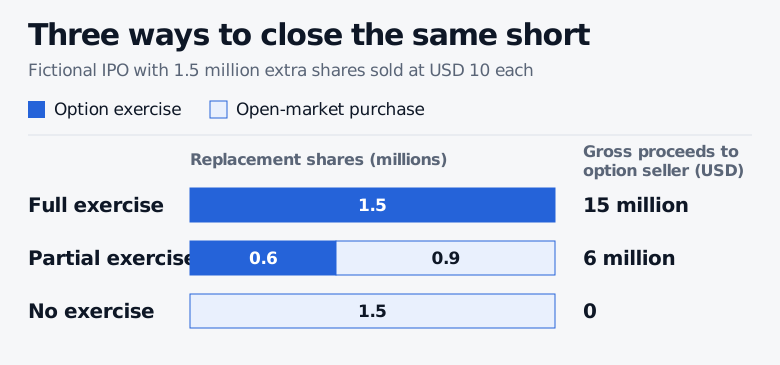
In the fictional IPO, each route closes the same short. The gross amount for the option seller depends on how many shares the syndicate buys by exercising.
Who gets the exercise proceeds?
When the issuer supplies newly issued shares, it receives the proceeds and its outstanding share count rises. When selling shareholders supply shares they already own, they receive the proceeds and ownership of those shares changes. Karman Holdings' February 2025 IPO prospectus showed a 23 million-share base deal and a 30-day option on 3.45 million shares supplied by existing holders. Its Form 8-K confirmed full exercise. The holders received the proceeds from those extra shares. Circle IPO prospectus, The Offering, Karman IPO prospectus, The Offering, Karman Form 8-K, Item 1.01.
Market covering and stabilizing bids
An open-market purchase to reduce the offering short adds buy demand. U.S. Regulation M treats this as a syndicate covering transaction. The SEC staff FAQ treats option exercise as a separate activity. Stabilizing describes a bid or purchase intended to maintain the price. Rule 104 permits stabilizing to prevent or slow a decline, sets limits on stabilizing prices and specifies separate advance notice requirements for stabilizing bids and syndicate covering transactions. Once the short is closed, the syndicate has no remaining shares to buy for that purpose. The market price can still fall below the offer price. Karman IPO prospectus, Underwriting, Regulation M definitions, Rule 104(b), (f) and (h), SEC staff FAQ on Rule 104.
Sources
- Karman Holdings final IPO prospectus, cover, The Offering, Dilution and Underwriting
- Karman Holdings IPO underwriting agreement, §§ 2–3 and Schedules II and V
- Karman Holdings Form 8-K, Item 1.01
- Circle Internet Group final IPO prospectus, cover, The Offering and Underwriting
- Regulation M definitions, 17 CFR § 242.100
- Regulation M Rule 104, 17 CFR § 242.104
- SEC Staff Legal Bulletin No. 9, Rule 104 FAQ