A cornerstone investor commits ahead of an initial public offering (IPO) to buy part of the deal under an allocation agreement. An anchor investor is an early institutional participant whose order or expressed interest can help attract other buyers. The strength of that commitment depends on the market and the deal. For anyone analysing bookbuilding, the distinction matters because a prearranged allocation covers part of the offer, while the rest of the order book provides separate evidence about demand.
What the labels tell you
Hong Kong cornerstone placing. Under HKEX’s Main Board rules, a cornerstone investor has a preferential allocation irrespective of where the final offer price is set. The investor pays that price, and the shares placed generally carry an IPO lockup of at least six months from listing. The prospectus discloses the arrangement and investor identities. An assured allocation can still be subject to closing conditions and can specify a cash commitment with a share count that depends on the final price. HKEX Main Board Rule 1.01 · HKEX Guide for New Listing Applicants, chapter 4.15
India’s formal anchor category. In a main-board book-built IPO under SEBI’s rules, qualifying institutional buyers can bid for the anchor portion one day before the issue opens. Allocation is discretionary within the rules. Half of the shares allotted to anchors are locked for 90 days and half for 30 days, both measured from allotment. By contrast, the 2021 U.S. SPAC prospectus for 10X Capital Venture Acquisition Corp. II used anchor investors for investors who had expressed nonbinding interest in the IPO units. The underwriters determined allocations, and the investors could buy fewer units or none. SEBI ICDR Regulations, regulation 32(3) and Schedule XIII · 10X Capital Venture Acquisition Corp. II final prospectus
How much of the deal did they take?
Suppose a fictional IPO offers 10 million newly issued shares at USD 10 each, with no over-allotment. A cornerstone takes 2 million shares and pays USD 20 million before fees. Its share of the offer is . If the company has 100 million shares outstanding after the IPO and the investor held none before, its stake in the issuer is . The numerator is the same block of shares in both calculations.
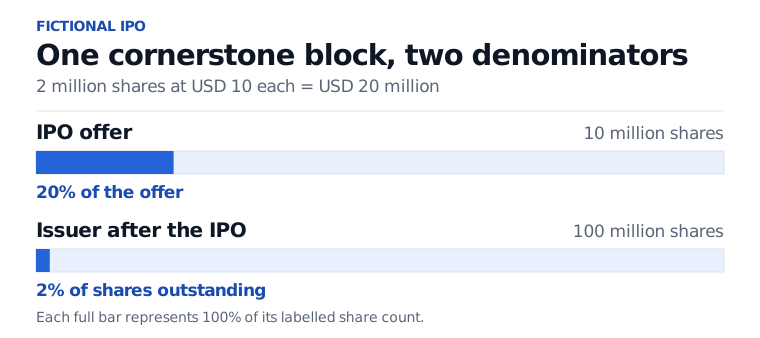
In this fictional IPO, both bars show the same cornerstone block. The top bar measures it against the offer and the bottom bar measures it against the issuer’s post-IPO shares.
Guangzhou Xiao Noodles’ November 2025 Hong Kong prospectus disclosed cornerstone commitments at the final offer price, with share counts subject to pricing, lot rounding and the deal terms. Its December allotment announcement reported 24,292,500 cornerstone shares, about 24.95% of the base offer and 3.42% of the issuer’s shares at listing, both on a basis that excludes exercise of the over-allotment option. The prospectus gives the commitments and restrictions. The allotment announcement gives the realised allocation. Xiao Noodles prospectus, pp. 291–297 · Xiao Noodles allotment results, Chinese edition
For a trading-supply estimate, track how many shares are subject to restrictions and when those restrictions expire. In Hong Kong, locked cornerstone shares can count toward regulatory public float if their holders qualify as members of the public. That classification and the number of shares available to trade answer different questions. At lockup expiry, the affected shares may become eligible for sale, subject to any other restrictions. HKEX Guide for New Listing Applicants, chapter 4.15
Sources
- HKEX Main Board Rule 1.01 and HKEX Guide for New Listing Applicants, chapter 4.15 cover the cornerstone definition, placing terms, lockup and public float treatment.
- SEBI ICDR Regulations, consolidated through 21 March 2026, regulation 2(1)(c), regulation 32(3) and Schedule XIII, set out India’s anchor category, bidding, allocation and lock-in.
- 10X Capital Venture Acquisition Corp. II final prospectus, 10 August 2021 describes this deal’s nonbinding indications of interest.
- Xiao Noodles prospectus, 27 November 2025 and allotment results, 4 December 2025, Chinese edition show the difference between conditional commitments and final allocations.