An IPO lock-up expiry is the point when an IPO lockup, an agreement made around an initial public offering, stops restricting resale for a specified group of shares. For a researcher, it marks when more existing shares may reach the market. Expiry changes what holders are allowed to do. Any order and any resulting trade are separate events. SEC investor bulletin
Read the release schedule by share block
In a U.S. IPO prospectus, start with Shares Eligible for Future Sale and cross-check the underwriting terms. For each block, record which holders and securities it covers, the share count, and the first session when the restriction ends. A scheduled expiry follows the contract’s date rule. An early release may follow a specified trigger or come from a waiver by the party authorised to grant it. Check the base date, calendar versus trading days, any blackout adjustments and whether the release covers all or part of the remaining block. A contractual release can still leave securities-law resale limits or an issuer trading policy in force. SEC investor bulletin · Hinge Health final prospectus
Hinge Health’s May 2025 prospectus described a possible early release of up to about 2 million shares for eligible employees and service providers. Its price test required the closing price to exceed 120% of the offer price on at least five trading days in a ten-trading-day window, with at least one qualifying close after the initial earnings release. The prospectus described a separate 180-day schedule for the remainder, subject to the stated exceptions and date adjustments. Hinge Health final prospectus
The condition was met on 6 August 2025. The 10-Q filed on 11 August confirmed that the conditions had been met. The 8-K filed on 13 August estimated that about 1.66 million shares would come out of lock-up at the 19 August market open, 90 calendar days after the prospectus date, subject to the remaining resale conditions. An event dataset can retain the May prospectus estimate and the August update as separate records with their own availability dates. Hinge Health Form 10-Q · Hinge Health Form 8-K
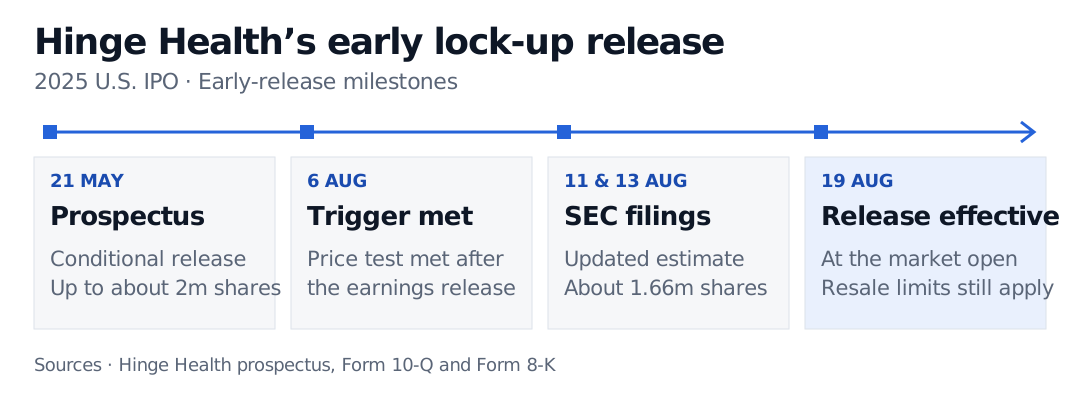
Hinge Health’s 2025 early release. Milestones are in chronological order. Share counts describe the block potentially eligible for sale.
Size the change against the initial tradable pool
A fictional issuer has 100 million shares outstanding and 20 million initially tradable. The next expiry releases 30 million existing shares from lock-up, while the other 50 million remain restricted. If the newly released block faces no other limits on resale, up to 50 million shares are now tradable. The shares outstanding still total 100 million.
The released block is of the initial tradable pool and of the outstanding shares. The first ratio sizes the potential change against the stock already available to trade. Both counts describe a simplified share ledger. Regulators and index providers apply their own definitions of free float.
Separate anticipation from the release session
An expiry can be known months in advance. A price move before the effective session may reflect expectations about who will sell and how much demand will be available. In an event study, distinguish the window around the effective release from the window around new information about its timing or size. Flag earnings and other news in those windows. Analyse price-triggered releases separately when the trigger itself selects stocks that have already risen. In a backtest, use the estimate available at each decision time to avoid look-ahead bias. The SelfMadeQuant lesson on event definition walks through how to assign a dated event to a trading session and flag overlapping news. Its preview is public and the full lesson requires membership. Event Definition
Field and Hanka studied 1,948 U.S. IPO lockups with expiries from 1988 to 1997. They found a mean three-day market-adjusted return of −1.5% around expiry, with negative market-adjusted returns in 63% of cases. That dispersion matters when interpreting the average. For a trading backtest, executable prices, trading costs and borrow availability for short positions determine what portion of any measured return could be captured. Field and Hanka, The Expiration of IPO Share Lockups
Sources
- SEC Office of Investor Education and Advocacy, Updated Investor Bulletin: Investing in an IPO, sections “Limited trading volume” and “Market overhang”. Investor.gov
- Hinge Health, final IPO prospectus dated 21 May 2025, “Shares Eligible for Future Sale” and “Underwriters”. Form 424B4
- Hinge Health, quarterly report filed 11 August 2025, Part II, Item 1A, and current report filed 13 August 2025, Item 8.01. Form 10-Q · Form 8-K
- Laura Casares Field and Gordon Hanka (2001), The Expiration of IPO Share Lockups, sections I.A, I.C and II.A, especially Table II. Journal of Finance paper