Free float is the portion of a company’s outstanding shares treated as available to public market investors under a specified definition. It is often reported as a share count or a percentage. For a quant building a stock index portfolio, float determines how much of a company’s equity value enters a float-adjusted benchmark calculation.
The definition matters. An index provider may exclude strategic holdings even when those shares are legally transferable. “Excluded from float” is a methodology classification, not a blanket statement that insiders or controlling shareholders cannot sell.
Count shares before valuing them
Consider a synthetic company with 100 million issued shares, all outstanding, in a single share class. There are no treasury shares. Under the stipulated index definition, 30 million strategic shares are excluded and every remaining share counts as float. No foreign-ownership constraint or other adjustment applies.
| Quantity | Calculation | Result |
|---|---|---|
| Float shares | 100 million − 30 million | 70 million shares |
| Float fraction | 70 million / 100 million | 70% |
| Full market capitalisation | USD 20 per share × 100 million shares | USD 2 billion |
| Float-adjusted market capitalisation | USD 20 per share × 70 million shares | USD 1.4 billion |
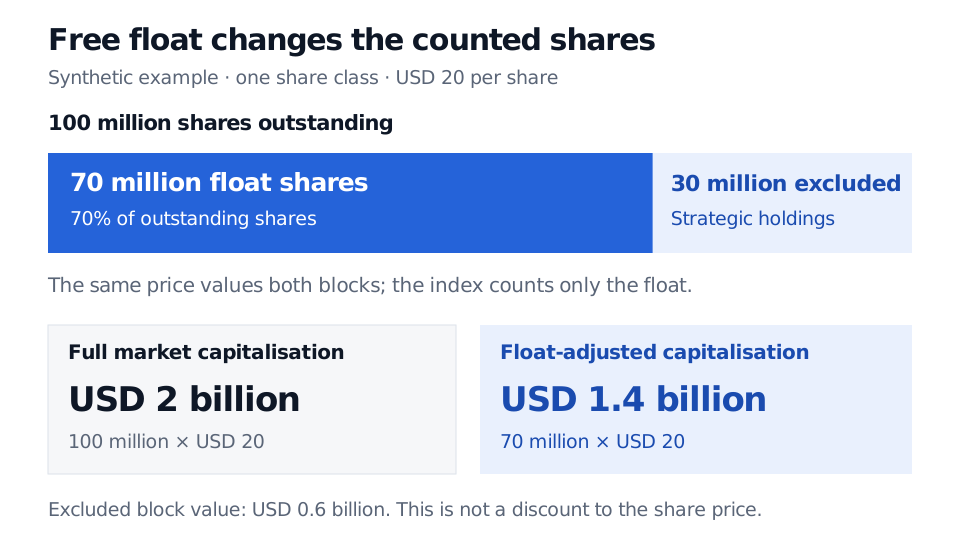
Original synthetic share-and-value ledger. One share class; 100 million issued shares are all outstanding, with no treasury shares. The stipulated index rule excludes 30 million strategic shares; no other investability adjustments apply.
The float adjustment changes the share count used, not the quoted share price. The excluded block still has a mark-to-market value of USD 0.6 billion at the same USD 20 price. The company’s market capitalisation has not fallen from USD 2 billion to USD 1.4 billion: those are two different measures computed at the same instant.
For total shares outstanding , excluded shares and price per share , the unrounded arithmetic in this example is
The float fraction is dimensionless; multiplying a price in USD per share by a share count produces a value in USD. Real provider factors can include rounding and additional investability rules, so an official factor need not equal a raw ownership percentage.
A float percentage is not an index weight
A 70% float fraction says which proportion of this company’s shares counts. It does not give the company a 70% benchmark weight. In an uncapped index weighted purely by float-adjusted capitalisation, its weight is its adjusted value divided by the adjusted value of all constituents:
All values must use consistent valuation times and a common currency. Changing one company’s factor changes the denominator as well as its numerator. Weight caps or other index rules require further adjustments. An index fund tracking that benchmark may consequently need to trade when an updated factor takes effect, even without a change in the company’s share price.
For the wider link between index construction and corporate actions, Equities, Indices and Corporate Actions covers weighting, splits and rebalancing. Its preview is public; the full lesson requires membership.
Availability is not immediate tradability
S&P Dow Jones Indices’ September 2026 float methodology classifies shareholder types, applies ownership thresholds and allows regional variations. Certain fund holdings generally count as public float; a large institutional holding is not automatically strategic. Its rules also address share classes and foreign-ownership limits. Use the specific index’s methodology and effective factor rather than substituting an informal “all shares except insiders” calculation.
Free float is also different from liquidity. It is a stock of classified shares, not today’s trading volume or displayed sell orders. Float holders need not offer their shares at the current price. To assess a proposed trade, examine the bid–ask spread, market depth, observed activity and execution conditions. A float number alone cannot establish the cost of buying or selling a position.
Sources
- S&P Dow Jones Indices: S&P Float Adjustment Methodology, September 2026, pp. 2–6 — definition, holder classification, thresholds, regional differences, factor calculation and share-count basis; checked 25 October 2026.
- S&P Dow Jones Indices: Index Mathematics Methodology — total versus float-adjusted capitalisation weighting and capped indices; checked 25 October 2026.
- Edward E. Qian, Ronald H. Hua and Eric H. Sorensen, Quantitative Equity Portfolio Management: Modern Techniques and Applications, Chapman & Hall/CRC, 2007, §11.2.1, p. 364 — distribution of benchmark portfolio weights. The share ledger and illustration here are original synthetic examples.