An IPO lockup is a contractual restriction that temporarily limits specified holders’ ability to sell or otherwise transfer securities around an initial public offering. It often covers founders, employees and early investors. For an event-driven quant, the useful question is how the agreement changes potential sale eligibility: a large block of existing shares may become available without the company issuing a single new share.
This article uses U.S. IPO documentation. The SEC’s investor explanation describes 180 days as common, while stressing that terms vary. Treat that as a convention, not a universal SEC-mandated lockup or a substitute for reading the prospectus.
The restriction belongs to a holder and an agreement
A lockup record needs more than an IPO date plus a day count. Identify the bound holders, covered securities, prohibited transactions, exceptions, release conditions and the party authorised to grant consent. Some contracts restrict lending, pledging or transferring economic exposure through derivatives as well as ordinary sales. An exception allowing a gift may require the recipient to remain bound; it need not release shares for public trading.
A historical example shows why the wording matters. Reddit’s final prospectus dated 20 March 2024, under “Shares Eligible for Future Sale,” described a lockup ending at the earlier of the opening of trading on the third trading day after its June-quarter earnings release and 180 days after the prospectus date. It also described holder-specific exceptions and underwriters’ discretion to release securities in whole or in part. Those are that offering’s historical terms, not a template for another issuer.
Contractual release and legal resale eligibility are separate checks. In the United States, a sale still needs registration or an applicable exemption. Rule 144 is one conditional resale pathway, with requirements depending on the seller and securities; it is not the IPO lockup itself. A holder may also remain constrained by the issuer’s trading policy or an earnings blackout. Ending one restriction does not certify that every other condition is satisfied.
A fivefold eligible pool, with no dilution
Take a fictional company immediately before contractual release:
- It has 100 million existing shares outstanding, all in one class.
- 20 million are available to public investors; 80 million are locked.
- On release, assume all 80 million satisfy every other resale condition. Ignore strategic-holder exclusions from index float, share conversions and other corporate actions.
Under these deliberately simple assumptions, the potential eligible pool becomes
The level is five times the original pool, a 400% increase. It is not 180 million shares outstanding: the 80 million were already part of the original 100 million.
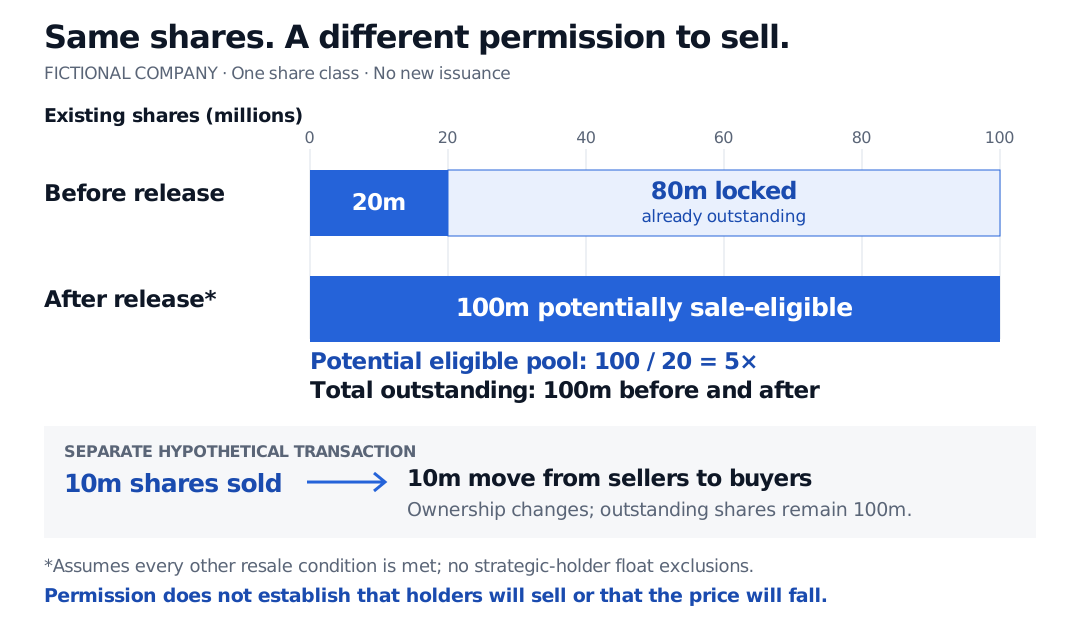
Original fictional eligibility ledger. Counts are millions of existing shares. Release assumes all other resale conditions are met and no strategic-holder float exclusions; a potential sale-eligible pool is not a sell order.
Suppose the share price stays at USD 10, purely to isolate the accounting:
| Measure | Before release | After release, under the assumptions |
|---|---|---|
| Shares outstanding | 100 million | 100 million |
| Potential sale-eligible shares | 20 million | 100 million |
| Total equity market value | USD 1 billion | USD 1 billion |
| Value of the potential eligible pool at that price | USD 200 million | USD 1 billion |
Market capitalisation remains price times total shares outstanding. If holders actually sell 10 million existing shares, those shares move from sellers to buyers; the sale itself neither raises capital for the company nor creates shares. New issuance, option exercises or award settlement can change the count, but those are additional events requiring their own reconciliation.
The simplified eligible pool is also not automatically an index provider’s free float. A strategic stake may remain excluded from an index’s float calculation even when its contractual lockup has ended.
Three clocks for a research dataset
Preserve three distinct records: when a release became known, when it became effective, and when any shares actually traded. An announced waiver can change expectations before its effective date. In the current U.S. FINRA rulebook checked on 30 October 2026, Rule 5131(d)(2) addresses officers’ and directors’ new-issue lockups: its release-or-waiver notice provision generally requires two business days’ advance notice and announcement, subject to its specified transfer exception. Supplementary Material .03 permits specified alternative ways to satisfy the announcement requirement. Do not apply that provision indiscriminately to every holder or ordinary scheduled expiry.
A useful research row therefore retains the source document, the covered share block, the conditional release rule, the effective trading session and the time the information was available. Update a conditional rule only when its triggering information becomes known. Replacing the historical record with a later waiver announcement creates look-ahead bias.
The owned lesson Observation, Event and Availability Timestamps develops the distinction between publication, usable information and feasible orders. Its preview is public; the full lesson requires membership.
Finally, a release is permission, not a forecast of supply offered at each price. Holders may retain shares; buyers may absorb sales; expectations may already reflect the event. Neither the fivefold pool nor the hypothetical 10-million-share transfer determines the stock’s return. An event study must measure the price response and account for overlapping news; a trading backtest must also establish executable prices, costs and, if shorting, available borrow.
Sources
- SEC Investor.gov — Initial Public Offerings: Lockup Agreements: variable contractual terms, common 180-day convention and prospectus disclosure; accessed 30 October 2026.
- Reddit, Inc. — final IPO prospectus dated 20 March 2024: “Shares Eligible for Future Sale,” pp. 213–216, and “Underwriters,” pp. 225–227. Historical conditional release, transaction restrictions, exceptions and waiver authority; accessed 30 October 2026.
- 17 CFR §230.144 — current eCFR text: preliminary note and paragraphs (b)–(f), separating conditional securities-law resale eligibility from a private lockup. The eCFR displayed Title 17 as up to date through 28 October 2026; accessed 30 October 2026. See also the SEC’s current Investor.gov Rule 144 explanation.
- Fastly — Insider Trading Policy, updated 12 December 2025, Q19–Q25: an issuer-specific example of quarterly and event-driven blackout restrictions; accessed 30 October 2026.
- FINRA Rule 5131 — New Issue Allocations and Distributions: paragraph (d)(2) and Supplementary Material .03, current online rulebook checked 30 October 2026. The share ledger is an original fictional example, not issuer data or an estimated price effect.