A follow-on offering is a public sale of shares after a company has gone public. In a marketed follow-on, the underwriting syndicate uses bookbuilding to gauge investor demand before the deal is priced for a specified number of shares. An at-the-market (ATM) programme lets a public company sell shares into the existing secondary market over time, typically through a sales agent. U.S. Rule 415(a)(4) defines an ATM as an offering into an existing trading market for outstanding shares of the same class with the sale price left open until execution. For an analyst tracking cash and shares outstanding, a priced deal and an ATM programme opening give different information about how much equity has been sold. Gao and Ritter (2010), Introduction · 17 CFR § 230.415(a)(4)
Who gets the proceeds?
In a primary sale of common stock, the company issues new shares. The issuer receives the proceeds after applicable costs, and shares outstanding increase when the new shares are issued. A holder who keeps the same number of shares then owns a smaller fraction of the company. In a secondary sale of already outstanding shares, the selling holder receives the proceeds, and the transaction transfers ownership of those shares. A follow-on can contain both. Nuvalent's prospectus supplement, for example, showed a base offering of issuer shares and a separate option for underwriters to buy additional shares from existing holders. Nuvalent prospectus supplement, cover and Use of Proceeds
One price versus a series of fills
Suppose a fictional company completes a marketed follow-on of 2 million newly issued shares at USD 5 each. Its gross proceeds are USD 10 million. In a separate ATM scenario, the company sells 500,000 new shares at USD 5 and later another 500,000 at USD 4. The two sales bring in USD 2.5 million and USD 2 million gross. The weighted average divides the USD 4.5 million total by the 1 million shares actually sold.
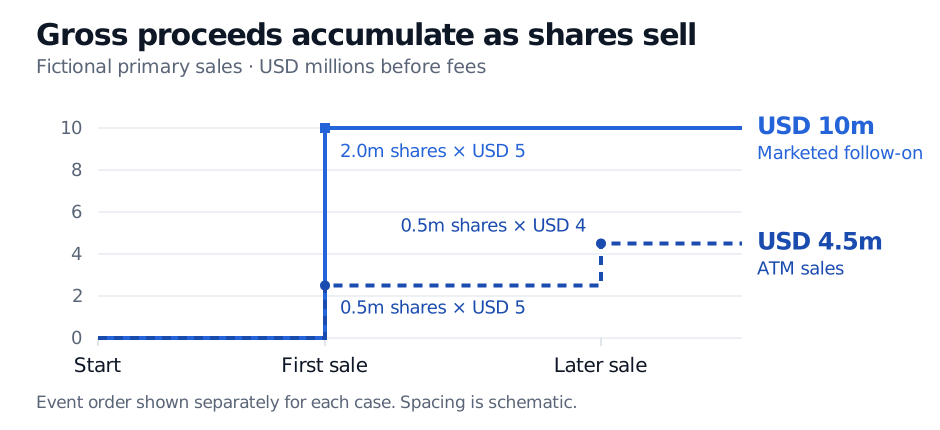
Cumulative gross proceeds rise once in the marketed example and in two steps in the ATM example. Each case sells a different number of shares.
The examples isolate how price and timing enter the proceeds calculation. The quantities differ, and the figures are gross. The issuer's net cash also reflects the underwriting discount or sales commission and any other applicable offering expenses.
Capacity, sales and price reaction
An ATM supplement's up-to amount describes how much can be offered under the programme terms. A placement notice can specify a sales window, maximum quantity and minimum price. OnKure's agreement, for example, called for commercially reasonable efforts by the agent under the notice. Its 2025 annual report described ATM capacity of up to USD 16 million and reported zero shares sold under it at that point. Later filings can update the capacity and disclose actual sales. OnKure sales agreement, §§2–5 and Schedule 1 · OnKure 2025 annual report, Notes 1 and 10
A marketed deal's announcement or pricing can reveal the size and terms of a single transaction. An ATM filing can change expectations about future share supply before any trades occur, while actual sales may span different trading sessions. A price move during those sessions can reflect the sales, other order flow or unrelated news. Estimating the sales' market impact requires an estimate of where the price would have traded without those sales. The SelfMadeQuant lesson shows how that differs from measuring the observed price move. Full lesson access requires membership. Market Impact