Authorised shares are the maximum number a company may issue under its current charter. Issued shares are shares the company has created that remain legally issued. Under the reporting convention illustrated here, that count includes treasury shares, which the company has reacquired and still holds. The rest are outstanding shares. Using the issued count to calculate market capitalisation would include shares that the company holds itself. Delaware General Corporation Law, § 102(a)(4), Caterpillar 2025 Form 10-K, consolidated statement of financial position and Note 16.
Follow the shares through a buyback
A fictional Delaware company has one class of common stock. Its charter authorises 100 million shares, and it has issued 70 million, all initially outstanding. The company buys back 10 million and keeps them in treasury. The issued count stays at 70 million. Under Delaware law, shares held in treasury carry no vote and are excluded from the quorum count. Delaware General Corporation Law, § 160(c)(1).
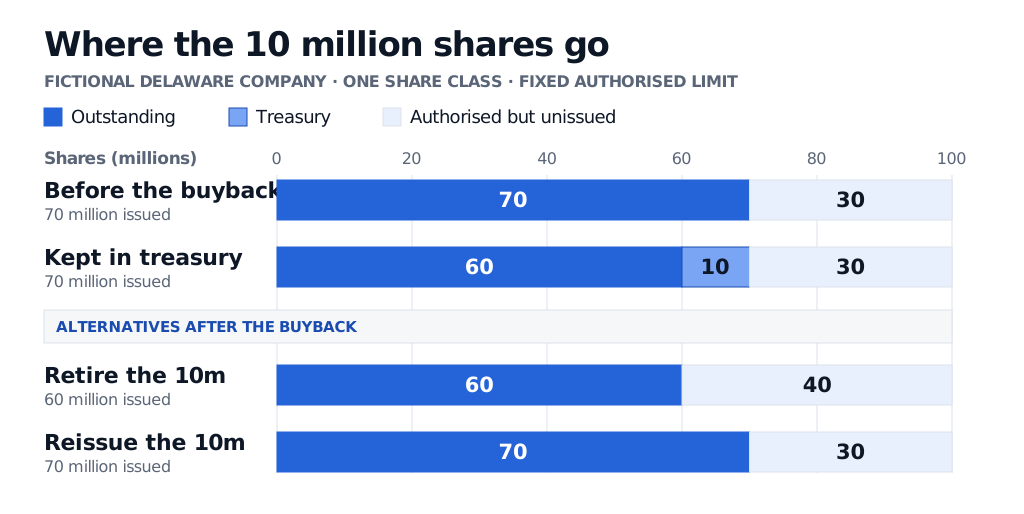
The same 10 million shares move between categories. Retirement and reissue are separate alternatives starting from the treasury balance.
If the board retires the 10 million treasury shares, the default under Delaware law is to return them to authorised but unissued status. With that treatment, issued shares fall to 60 million, the unissued pool rises to 40 million, and 60 million stay outstanding. The charter can change this treatment. If it prohibits reissuance, a retirement certificate that takes effect reduces the corresponding authorisation. Delaware General Corporation Law, § 243.
If the company instead reissues the 10 million shares from treasury to investors, those shares become outstanding again. The issued count stays at 70 million and the unissued pool stays at 30 million. A new issue from the unissued pool would increase both the issued and outstanding counts. Delaware General Corporation Law, §§ 153(c), 160 and 161.
Match the share count to the calculation
- Full market capitalisation for a single share class is the share price multiplied by shares outstanding at the valuation date. Free float uses the shares a provider treats as available to public investors. An outstanding block held by a strategic shareholder counts toward full market capitalisation and may be excluded from index float. S&P Dow Jones Indices, S&P Float Adjustment Methodology, pp. 3 and 6.
- Basic earnings per share uses the weighted-average number of ordinary shares outstanding over the reporting period. Shares bought back partway through the period still contribute for the time they were outstanding. Diluted EPS adjusts the period-average count for the incremental effect of dilutive potential shares, such as from assumed option exercise or conversion. IAS 33, paragraphs 19–20 and 36–44.
Caterpillar's charter authorises 2 billion common shares. At 31 December 2025 its balance sheet showed 814,894,624 issued and 349,607,292 in treasury. The difference is 465,287,332 outstanding, which matches the rounded 465.3 million in Note 16. The same note reports 470.0 million weighted-average shares for basic EPS and 472.3 million for diluted EPS after adding 2.3 million shares from assumed exercise of stock awards under the treasury stock method. Those EPS figures cover the year, while 465.3 million is the count at year-end. Caterpillar's restated charter, Article Fourth(a), 2025 Form 10-K, consolidated statement of financial position and Note 16.
For how buybacks distribute cash and how rights issues create new shares, see Equities, Indices and Corporate Actions. The preview is public and the full lesson requires membership.
Sources
- Delaware General Corporation Law on charter authorisation (§ 102(a)(4)), treasury stock and new issuance (§§ 153(c), 160 and 161) and retirement (§ 243).
- Caterpillar Inc. Restated Certificate of Incorporation, Article Fourth(a) and 2025 Form 10-K, consolidated statement of financial position and Note 16.
- IFRS Foundation, IAS 33 Earnings per Share, paragraphs 19–20 and 36–44.
- S&P Dow Jones Indices, S&P Float Adjustment Methodology, September 2026, pp. 3 and 6.