The treasury stock method calculates how many shares an issuer’s call options and warrants can add to the denominator of diluted earnings per share (EPS). In a US GAAP quarterly calculation, it assumes exercise and uses the proceeds to buy shares at the average market price for the quarter. The difference between shares issued and shares bought back is the potential addition to the denominator. IAS 33 reaches the same result for simple options by treating the proceeds as funding some shares at the average price and counting only the remaining shares issued for no consideration. Both calculations are hypothetical. ASC 260-10-45-22 and 45-23, IAS 33, paragraphs 45–47.
Ten options can add two shares
A fictional issuer has 50 weighted-average common shares and 10 vested, equity-classified options outstanding throughout the quarter. Each option buys one share at a strike of 8 currency units (CU). The share price averages 10 CU and exercise cash is the only assumed proceeds.
- Exercising all 10 options issues 10 shares and brings in 80 CU.
- At 10 CU per share, 80 CU buys back 8 shares.
- The net addition is 2 shares. If dilutive, it brings the denominator from 50 to 52.
With 100 CU of earnings available to common shareholders, all from continuing operations, and no other potential shares, the two shares lower EPS. These options leave the earnings numerator unchanged.
For a simple cash-exercise option, the average share price must exceed the strike to produce a positive share increment. A period-end rally can put an option in the money at the closing price while its average-price share increment is still zero. Assume exercise at the start of the reporting period or at issuance if later, and weight the potential shares for the time the instrument was outstanding. For year-to-date EPS under ASC 260, use a weighted average of the quarterly increments and assess dilution using year-to-date continuing operations. The Finance Primer lesson explains the strike, exercise and moneyness of a call. ASC 260-10-45-23 and 55-3 through 55-5, IAS 33, paragraphs 36–38, 45–47 and A4–A5, Options (public preview, full lesson with a free account).
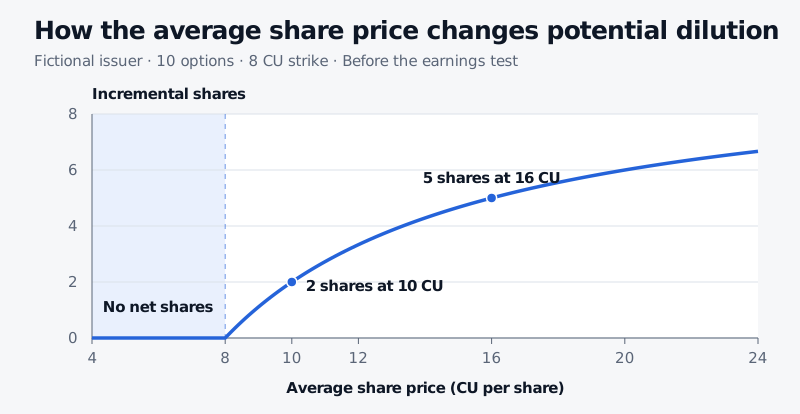
As the average share price rises, fixed exercise proceeds buy fewer shares, so more of the 10 option shares can enter diluted EPS.
Apply the continuing-operations test
Use earnings from continuing operations available to common shareholders to determine which potential shares are dilutive. If the same issuer instead loses 100 CU from continuing operations, spreading the loss over 52 shares would make it smaller per share. The options are antidilutive, so the share count stays at 50 and diluted EPS is CU per share. Convertible instruments are assessed under the if-converted method, where assumed conversion can also change earnings. ASC 260-10-45-18 through 45-20, ASC 260-10-45-40, IAS 33, paragraphs 41–44 and 49.
Employee awards can have proceeds without an exercise payment
For equity-classified share-based awards within ASC 718, assumed proceeds include eligible compensation cost yet to be recognised as well as any cash payable at exercise. IAS 33 includes the IFRS 2 fair value of goods or services still to be supplied in the assumed issue or exercise price. A restricted stock unit with service-based vesting can therefore have assumed proceeds even with zero cash payable by the employee. The future-service amount affects the share calculation. Compensation expense already recognised stays in earnings for these equity-classified awards. For an award tied to a performance target, check the separate rules for contingently issuable shares. ASC 260-10-45-28A, 45-29 and 45-32, IAS 33, paragraphs 44 and 47A–48.
Sources
- FASB ASU 2020-06 reproduces the ASC 260 mechanics for options and warrants and the guidance on averaging market prices.
- IFRS Foundation, IAS 33 Earnings per Share (2026 issued text) covers option and warrant dilution in paragraphs 45–48 and market prices in Appendix A.
- FASB ASU 2015-01 sets out the ASC 260 continuing-operations test.
- FASB ASU 2018-07 gives the ASC 260 treatment of share-based awards and their assumed proceeds.