See how assumed conversion changes both earnings and the share count, and why the order of dilution tests can change reported diluted EPS.
The If-Converted Method for Diluted EPS
The if-converted method measures the effect of assumed conversion into common stock when calculating diluted earnings per share (EPS). Assumed conversion can remove interest expense or preferred dividends from the earnings calculation while increasing the share count. The extra earnings can offset some or all of the dilution from the extra shares.
What conversion changes
For a convertible bond that converts entirely into shares, add back the interest expense that would have been avoided, net of the applicable tax effect. Use the interest recognised for the period the debt was outstanding. Reflect any other income or expense changes caused by assumed conversion, such as higher costs under a profit-sharing agreement tied to earnings. For convertible preferred stock, restore the preferred dividends that reduced the basic numerator, accounting for any applicable tax effects under the reporting standard. Settlement terms matter. Under ASC 260, when principal must be paid in cash and the conversion premium can be paid in shares, the premium can add shares but the interest stays in earnings as an expense. ASC 260-10-45-16, 45-21A and 45-40, IAS 33, paragraphs 33–35 and 49–50.
A fictional issuer has 100 currency units (CU) of earnings available to common shareholders, all from continuing operations, and 50 weighted-average common shares. Its only convertible is a bond outstanding throughout the period. Conversion would replace the debt with 10 shares and remove 10 CU of recognised, fully tax-deductible interest. The applicable tax rate is 20%, so removing the expense increases the tax charge by 2 CU and adds 8 CU to earnings. Assume no other conversion adjustments or potential shares.
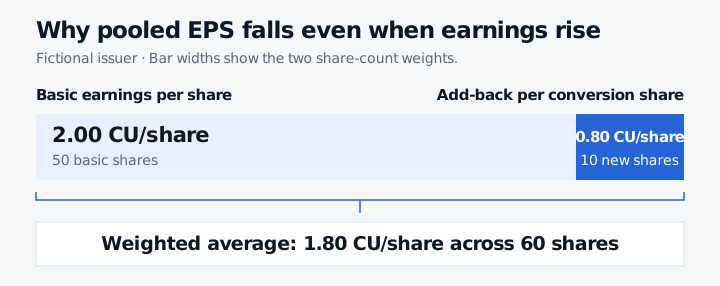
The bond is dilutive, so include it. The 8 CU add-back works out to 0.80 CU per conversion share, below the 2.00 CU earned per basic share. The combined figure is a share-weighted average of those two rates.
A fictional issuer combines 50 basic shares at 2.00 CU per share and 10 conversion shares at 0.80 CU of add-back per share, giving diluted EPS of 1.80 CU per share.
The bar widths represent the share counts. The 10-share block pulls the average down because the add-back per conversion share is below basic EPS.
Test each issue against the running EPS
Use earnings available to common shareholders from continuing operations for the dilution test. A dilutive issue reduces continuing-operations EPS or makes a loss per share larger. Exclude issues that improve that result. The continuing-operations test determines which potential shares enter the other diluted EPS measures, including total diluted EPS when there is a discontinued operation. ASC 260-10-45-18 and 45-20, IAS 33, paragraphs 41–44 and Appendix A3.
Test each issue or series separately, starting with the lowest earnings adjustment per incremental share. Simple options and warrants usually come first because the treasury stock method uses assumed exercise proceeds to offset some of the new shares and generally leaves earnings unchanged. ASC 260-10-45-18, ASC 260-10-45-23, IAS 33, paragraphs 44–46.
Suppose a second convertible adds 19 CU of earnings and 10 shares, or 1.90 CU per incremental share. By itself it would lower basic EPS to 119/60≈1.98. The first bond enters ahead of it at 0.80 CU per incremental share and lowers EPS to 1.80. Adding the second issue now would raise EPS to 127/70≈1.81, so exclude it.
Sources
FASB ASU 2020-06 sets out the operative ASC 260 amendments on convertibles. The final mandatory adoption date applies to fiscal years beginning after 15 December 2023.
FASB ASU 2015-01 sets out ASC 260-10-45-18 and 45-20, including the sequencing and continuing-operations rules.
FASB ASU 2025-12, Issue 4 clarifies the treatment of certain cash-or-share contracts in loss periods. It applies to annual reporting periods beginning after 15 December 2026, with early adoption permitted.