A bear spread limits expiry gain and loss. Follow a bear put spread from entry premiums to capped payoff, break-even and the difference between expiry bounds and assignment risk.
Bear spread
A bear spread is an option strategy that benefits from a lower underlying price while limiting both the gain and the loss in its expiry profit profile. The usual vertical versions pair equal quantities of options of the same type, on the same underlying and with the same expiry, at different strikes. The practical trade-off is that the option sold helps fund the option bought, while surrendering some favourable outcomes.
A bear put spread buys the higher-strike put and sells the lower-strike put. A bear call spread sells the lower-strike call and buys the higher-strike call. “Bear” describes the direction of the combined exposure; it does not mean that every leg is sold short.
Pay less for a put; give up the crash windfall
Consider a synthetic European bear put spread. Both puts have the same expiry, underlying and contract size. All prices and premiums below are USD per share:
Entry leg
Strike
Premium cash flow
Buy one put
105
−8
Sell one put
95
+3
Combined entry
—
−5
The net debit is 5. Buying the higher-strike put alone would cost 8; the sold put supplies 3 of that cost. In return, once the underlying falls below 95 at expiry, the short put's losses offset further gains on the long put. The combined payoff stops growing.
Let ST be the underlying price at expiry. The gross combined payoff and the profit after premium, per share, are
HT=max(105−ST,0)−max(95−ST,0),ΠT=HT−5.
Here “gross” means before the net entry premium; it already nets the two legs' expiry payoffs. These calculations ignore funding, fees and tax, assume both legs perform, and assume any exercise, assignment and settlement are handled so no residual stock position remains.
ST
Long 105 put
Short 95 put
Combined payoff HT
Profit ΠT
80
25
−15
10
+5
95
10
0
10
+5
100
5
0
5
0
105
0
0
0
−5
120
0
0
0
−5
At 80 the long put produces 25, but the short put costs 15. Calling 25 the spread's payoff would omit the obligation used to lower its entry cost. At 100 the spread has a positive payoff of 5 and no profit: that receipt only recovers the debit.
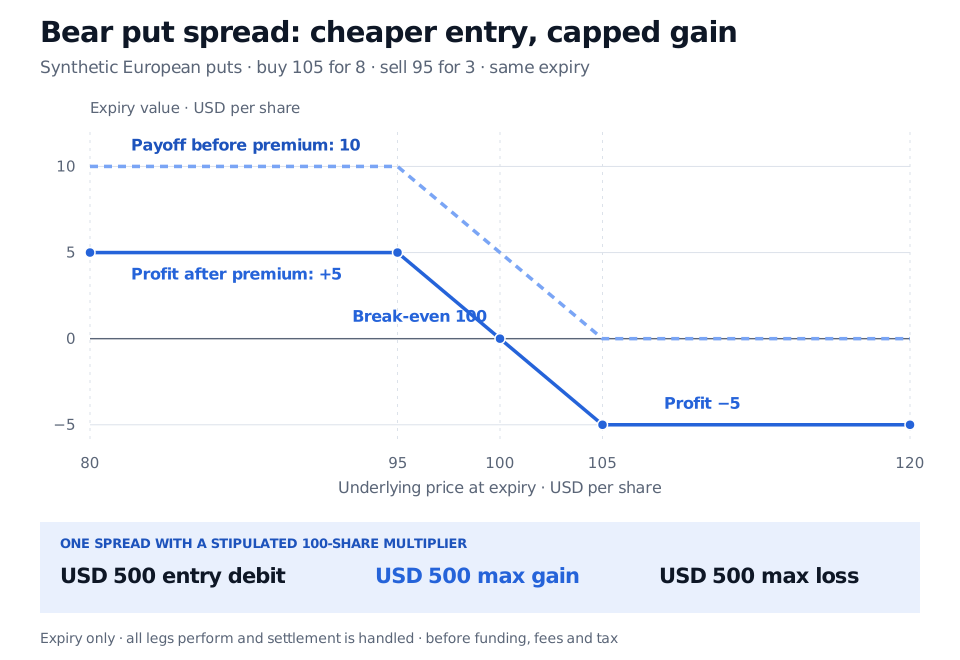
The synthetic bear put spread has a dashed payoff plateau at 10 USD per share below 95 and a solid profit plateau at positive 5. Profit falls between strikes 95 and 105, crosses zero at 100 and stays at negative 5 above 105.
Original synthetic expiry chart. The net debit moves profit 5 USD per share below payoff. With a stipulated 100-share multiplier, the entry debit, maximum gain and maximum loss are each USD 500. Both legs perform and settlement is handled; funding, fees and tax are excluded.
For a bear put spread with high strike KH, low strike KL and positive net debit D, the corresponding expiry quantities are
maximum gain=KH−KL−D,maximum loss=D,break-even=KH−D,
assuming 0<D<KH−KL and the same conventions as above. Here the strike width is 10, so the maximum gain is 10−5=5, the maximum loss is 5, and break-even is 105−5=100. The gain is already capped at 95; a further fall to 80 adds nothing.
The credit version uses calls
The bear call spread reverses the cash timing: selling the lower-strike call normally raises more premium than buying the higher-strike call costs, producing a net credit. If the underlying finishes below both strikes, both calls expire without value and the credit is retained. Above the higher strike, gains on the purchased call offset further losses on the written call. Before costs and funding, maximum gain is the credit and maximum loss is the strike width less that credit. The OIC's bear call guide explains this construction.
Receiving a credit is not the same as earning a profit at entry: the short option still carries an obligation. Call and put bear spreads also have different cash-flow timing; comparing their economics requires allowing for funding rather than matching raw premiums alone.
An expiry shape is not a complete trading account
Before expiry, the value of the two options depends on time remaining and implied volatility, as well as the underlying price. Selling the spread early therefore need not produce the profit read from its expiry graph at the same underlying price.
The example uses European options, which cannot be exercised early. With American options, the short leg may be assigned before the long leg is exercised. Physical delivery can create stock and funding requirements; expiry instructions can also leave an unintended stock position. The OIC's bear put guide discusses these assignment and expiry risks. A bounded combined expiry payoff is not an unconditional guarantee about a broker's margin requirements or the cash needed to manage the trade.
Rebuild the two legs
Open the free public Option strategy designer, choose Bear put spread, and manually enter a buy put at strike 105 with entry premium 8 and a sell put at strike 95 with entry premium 3. Use one contract on each leg. The tool uses a 100-share option multiplier, so its expiry P&L is the table's last column multiplied by 100: maximum gain USD 500, maximum loss USD 500, and underlying break-even 100.
Keep the stated entry premiums when reproducing the example; Use current model prices replaces them. The tool's before-expiry scenario uses European Black–Scholes values and a shared expiry. It excludes early exercise, assignment, margin, trading costs and tax. The link opens the tool; enter these values manually.
For the wider family of spreads, the option trading strategies lesson develops the bear-put payoff by price region and compares call-based construction with other combinations. Its public page is a preview; the full lesson requires membership.
Sources
John C. Hull, Options, Futures, and Other Derivatives, 9th Global edition, Pearson, 2018, §12.3, pp. 282–283: put- and call-based bear spreads, capped payoff and premium treatment.