The trade-off theory of capital structure says a firm balances the tax savings from borrowing against the expected costs of financial distress when choosing its mix of debt and equity. In the basic model, the firm adds debt while the next increment saves more in taxes than it costs in expected distress. This explains how existing debt can add value even when borrowing more would reduce firm value. Myers (1984), The Static Tradeoff Hypothesis
What does the next round of borrowing add?
The Modigliani–Miller benchmark holds firm value constant across financing mixes in a frictionless market without taxes. The trade-off model keeps the firm's assets and investment plans fixed and adds two financing effects. The interest tax shield is the reduction in cash taxes from interest deductions the firm expects to use. Financial distress costs are losses caused by financial pressure, such as restructuring fees or business lost when customers doubt the firm's ability to deliver. They depend on both how likely distress is and what it would cost. Value each effect today using its own timing and risk. Myers (1984), The Static Tradeoff Hypothesis
Suppose a fictional firm considers replacing some equity with debt. The table gives all effects in millions of present value, relative to funding the same business entirely with equity. The expected distress cost is the additional cost attributable to the financing. The example isolates these two effects.
| Financing plan | Tax shield | Expected distress cost | Net value added |
|---|---|---|---|
| Current debt | 24 | 9 | 15 |
| Proposed higher debt | 29 | 16 | 13 |
The additional debt increases the tax shield by 5 million and increases expected distress costs by 7 million. The change in firm value is million. Both plans beat all-equity funding in this example, and the current plan has the higher value of the two. Finding the best debt level would require comparing other feasible plans.
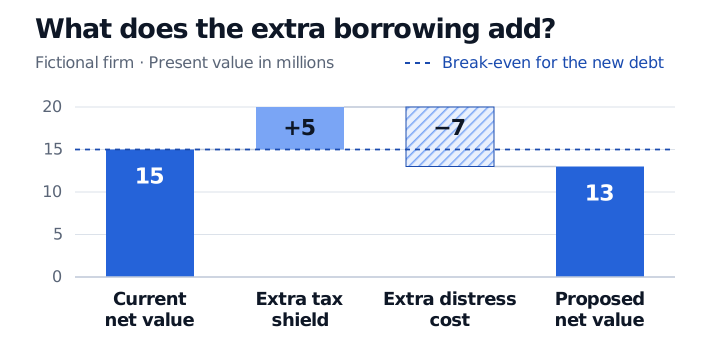
The dashed line marks the current 15 million net benefit. The new borrowing can absorb up to 5 million of extra distress cost before it reduces firm value.
When does the balance give a target?
If debt can vary smoothly and the net gain from an extra dollar of debt turns from positive to negative, an interior value maximum occurs where the marginal tax benefit equals the marginal expected distress cost. Those are changes in value per extra dollar of debt. Total tax savings can still exceed total distress costs at that point. With discrete financing choices or binding borrowing constraints, compare total firm values across the feasible plans. Myers (1984), Figure 1 · van Binsbergen, Graham and Yang (2010)
The inputs are firm-specific. A firm may have little taxable income against which to use another interest deduction, or a cash shortfall may force it to defer a profitable project if outside funding is costly. Section 2.4 of the SelfMadeQuant lesson develops that second channel. Why Manage Financial Risk? Full lesson for members
The simple calculation leaves out other effects of debt, such as how debt payments can discipline spending or how conflicts between creditors and shareholders can change investment decisions. van Binsbergen, Graham and Yang (2010)
An adjusted present value model can show financing effects separately. Adding a stand-alone tax shield to a valuation that already captures that shield through an after-tax weighted average cost of capital would count it twice.
Issuance or refinancing costs can keep a firm away from its target. The pecking order theory gives another explanation for observed debt levels. In that model, firms prefer internal funds and turn to debt before issuing equity when they need external funding, so leverage can reflect past financing shortfalls. Myers (1984), The Pecking Order Theory