The pecking order theory says firms prefer to finance investment with internal cash, then low-risk debt, and turn to new shares later. It explains how two firms with similar assets can end up with different leverage. The firm that repeatedly needs more cash than it generates is more likely to accumulate debt when it can borrow. In the pure theory, there is no target debt ratio. Myers (1984), The Pecking Order Theory
What the firm needs to raise
A fictional firm needs USD 100 million for investment this period and has USD 70 million of internal cash available for it. Its external financing deficit is million. If it can raise the full USD 30 million in low-risk debt, the stylised hierarchy funds the investment with USD 70 million in cash and USD 30 million in debt. If safe borrowing falls short, the firm might consider riskier debt, a hybrid such as a convertible bond, or new shares. Myers (1984), The Pecking Order Theory and Conclusion
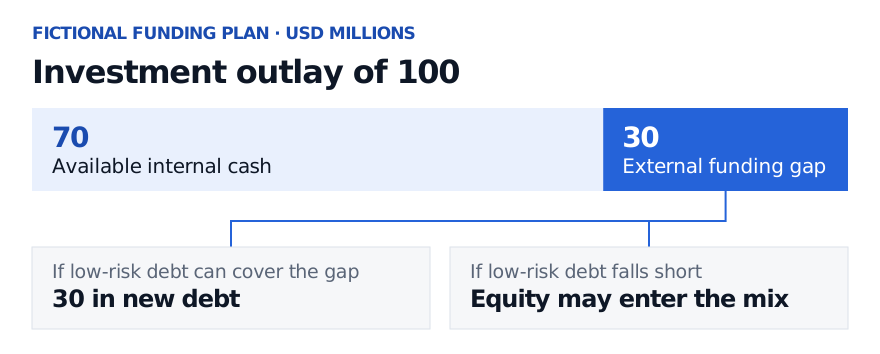
The same funding gap can lead to different financing choices depending on whether the firm can raise enough low-risk debt.
Why an equity issue can cost a project
In the Myers–Majluf model, managers know more than outside investors about the value of the firm's existing assets and investment opportunities. Investors account for the fact that firms are more willing to issue shares when managers see the price as favourable. For a firm that managers know is undervalued, raising cash through new shares can transfer value from existing shareholders to incoming buyers. If that transfer exceeds the project's net present value, managers acting for existing shareholders may decline to issue shares and give up the profitable project. Internal cash avoids selling a claim. Low-risk debt is less sensitive to private information about firm value because its promised payments are likely across a range of outcomes. Riskier debt may itself be sensitive to private information about the firm's ability to repay. Myers and Majluf (1984), §§2.2, 3 and 3.3
That funding problem also matters for corporate hedging. See §2.4 of Why Manage Financial Risk? Shareholder, Societal, and Quantitative Views for how volatile cash flows can force a firm to raise outside capital or pass up an investment. The preview is public, and the full lesson requires membership.
What an issuance record can tell you
The strict version predicts that net borrowing should track funding deficits when firms can finance them with debt. In a broad sample of publicly traded US firms from 1971 to 1998, Frank and Goyal found that net equity issuance tracked the deficit more closely than net debt issuance did. Frank and Goyal (2003), Abstract
An analyst comparing a firm's debt and equity choices can start with the cash shortfall and then check borrowing terms, equity valuations and what else the firm disclosed. Trade-off theory weighs debt's tax benefits against expected distress costs. Market timing looks at when equity is relatively cheap for the issuer. Financing signals concern what investors infer from the instrument chosen. A single issue can fit several of these explanations. Myers (1984), Introduction Baker and Wurgler (2002), Introduction
Sources
- Stewart C. Myers (1984), The Capital Structure Puzzle, Journal of Finance 39(3), pp. 574–592.
- Stewart C. Myers and Nicholas S. Majluf (1984), Corporate Financing and Investment Decisions When Firms Have Information That Investors Do Not Have, Journal of Financial Economics 13(2), pp. 187–221.
- Murray Z. Frank and Vidhan K. Goyal (2003), Testing the Pecking Order Theory of Capital Structure, Journal of Financial Economics 67(2), pp. 217–248.
- Malcolm Baker and Jeffrey Wurgler (2002), Market Timing and Capital Structure, Journal of Finance 57(1), pp. 1–32.