The market timing theory of capital structure says that a firm's mix of debt and equity reflects when it chose to raise or return capital. Managers tend to issue shares when they see equity financing as relatively cheap and may borrow instead or buy back shares when they think the stock is undervalued. If firms leave those financing choices in place, past equity issues and buybacks can help explain why firms with similar businesses carry different leverage today. Baker and Wurgler (2002), Introduction and §II.D
Same cash raise, different ownership
Suppose a fictional company has 100 million ordinary shares outstanding and raises 100 million currency units by selling new shares to outside investors. Assume identical rights for all shares, no fees and no purchases by existing shareholders. For proceeds , offer price per share and existing shares, the fraction of the company acquired by the new buyers is
At 20 per share, the company sells 5 million shares and the buyers own , or 4.76%, of the company. At 10 per share, it sells 10 million shares and the buyers own , or 9.09%.
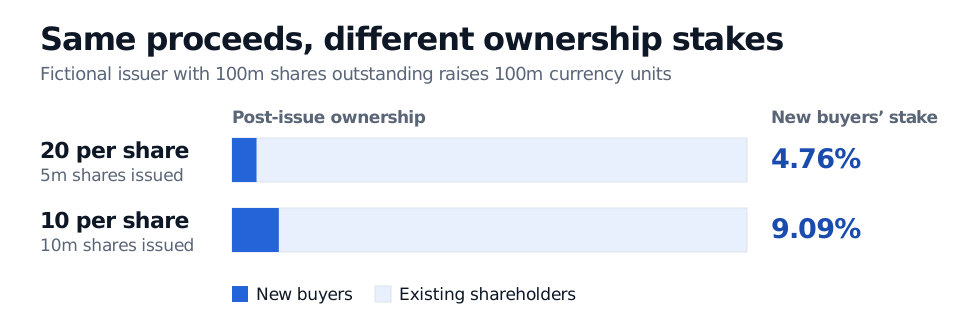
Each bar is the whole company after the raise. At the lower offer price, buyers acquire a larger stake for the same payment.
Both offers have the same immediate effect on book leverage. If debt and other assets stay fixed, the company adds the same cash to book assets in either case, and debt falls as a share of those assets. The ownership effect differs. Whether continuing shareholders lose or gain wealth depends on how the offer price compares with fair value. The share prices here are comparable because the starting share count is the same. A stock split changes both the share count and price per share while leaving the underlying ownership stakes intact. See Stock dividends and stock splits in Equities, Indices and Corporate Actions. The preview is public, and the full lesson requires membership.
How long does a financing choice show up in leverage?
Baker and Wurgler gave more weight to a firm's past market-to-book ratios in years when it raised more net external finance. Their measure weights by the sum of net debt and net equity issues, with negative sums set to zero. Their market-to-book ratio is book assets with book equity replaced by market equity, divided by book assets. Firms that raised funds when their valuations were high tended to have lower leverage later. In one book-leverage specification, the coefficient on the historical measure at the ten-year horizon was about 73% of the near-term coefficient, with both regressions using the same surviving firms and controls measured at the starting date. Baker and Wurgler, §§I.C–I.D and Table VI
Alti isolated a single financing event, the initial public offering (IPO), and classified markets by how many firms went public. Firms listing in high-volume markets raised more equity and initially reduced leverage more. They subsequently relied more on debt and less on equity than firms listing in quieter markets. By the end of the second post-IPO year, the estimated leverage gap was statistically indistinguishable from zero. The IPO result measures the persistence of one financing event, while Baker and Wurgler's measure combines financing decisions across years. Alti (2006), §§II.B and III, Tables VI–VIII
What the financing record can tell you
A high market-to-book ratio can reflect valuable growth opportunities. Equity issuance can also cluster when investors know more about the business and demand a smaller discount for the information gap. That second mechanism is related to the pecking order theory, in which firms generally prefer internal funds, then debt, then equity. Under trade-off theory, firms can take advantage of an issuance window and later move back toward a debt target shaped by tax benefits, distress and agency costs. The Modigliani–Miller theorem supplies the frictionless benchmark in which switching between fairly priced debt and equity leaves firm value unchanged for a fixed investment policy. Baker and Wurgler, §II, Alti, §IV
When explaining a firm's debt ratio, separate net issuance and repurchases from moves in market equity value. A rising share price can lower market leverage through the denominator alone. Then check whether later financing reinforced or reversed the change. The sequence shows how capital structure evolved. Establishing whether managers sold overpriced shares requires evidence about fair value beyond that financing record. Baker and Wurgler, §§I.A–I.B and II.D
Sources
- Malcolm Baker and Jeffrey Wurgler (2002), Market Timing and Capital Structure, Journal of Finance 57(1), pp. 1–32.
- Aydoğan Alti (2006), How Persistent Is the Impact of Market Timing on Capital Structure?, Journal of Finance 61(4), pp. 1681–1710.