Agency costs of debt and equity are the costs of managing conflicts between the people who control a firm's decisions and the investors whose money is at stake, plus the value lost when those conflicts still distort decisions. They help explain why two firms with similar assets can face different financing terms. Investors care about what decision-makers are likely to do with the money after the deal closes. Jensen and Meckling (1976)
Who wants what?
Outside equity puts managers and outside shareholders on different sides of some decisions. Suppose a founder who retains control sells part of the company. The founder still gets the full personal benefit of a company-funded perk, but now bears only their share of the resulting reduction in equity value. Outside shareholders have reason to pay for oversight of that spending. Jensen and Meckling, §§2.1–2.4
Debt puts shareholders and creditors on different sides of some decisions. Once borrowing terms are set, shareholders can gain from a riskier project whose upside goes to equity while some of the downside falls on lenders. That's asset substitution or risk shifting. Debt overhang distorts a different decision. Shareholders may decline to fund a project with positive net present value if too much of the benefit goes to existing creditors. Jensen and Meckling, §4.1, Myers (1977), §2.2
A debt covenant can curb the conflict by restricting actions such as large dividends or additional borrowing. Drafting and enforcing restrictions takes resources, and a tight restriction can also block a worthwhile decision. Jensen and Meckling, §4.2
The SelfMadeQuant Credit-Sensitive Bonds lesson distinguishes restrictions on borrower actions from obligations such as financial reporting. The preview is public, and the full lesson requires membership.
What does a control cost?
Jensen and Meckling separate the cost into three parts. Jensen and Meckling, §§1.4 and 4.2
- Monitoring is what the party seeking protection spends to observe or constrain decisions. An outside shareholder might pay for an independent review of expenses.
- Bonding is what the decision-maker spends to make a commitment credible. An issuer might agree to provide financial statements and pay for independent verification.
- Residual loss is the money-equivalent value the protected party still loses because decisions diverge from its interests under the chosen controls. Measure it against the same aligned-decision benchmark and keep the direct costs of the controls separate.
Who pays for a control and who ultimately bears its cost can differ. If investors anticipate costly monitoring or weaker cash flows when they buy a claim, they may pay less for it. In that case, the seller can bear the cost through lower proceeds even when investors pay for the monitoring. Jensen and Meckling, §§2.2 and 4.2
An expense review that pays for itself
Suppose outside shareholders compare two arrangements for a fictional firm over one period. All amounts are in currency units at the same date and losses use the same benchmark. Without an expense review, residual loss is 12. With it, shareholders spend 4 on monitoring and residual loss falls to 5. Bonding costs are zero in both cases.
The review prevents 7 units of loss. It costs 4, so the net saving is 3. The residual loss that the review prevents would have to cover its cost for the review to break even.
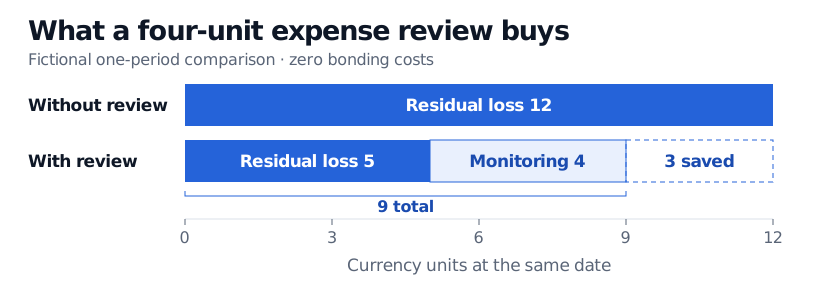
Of the seven units of loss the review prevents, four pay for monitoring and three remain as net savings.
A transfer from lenders to shareholders changes the value of their claims. At the level of the whole firm, the cost comes from resources spent on controls or value lost through distorted decisions. In a valuation, estimate those cash-flow effects as of the same date. If the forecast already reflects them, a separate agency-cost deduction would count them twice.
Sources
- Michael C. Jensen and William H. Meckling (1976), Theory of the Firm: Managerial Behavior, Agency Costs and Ownership Structure, Journal of Financial Economics 3(4), pp. 305–360.
- Stewart C. Myers (1977), Determinants of Corporate Borrowing, Journal of Financial Economics 5(2), pp. 147–175.