Debt overhang is the incentive for shareholders to pass up an investment with positive net present value when existing creditors capture enough of the benefit that shareholders would lose money funding it. When that leads to underinvestment, a credit forecast that includes the project’s proceeds can overstate what lenders will recover. Stewart C. Myers (1977), Determinants of Corporate Borrowing, §2.2
A project worth 10 that shareholders turn down
A fictional firm’s existing assets will pay 80 when its only debt payment of 100 comes due. A project would add 25 to the terminal payoff and costs 15 today. Existing shareholders decide whether to supply that 15 as fresh cash. Assume a zero discount rate, no taxes or resolution costs, no change in debt terms, and no other funding. Creditors are paid first, up to the 100 they are owed. Shareholders get what is left.
| At debt maturity | Skip the project | Fund the project | Change |
|---|---|---|---|
| Total asset payoff | 80 | 105 | +25 |
| Existing creditors receive | 80 | 100 | +20 |
| Shareholders receive | 0 | 5 | +5 |
The project adds in net value. The first 20 of its payoff closes the gap in debt repayment, and shareholders get the remaining 5. After putting in 15, shareholders are worse off than if they skip the project. The 20 is what creditors would gain if the project went ahead. If it is skipped, the 10 of project value never materialises.
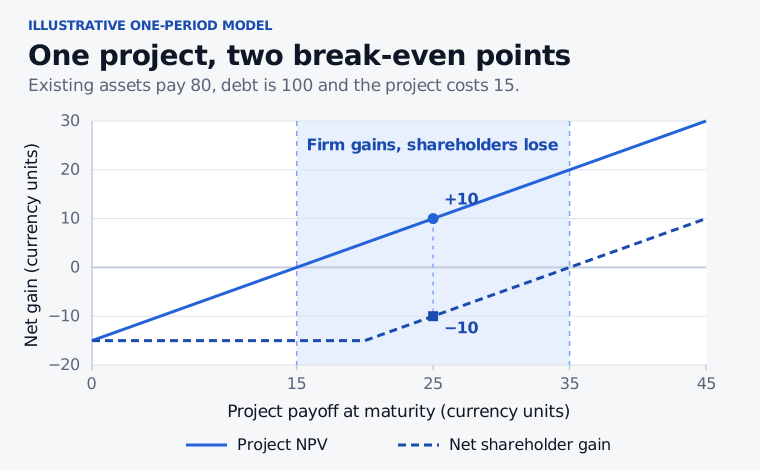
Between 15 and 35, the project adds value to the firm but costs shareholders more than they recover.
Value the project and the claims separately
With shareholders funding the full outlay and debt terms fixed, subtract the gain to existing creditors from project NPV to get the shareholders’ net gain. Compare the claims with and without the investment, using present values on the same date. In the example, a payoff above 15 creates value, while shareholders need a payoff of 35 just to break even. If existing creditors would be paid in full either way in every outcome, a project cannot raise the value of that fixed debt claim and the two tests agree under the same funding assumptions. Myers, §4.2 and fig. 4
Debt overhang and risk shifting can both generate agency costs of debt. Here shareholders decline to fund a good project because it improves creditors’ recovery. With risk shifting, shareholders choose a riskier project because it can raise their equity value at creditors’ expense. Myers, §4.2.3
If lenders and shareholders can renegotiate, the repayment terms can change who gains from the investment. Any gain from getting the project funded has to cover the costs of assessing it and reaching an agreement. Myers, §3.2.2
The SelfMadeQuant lesson on structural default models derives the same debt and equity payoffs and values them when the firm’s asset payoff is uncertain. The preview is public, and the full lesson requires membership. Structural Models of Default
Sources
- Stewart C. Myers (1977), Determinants of Corporate Borrowing, Journal of Financial Economics 5(2), pp. 147–175. Full text