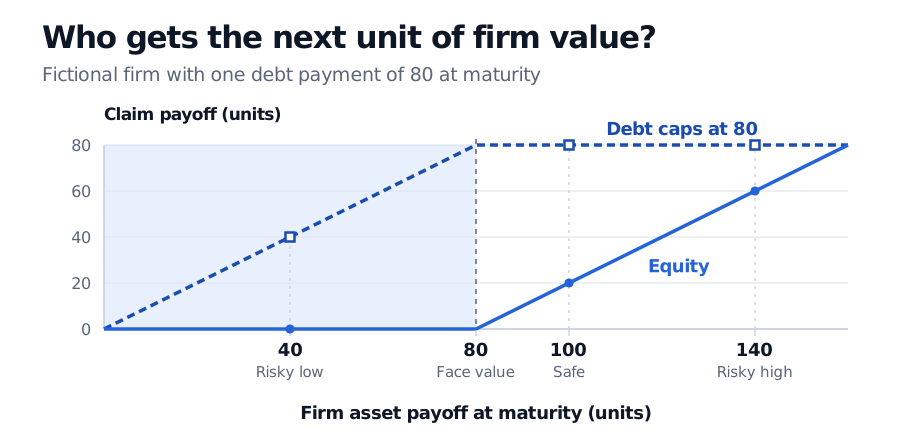
How a switch to a riskier project can make existing equity more valuable while reducing the value of debt and the firm.
Asset Substitution and Risk Shifting
Asset substitution, or risk shifting, is the incentive for shareholders to switch to a riskier project after debt is in place when the switch raises equity value at lenders’ expense. Equity can gain even when the firm as a whole loses value. For a credit analyst, this makes the borrower’s future project choices relevant to what its existing debt is worth. Jensen and Meckling (1976), section 4.1
The debt payment divides the upside from the downside
Let AT be the firm’s asset payoff when its only debt payment, of face value F, comes due. Assume lenders have first claim on the assets and there are no resolution costs. The payoffs to lenders and shareholders are
DT=min(AT,F),ET=max(AT−F,0).
Shareholders receive the residual after lenders are paid. Limited liability floors equity’s payoff at zero, so shareholders make no additional payment if the firm’s assets fall short. Equity has the shape of a call option on the firm’s assets, with the debt’s face value as the strike. Once assets cover that strike, any further upside goes to equity.
Debt rises with firm asset payoff until it caps at 80. Equity stays at zero until 80 and then rises. Firm payoffs of 40, 100 and 140 give debt 40, 80 and 80, and equity 0, 20 and 60.
Below 80 an extra unit goes to lenders. Above 80 it goes to shareholders.
A project switch that equity would take
A fictional firm already owes 80. Shareholders can choose between two projects with the same upfront cost and maturity. The safe project pays 100 for certain. The risky project pays 140 or 40 with equal probabilities. Take those probabilities as the valuation weights and set the discount rate to zero, so values are simply weighted payoffs in this example.
Project and outcome
Firm asset payoff
Debt payoff
Equity payoff
Safe, certain
100
80
20
Risky, high
140
80
60
Risky, low
40
40
0
Risky, weighted average
90
60
30
In the high outcome, equity gets the entire 40 of upside relative to the safe project. In the low outcome, equity loses 20 relative to the safe project and lenders absorb the other 40. Across both outcomes, debt loses 20 in value. Of that decrease, 10 shows up as higher equity value and 10 is lost in total firm value. If both projects covered the debt in every outcome, lenders would receive 80 either way and equity and firm value would rank the projects identically.
Why the timing matters
The comparison holds the outstanding debt terms fixed while shareholders choose the project. A lender who anticipates that choice at issuance can offer less for the same promised payment. A financial covenant can also restrict some actions that would increase lender exposure, though drafting and monitoring restrictions take resources. Jensen and Meckling (1976), sections 4.1–4.2
Risk shifting and debt overhang are both sources of agency costs associated with debt, but they distort different decisions. In risk shifting, shareholders prefer a riskier project because the upside accrues to them while lenders absorb some of the downside. In debt overhang, shareholders may pass up a project with positive net present value because the improvement in repayment to existing lenders leaves too little of the gain to justify the shareholders’ investment. Myers (1977), Determinants of Corporate Borrowing
The SelfMadeQuant lesson on structural credit models derives the same payoff split and uses it to value equity and debt in Merton’s model. The full lesson requires membership. Structural Models of Default