A financial covenant is a provision in a debt agreement that sets a threshold for a financial measure, such as a maximum leverage ratio or a minimum interest coverage ratio. For a credit analyst, the threshold turns an earnings or debt forecast into a dated question. How much room does the borrower have before it fails a test or loses access to a permitted transaction?
When the test applies
| Test | What triggers it |
|---|---|
| Maintenance | A scheduled test date, such as fiscal quarter-end. A fall in earnings can cause a failure without any new borrowing. |
| Springing maintenance | A scheduled test applies only if a specified condition is met. For example, a revolving credit facility may require a leverage test only when defined usage crosses a threshold. |
| Incurrence | A specified action, such as issuing debt under a ratio-based permission. The agreement may require the ratio to pass pro forma, giving effect to the transaction and the use of proceeds. |
Tutor Perini’s July 2026 credit agreement sets maximum total net leverage and minimum cash interest coverage for its revolver. Its September 2026 quarterly filing reports the actual ratios against those limits on a rolling four-quarter basis. As a contrasting example, Medline’s agreement as amended in July 2024 made the quarter-end first-lien leverage test conditional on defined revolving loan usage. In a springing test, check what counts towards usage and whether equality triggers the test. Tutor Perini credit agreement, §7.11, Tutor Perini Form 10-Q, Debt, Medline agreement as amended in July 2024, §7.09
How much room is left?
A fictional borrower’s agreement defines net debt as funded debt minus eligible cash. At the test date it has USD 300 million of funded debt, USD 50 million of eligible cash and USD 80 million of trailing four-quarter covenant EBITDA. The test allows net leverage of at most 3.5×.
The ratio passes. With EBITDA fixed, the test permits net debt of million, or USD 30 million above the current USD 250 million. That is headroom under this one test. With debt and eligible cash fixed instead, the ratio reaches its limit when EBITDA falls to million. This lets an analyst stress the earnings forecast even if no new debt is planned.
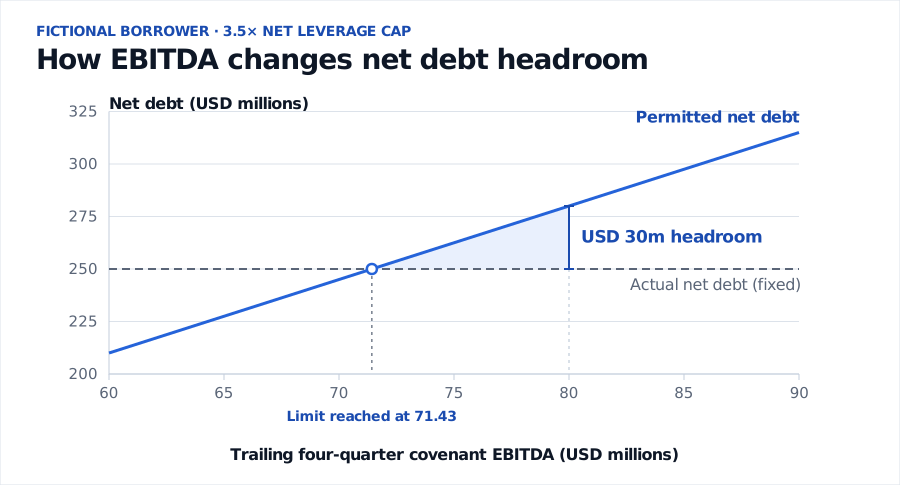
A fall in EBITDA reduces headroom even when net debt stays at USD 250 million. Below about USD 71.43 million of EBITDA, the ratio exceeds the cap.
What the agreement can change
Inputs and dates. Identify whose debt and cash are included, which cash qualifies for netting and which EBITDA adjustments the agreement allows. Separate the measurement date from the financial reporting and compliance certificate deadlines. Tutor Perini’s agreement, for example, excludes certain receivables and securitisation debt from its total net indebtedness measure and uses four quarters of EBITDA with specified pro forma adjustments. Tutor Perini credit agreement, §§1.01, 6.01–6.02 and 7.11
Permission to act. Actual debt capacity also depends on cash flow, available commitments and transaction restrictions. A basket is a negotiated exception to a restriction, such as a capped permission to incur certain debt or make certain payments. Its remaining capacity depends on the clause, prior use and any conditions that apply. Tutor Perini’s agreement has separate provisions for new debt and restricted payments. For some restricted payments, the agreement provides a capped basket and a separate route based on pro forma leverage. Tutor Perini credit agreement, §§7.03 and 7.06(b)(xvi)
Cure and remedies. A failed calculation prompts a separate check of cure rights and deadlines, including when lenders can direct the agent to demand early repayment. Medline’s July 2024 agreement allowed qualifying cash contributions or subordinated shareholder loans to count as EBITDA for its maintenance test, subject to limits and a deadline. The deemed EBITDA increase applied to that test, with separate rules for any subsequent effects of the cash or an actual debt repayment. Medline agreement as amended in July 2024, §§8.01–8.02 and 8.05
The SelfMadeQuant lesson Credit-Sensitive Bonds places covenants alongside other protections in a bond indenture and connects covenant compliance to ratings surveillance. The preview is public and the full lesson requires membership.