How investors interpret debt and equity choices when managers know more about the firm, and what makes a financing signal credible.
Signaling Through Financing Choices
Signaling through financing choices occurs when investors infer something management knows privately from how a firm raises money. Issuing shares, borrowing or using internal cash can change what investors expect about the firm's prospects. For an analyst reading an issuance announcement, the question is whether firms with different prospects would have chosen the same financing given the alternatives available to them.
When is borrowing a credible signal?
In Ross's model, managers are rewarded for a higher market valuation today and penalised if the firm later goes bankrupt. A manager who knows the firm can service a large debt commitment can take on that debt and benefit from a higher valuation. A weaker firm's manager would face the bankruptcy penalty for taking on the same commitment. If that penalty outweighs the short-term reward, the weaker firm has a reason to choose less debt. The credibility comes from the different consequences of the same action. Ross (1977), §2
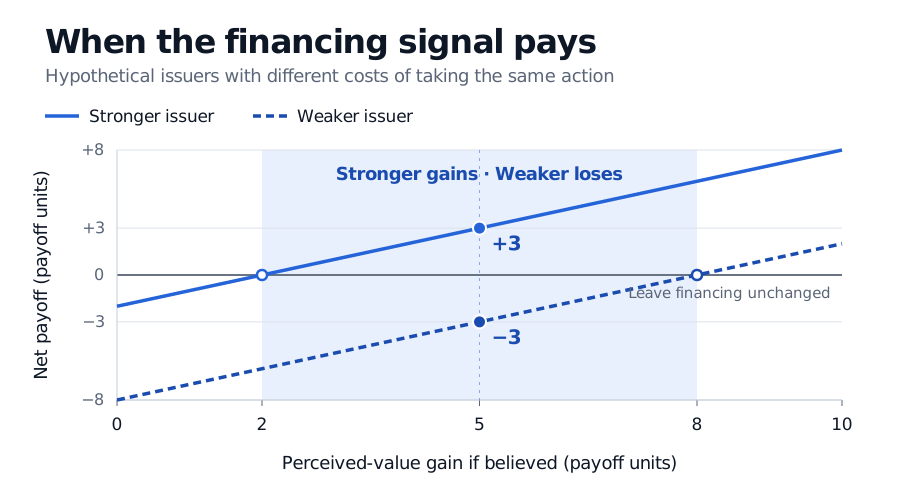
Consider two hypothetical issuers. Suppose that if investors read a financing commitment as evidence of strength, the rise in perceived value gives the decision-maker a benefit of 5 payoff units. Taking on the commitment costs the stronger issuer 2 units and the weaker issuer 8. Leaving financing as it is gives each a payoff of 0 relative to its own starting point.
Stronger issuerWeaker issuer:5−2=+3,:5−8=−3.
Under those beliefs, the stronger issuer takes the action and the weaker issuer declines. The figure varies the perceived-value gain while holding the costs fixed. The incentives point in strictly opposite directions when the gain is between 2 and 8. At either threshold, one issuer is indifferent.
At a perceived-value gain of 5, signaling pays the stronger issuer +3 and the weaker issuer −3 relative to zero for leaving financing unchanged. The issuers break even at gains of 2 and 8, respectively.
The shaded range shows where the stronger issuer gains from signaling and the weaker issuer would lose by copying it.
This is an incentive-compatibility check conditional on investors granting the higher valuation. To establish a separating equilibrium, the investors' valuations would also need to follow from which issuers choose each action. In practice, credit limits and other funding needs can change the choices available to either issuer.
Why selling shares can convey different news
In Myers and Majluf's model, managers who act for existing shareholders may pass up a valuable project if selling shares at the price investors will pay would transfer too much value to new shareholders. Investors anticipate that reluctance. An equity issue can therefore lead them to lower their estimate of the value of the assets already in place. This information cost helps explain the pecking order preference for internal funds and then debt, especially when debt can be issued on terms less sensitive to what managers know. Myers and Majluf (1984), numerical example and Debt Financing
Equity market timing asks when issuing shares is relatively attractive. Equity issuance after a price rally can fit both stories. Managers may believe the stock is expensive, or the rally may follow a disclosure that narrows the information gap and makes issuing equity less costly. Baker and Wurgler (2002), Introduction and §II.D
What an announcement return can tell you
Asquith and Mullins found that share prices fell around seasoned equity offering announcements in their sample. They identified two interpretations consistent with the result. Investors could read the issue as unfavorable news, or prices could fall because investors require a lower price to absorb a larger supply of shares. An event study can estimate the price reaction. To interpret it, check what the issue funds, what alternatives the issuer had before the announcement, and whether the firm released earnings, guidance or acquisition news at the same time. The SelfMadeQuant lesson works through how to date an announcement and flag overlapping disclosures. Full lesson access requires membership. Asquith and Mullins (1986), abstract · Event Definition