The debt vs equity financing decision is a company’s choice of how much external funding to raise by borrowing and how much to raise by issuing shares. Borrowing commits the company to interest and principal payments. Issuing ordinary shares gives buyers a continuing share of the cash flows available to owners after senior claims. For the same investment, the mix changes how much cash the business must find on specific dates and how much of the upside existing owners keep. Damodaran, The Choices in Financing
The same USD 50 million, raised two ways
A fictional company needs USD 50 million. It can take a three-year loan at a fixed annual rate of 6%, or sell ordinary shares for USD 20 each. It starts with 10 million shares. Ignore fees and assume existing shareholders sit out the issue and new shares have the same rights as existing ones.
Borrow. On USD 50 million outstanding, annual interest is million before tax. The principal is due in full at the end of year three, so the company owes USD 3 million at each of the first two year-ends and USD 53 million at the third. The funding forecast has to cover that final payment, whether from cash on hand or refinancing. Missing a payment can trigger default. A financial covenant can also require the borrower to stay below a maximum leverage ratio. The credit agreement may impose separate limits on new debt or dividends. Damodaran, Agency Costs
Issue shares. The company sells million new shares, bringing the total to 12.5 million. Buyers own of the company after the issue. The shares carry no contractual interest or principal payments. Equity investors still require a return commensurate with the risk of their claim, which they may earn through dividends or a higher share price. Damodaran, Debt versus Equity
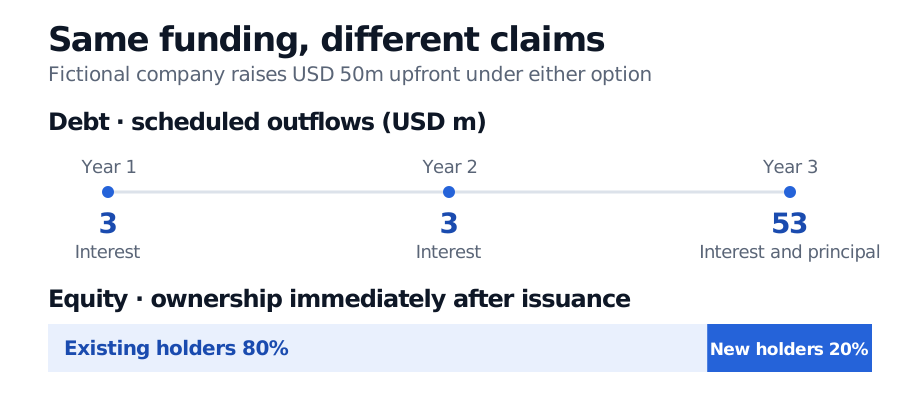
The final loan payment includes USD 50 million of principal. The equity bar shows how the enlarged share count is split.
The existing holders’ percentage falls from 100% to 80%. Their stake can keep the same dollar value. If USD 20 was fair value before the issue and the incoming cash adds dollar for dollar to equity value, their 80% of USD 250 million is still worth USD 200 million. An issue below fair value can transfer wealth to new buyers. The SelfMadeQuant lesson’s rights-issue example shows how transferable subscription rights can compensate existing holders for a below-market offer under frictionless assumptions. Equities, Indices and Corporate Actions, full lesson for members
Compare cash obligations and required returns
For a cash-flow forecast, put interest and principal on their due dates and test whether the firm can pay in a weak operating scenario. Include any interest tax savings when the firm can actually use the deduction. For a valuation, weighted average cost of capital combines the required returns on both claims using their market-value weights. In the frictionless, no-tax Modigliani–Miller benchmark, raising leverage leaves total firm value unchanged for the same operating assets and raises the required return on the riskier remaining equity. Damodaran, Tax Benefits of Debt · Modigliani and Miller, Propositions I–II
The share price also matters. A higher offer price raises the same cash with fewer shares. Market timing theory studies whether firms issue equity when valuations are relatively high and whether those decisions leave a lasting imprint on leverage. Baker and Wurgler, Market Timing and Capital Structure
Sources
- Aswath Damodaran, NYU Stern, Finding the Right Financing Mix: The Capital Structure Decision
- Aswath Damodaran, NYU Stern, Corporate Finance Session 17: Capital Structure
- Franco Modigliani and Merton H. Miller (1958), The Cost of Capital, Corporation Finance and the Theory of Investment
- Malcolm Baker and Jeffrey Wurgler (2002), Market Timing and Capital Structure