A perpetuity is a stream of payments that continues indefinitely. A level perpetuity pays the same amount at regular intervals. It is a useful benchmark for valuing long-lived income: infinitely many positive payments can have a finite present value, because sufficiently distant receipts receive progressively less weight.
The familiar formula is . Here is the payment per period, is a constant positive effective discount rate per payment period, and the first payment arrives one full period from today. Those timing and rate assumptions are part of the formula.
An infinite stream worth 2,000
Consider certain receipts of 100 currency units at the end of every year forever, starting at year 1. Use a flat 5% annual effective rate, with annual compounding. Ignore default, taxes and fees. This is a synthetic valuation example, not an available investment or a promise about future rates.
There is no final principal repayment in this cash-flow specification. The 2,000 is the value of all the receipts, not a separate amount paid at maturity.
A funding check makes the result tangible. In the stipulated constant-rate world, a fund of 2,000 grows to 2,100 over the first year. Withdraw 100 and 2,000 remains. Repeating the same calculation finances each subsequent payment without reducing the balance. This interpretation requires earning the assumed rate every year; today's valuation rate does not guarantee future reinvestment opportunities.
Now split the stream immediately after the year-3 payment:
| Cash flows being valued | Value at time zero, currency units |
|---|---|
| First three receipts, at years 1, 2 and 3 | 272.32 |
| All receipts from year 4 onward | 1,727.68 |
| Whole perpetuity | 2,000.00 |
The first part is a finite annuity. The remaining tail is another perpetuity: at year 3, immediately after that year's receipt, its next payment is one year away, so its value at that date is again 2,000. Discount that value back three years:
Using unrounded values, the first three payments have value and the tail has value . Their sum is exactly 2,000. The tail is large even though each distant payment is small in present-value terms; there are many such payments left.
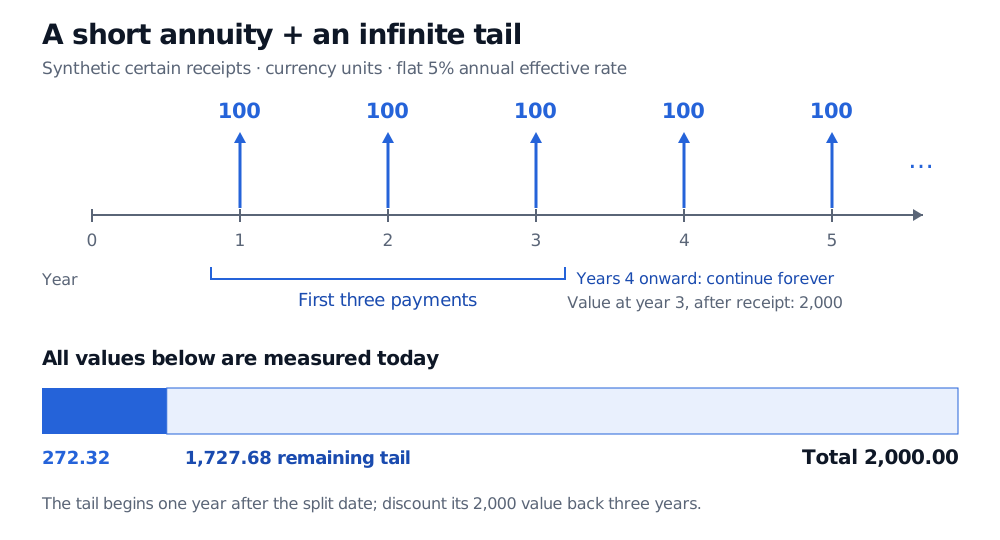
Original synthetic example. The blue segment values the first three receipts; the pale segment values every later receipt. Both segments are measured at time zero, in currency units.
Why the infinite sum converges
For a positive payment and a flat rate , the value of the first receipts is
As increases, approaches zero, leaving . The discount factor shrinks geometrically; the unpaid tail's value approaches zero only as the cut-off date moves arbitrarily far away. No particular late payment suddenly becomes worthless.
At zero rates, the partial sum is and grows without bound. With a constant effective rate between and zero, the discounted positive payments grow rather than shrink, so the series also diverges. Substituting a negative rate into does not produce a valid negative price for this positive stream.
The geometric-series lesson develops partial sums and applies them to perpetuities and finite coupon streams. A public preview is available; the full lesson requires membership.
Check the promise behind the shortcut
- Payment today: a level stream starting now has value , because the time-zero receipt is added to the ordinary perpetuity. A deferred stream must be valued one period before its first receipt, then discounted to today.
- Changing payments or rates: growing, inflation-linked or irregular receipts need their actual schedule. With a non-flat yield curve, value a certain level stream as and check convergence; one arbitrary quoted rate cannot replace every discount factor.
- A real security: a perpetual bond can have contractual features that alter the stream. For example, the UK Debt Management Office's 2012 consultation described perpetual gilts with an issuer redemption option. “No fixed final maturity” did not mean the issuer could never repay them. That historical document is not a list of securities available today.
- Income for life: a life-contingent insurance promise depends on survival and contract terms. It is not the same cash-flow object as certain payments forever. Nor does a constant nominal payment preserve purchasing power against inflation.
Sources
- Frank J. Fabozzi and Francesco A. Fabozzi, Bond Markets, Analysis, and Strategies, 10th edition, MIT Press, 2021, Chapter 2, “Present Value of an Ordinary Annuity”; PDF pages 53–54 in the inspected local edition. Supports the finite-payment timing and discounted-sum foundation.
- OpenStax, Principles of Finance, §8.1: Perpetuities: level-payment valuation and the distinction between a modelled income stream and conditional preferred dividends.
- UK Debt Management Office, Super-long and Perpetual Gilts: A Consultation Document, 25 May 2012, paragraphs 23–25: historical discussion of perpetual instruments and redemption options. External sources checked 26 October 2026.