A perpetual bond has no fixed maturity date. See why fixed coupons can have a finite value, why face value is not a scheduled repayment, and how calls and payment terms change the model.
Perpetual bond
A perpetual bond is a bond with no fixed maturity date. The issuer has no scheduled final date on which it must return the principal. For the investor, this removes the usual maturity payment that helps anchor a conventional bond’s value: getting capital back may depend on selling the security or on a redemption permitted by its terms.
“Perpetual” describes the absence of a maturity date. It does not guarantee that coupons will actually arrive forever, make the coupon fixed, or rule out an issuer’s right to redeem.
A price without a maturity payment
Start with an intentionally simple model: a noncallable bond with face value of 1,000 currency units and a fixed annual coupon of 40. The first coupon arrives in one year, with another at each year-end thereafter. Assume every coupon is paid forever, no fees or taxes, and a flat annual effective discount rate of 5%.
This level infinite payment stream is a perpetuity. There is no promised finite principal payment to add. The present value is just the discounted coupon stream:
P=t=1∑∞(1+y)tC=yC,y>0.
Here C is the annual coupon in currency units and y is the annual effective rate as a decimal. Thus
P=0.0540=800.
The coupon rate is 40/1,000=4%, while the current yield at this price is 40/800=5%. They have different denominators. Face value defines the coupon amount here; it does not create an eventual payment of 1,000.
An infinite number of positive payments can have a finite value because their discounted amounts shrink geometrically. Through year N, the coupon value is
PN=yC[1−(1+y)−N].
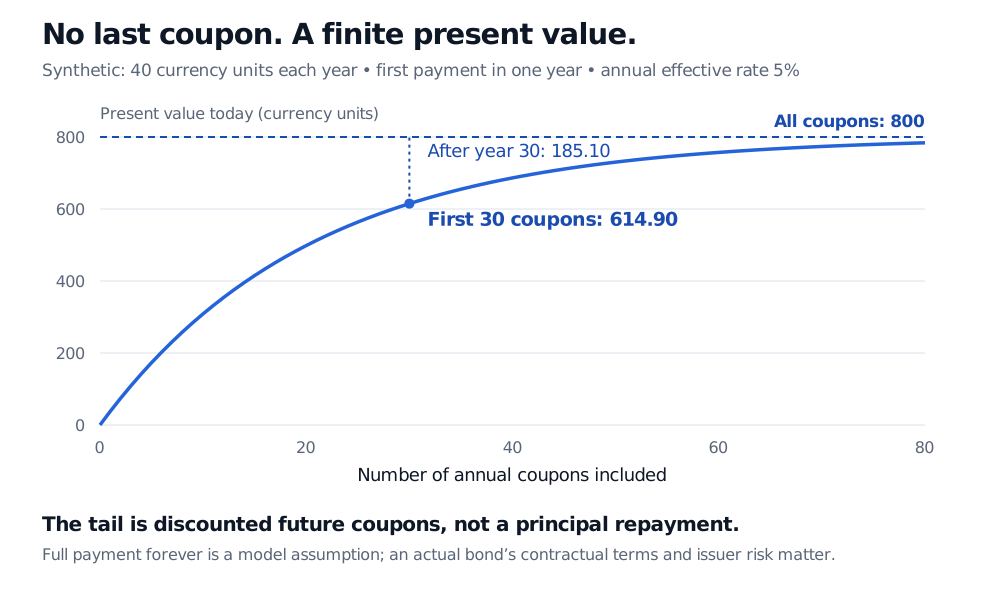
The remaining coupons have value yC(1+y)−Ntoday. For the first 30 coupons, the value is 614.90; all coupons after year 30 contribute the other 185.10. That remaining value represents future interest payments, not principal arriving in year 30.
Cumulative present value of a synthetic annual coupon of 40 at a 5 percent annual effective rate: the first 30 coupons contribute 614.90 currency units and the later coupons 185.10, giving total present value 800. The curve approaches the dashed 800 limit.
Original synthetic illustration. Full coupon payment forever, first payment in one year, fixed annual effective discount rate of 5%; all amounts are values today in currency units.
The positive-rate condition matters. At a zero discount rate the same positive coupons add without bound. At a negative annual effective rate above minus 100%, their discounted amounts grow rather than decay. Substituting such a rate into C/y does not produce a valid value for this infinite stream.
For the series derivation, Series and the Geometric Series develops partial sums and applies them to perpetuities. The link opens a public preview; the full lesson requires membership.
Read the terms before using the formula
The level-coupon model is a benchmark for thinking about price and rate sensitivity. Holding its coupons fixed, a 4% annual effective rate gives a value of 1,000; a 6% rate gives 666.67. There is no scheduled maturity at which the price must return to face value.
An actual instrument may have materially different cash flows. Its documentation determines whether coupons can reset or be deferred, whether the issuer can redeem it, and the investor’s position if the issuer defaults. The IFEC’s bond-risk guidance identifies these features and explains that a perpetual’s payments depend on the issuer’s long-term viability. They must be reflected in valuation rather than treated as an unchanged stream of 40.
A first call date is particularly easy to mistake for a maturity date. A callable bond gives the issuer a redemption right under specified conditions; it does not by itself give the investor a right to demand repayment on that date. Assuming the call will occur can understate how long the investment remains outstanding.
Historical UK undated gilts show that “no fixed maturity” can coexist with eventual redemption. In its 27 March 2015 notice, the UK Debt Management Office announced redemption of the remaining undated gilts on 5 July 2015, using the relevant statutory powers and prospectus terms. That was a specific redemption decision, not a universal promise that perpetual bonds repay at par.