A new issue concession is the signed difference between a new bond’s final offering credit spread and the spread at which comparable debt is estimated to trade in the secondary market when the deal prices. Investors use it to compare the new bond with outstanding alternatives. Issuers use it to gauge how far their borrowing terms in the primary market differ from the levels implied by their existing debt. A positive concession means the issuer sells at a wider spread. In a syndicated offering, offering that extra spread can help attract enough orders to place the deal, while strong demand during bookbuilding can allow the issuer to tighten the spread. Siani, Appendix A.3 · Krebbers et al., §6.2
Compare both sides at pricing
A fictional issuer sells a five-year, option-free, senior unsecured bond at a 5.20% yield to maturity. Its secondary curve implies a 5.00% fair yield for the new bond’s terms at pricing. Both yields use the same currency, benchmark and yield conventions. With the same benchmark on both sides, it cancels in the spread difference, so subtracting the yields gives the concession directly.
Suppose the fair yield was 4.90% earlier in the day and the benchmark then rose 10 basis points with the issuer’s secondary spread unchanged. Comparing the final issue yield with that earlier mark gives 30 bp. Of that gap, 10 bp came from the benchmark move. If the issuer’s secondary spread moves too, update both components before calculating the concession.
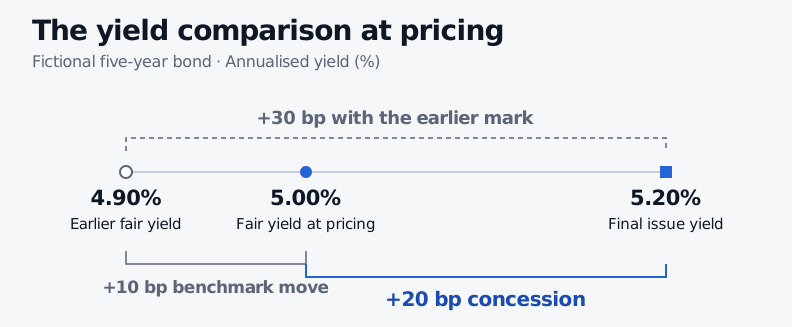
The stale comparison gives 30 bp. Updating the secondary fair yield leaves 20 bp of concession.
The fair spread is an estimate
Start with outstanding bonds of the same issuer or guarantor, currency, seniority and collateral terms. Use the same benchmark and spread convention, and estimate the spread at the new bond’s maturity or duration from comparable bonds on either side where possible. A subordinated bond can trade wider because its claim ranks lower. A callable bond adds the issuer’s right to redeem early. Match the option terms where possible, or use option-adjusted spreads under a consistent model. Krebbers et al., §6.2 · Boyarchenko and Elias, §§2.1 and 4.1
Check how recently the comparables traded and whether the quotes are executable for the relevant size. A fresh dealer mark can inform the curve without committing the dealer to trade at that level. Wide bid–ask spreads or sparse trades make the estimate less precise. The new bond may also be easier to trade than older bonds. If investors value that liquidity or demand is strong enough, the final spread can come in below estimated fair value, giving a negative concession. In Boyarchenko and Elias’s corporate-bond sample, the average investment-grade issue priced tighter than the prior month’s duration-matched, currency-adjusted spread for the same firm. The sign reversed when they compared the issue spread with the same bond’s first index quote. Boyarchenko and Elias, §4.1 and Table 7
Keep underwriting fees on a separate line. They reduce the proceeds the issuer receives. The new issue concession compares investor pricing with a secondary fair spread. An offering document’s selling concession can refer to compensation for dealers distributing the notes. Bank of America Corporation, pricing supplement cover and footnotes
Sources
- Kerry Yang Siani, Raising Bond Capital in Segmented Markets, Appendix A.3 on new issue concession and aftermarket measures.
- Krebbers et al., Orderbook demand for corporate bonds, §6.2 on estimating fair spread and the link with investor demand.
- Nina Boyarchenko and Leonardo Elias, Corporate Credit Conditions Around the World, New York Fed Staff Report No. 1074, revised December 2024, §4.1 and Table 7.
- Bank of America Corporation, May 2026 fixed-rate callable notes pricing supplement, cover pricing table and distribution footnotes.