An integral adds continuous contributions. Read its notation, track units and signed cash flows, and distinguish definite, indefinite, improper and double integrals.
Integral
An integral adds contributions distributed across a continuous range. In ordinary calculus, a definite integral gives a signed total over specified bounds; an indefinite integral denotes a family of antiderivatives. The notation tells you which meaning is intended.
For a quant, the key question is what each contribution measures. Integrating a cash-flow rate over time gives cash. Integrating a probability density over a range gives probability. Neither result is determined by the curve's height alone.
Read the whole expression
In
∫abf(x)dx,
f(x) is the integrand, a and b are the lower and upper bounds, and dx identifies x as the variable of integration. For a<b, the Riemann interpretation adds products f(xi∗)Δxi over ever finer intervals. When those sums approach the same finite value as the largest interval width approaches zero, independently of the sample points, that value is the integral. A continuous function on a closed, bounded interval satisfies this condition.
Think “value times width, then add.” The dx is part of the integral notation, not a fixed tiny number to choose. It also tells you how units combine: an integrand measured in USD/year integrated against time in years produces USD. Renaming the bound variable consistently from x to u does not change the result.
Positive and negative cash belong in the same total
Suppose a synthetic arrangement has net cash-flow rate
c(t)=30−10t,0≤t≤4,
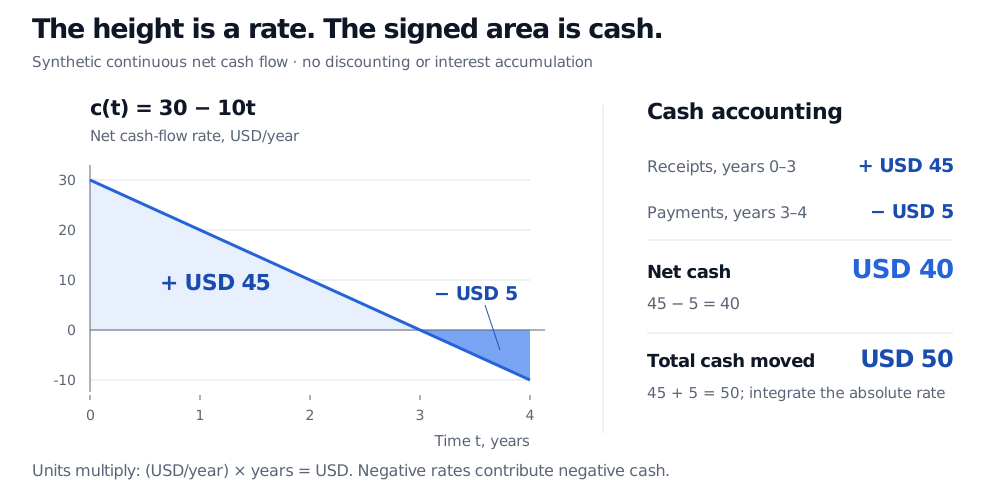
with t in years and c(t) in USD/year. The intercept is USD 30/year and the slope is −USD 10/year². Positive rates mean receipts; negative rates mean payments. Ignore discounting and interest on cash received.
The rate reaches zero after three years. The positive triangle contributes 21×3×30=45 USD; the final negative triangle contributes −21×1×10=−5 USD. Hence
∫04c(t)dt=45−5=40 USD.
Synthetic net cash-flow rate declines from USD 30/year to −USD 10/year over four years. The positive region contributes USD 45 and the negative region contributes −USD 5, leaving net cash of USD 40. Total unsigned cash moved is USD 50.
Original synthetic example. Rate height has units USD/year; each shaded contribution has units USD. The integral nets receipts against payments.
The net USD 40 differs from the USD 50 of total cash moved:
∫04∣c(t)∣dt=45+5=50 USD.
Taking absolute values answers a different question. Likewise, a cash integral alone is not present value: valuation requires appropriate discount factors inside the integrand.
A total or a family of functions?
For this example,
∫c(t)dt=30t−5t2+C.
This indefinite integral describes all antiderivatives on the interval; C is an arbitrary constant with cash units. It does not specify an initial cash balance. The fundamental theorem of calculus connects the two meanings: because c is continuous, subtracting endpoint values of any antiderivative gives the definite total,
[30t−5t2]04=120−80=40 USD.
The constant cancels. A definite integral has no extra +C.
Two common extensions change the setup. An improper integral handles an unbounded interval or an unbounded integrand through limits; a finite result requires convergence. A double integral adds contributions over a two-dimensional region, using area elements rather than interval widths. For instance, integrating a joint probability density over a region gives the probability that two continuously distributed risk factors fall in that region.
For the first calculation techniques, Integration in the Mathematics Primer develops antiderivatives, substitution and continuous cash-flow valuation. The public page is a preview; the full lesson requires membership.
Sources
James Stewart, Single Variable Calculus: Early Transcendentals, sixth edition, Thomson Brooks/Cole, 2008, §§5.2–5.4: definite integrals, the fundamental theorem and net change.