The fundamental theorem of calculus links local accumulation rates to endpoint differences. Follow a continuous cash stream through both directions, their units and conditions.
Fundamental theorem of calculus
The fundamental theorem of calculus connects a derivative, which measures local change, with a definite integral, which adds changes over an interval. It answers two different questions: what is the current rate of accumulation, and how much accumulated between two endpoints?
For a continuous payment stream, these are the difference between the cash rate today and the cash received over a period. A rate measured in USD per year becomes an amount measured in USD after integration; differentiation reverses that unit change.
The two statements, with their conditions
A convenient sufficient assumption is that f is continuous on a finite closed interval [a,b].
Differentiate an accumulation. Define
A(x)=∫axf(t)dt.
Then A is differentiable at each interior point, and
A′(x)=f(x),a<x<b.
The upper limit x moves; the lower limit a stays fixed. The integration variable t merely names the positions being added. The integral defines a function of x even when no elementary formula for it is available.
Evaluate an integral by its endpoints. If F is an antiderivative of f on this interval—continuous on [a,b] with F′=f on (a,b)—then
∫abf(t)dt=F(b)−F(a).
The first statement constructs an antiderivative from accumulated area. The second uses any antiderivative to calculate an interval total. These are commonly called Parts I and II respectively. OpenStax gives the two statements and their proofs.
Why does any antiderivative work? Since A′=F′, the mean value theorem implies that F−A is constant on the interval. That same constant appears at both endpoints and cancels. An integral of a rate determines a change; a starting amount is needed to recover a balance.
A licence that pays continuously
Consider a hypothetical four-year data-licensing agreement with a continuously paid cash rate
f(t)=12+6t,0≤t≤4,
where t is measured in years and f(t) in USD per year. The coefficients carry units: USD 12 per year initially, increasing by USD 6 per year for each year elapsed. Assume the agreed cash receipts are certain. We are counting nominal receipts, without discounting or reinvestment.
Cash received since inception is
C(T)=∫0T(12+6t)dt=12T+3T2.
To find the cash received from year 1 to year 3, use the endpoint difference:
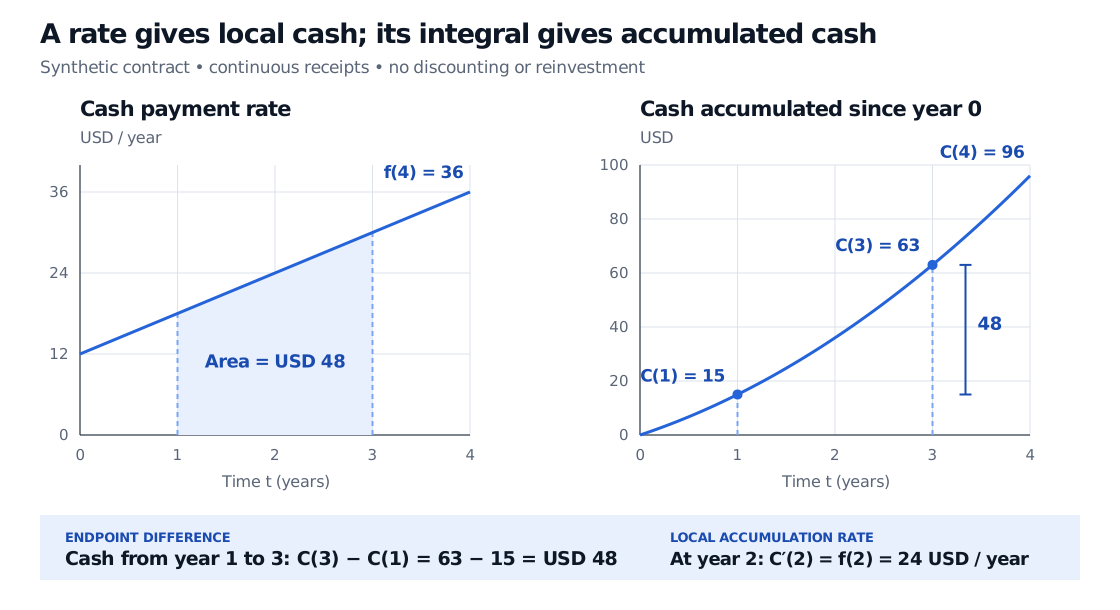
∫13(12+6t)dt=[12t+3t2]13=63−15=USD 48.
USD 63 is the amount received since year 0 by year 3. It includes USD 15 received before year 1; subtracting that earlier cash is essential. A geometric check gives the same answer: the endpoint cash rates are USD 18 and USD 30 per year, so the trapezoid has average height 24 over two years, giving USD 48.
The hypothetical cash rate 12 plus 6t USD per year has area USD 48 between years 1 and 3. The accumulated-cash curve 12t plus 3t squared rises from USD 15 to USD 63 over the same dates. At year 4, the rate is USD 36 per year and accumulated cash is USD 96.
Original synthetic contract. The left panel's shaded area equals the right panel's endpoint change. The panels have different vertical units: USD per year for the rate, USD for accumulated cash.
Adding an initial cash balance would move the accumulated-balance curve vertically. It would leave both the USD 48 interval receipt and the payment rate unchanged. Conversely, at year 4 the agreement has paid USD 96 in total, while its current payment rate is USD 36 per year. Those quantities answer different questions.
Why the accumulation slope is the current rate
Focus on year 2, when the payment rate is USD 24 per year. Over a small extension h of the horizon,
C(2+h)−C(2)=24h+3h2.
Dividing cash by elapsed time gives the average rate over that extension:
hC(2+h)−C(2)=24+3h⟶24as h→0.
Extension h, years
Additional cash, USD
Average rate, USD/year
0.5
12.75
25.50
0.1
2.43
24.30
0.01
0.2403
24.03
The finite-interval average is slightly above 24 because the payment rate increases during the extension. Its limit is exactly C′(2)=f(2)=24. The general argument replaces this polynomial calculation with
hA(x+h)−A(x)=h1∫xx+hf(t)dt.
MIT's explanation relates this quotient to the narrow strip added by moving the upper limit. Continuity makes the strip's average height approach f(x), from either side. A small interval gives an approximation; the derivative is the limit.
Where the elementary version needs care
A jump in the rate can create a corner in the accumulation. Suppose a different contract pays USD 12 per year before year 2 and USD 30 per year afterwards. Its accumulated cash is continuous, but at year 2 its left and right slopes are 12 and 30. There is no two-sided derivative there. The cash total still exists: split the integral at the payment-rate change. Continuity is a sufficient condition for the statements above, rather than a claim that every discontinuous integrand defeats all versions of the theorem.
The integration variable and moving bounds matter. If an upper limit is g(x), the chain rule gives
dxd∫ag(x)f(t)dt=f(g(x))g′(x).
This formula assumes the integrand depends on t alone. A parameter that also changes the cash rate requires an additional derivative contribution; substituting into the endpoint is then insufficient.
The theorem is not a promise of a convenient formula. A continuous rate has an accumulation function, but that function may lack an elementary expression. Numerical integration can still evaluate its totals. Nor should this ordinary-calculus argument be applied by treating a random price path as a differentiable cash balance; stochastic integration needs its own definitions and rules.
For more worked calculations, Integration introduces signed accumulation, antiderivatives and substitution. The Fundamental Theorem lesson develops the two statements and moving-limit examples. Both have public previews; full lessons require membership.
Sources
James Stewart, Single Variable Calculus: Early Transcendentals, 6th edition, Thomson Brooks/Cole, 2008, §5.3, pp. 379–387 — both parts of the theorem, the accumulation proof and endpoint evaluation.