The task runs differentiation backwards: recover a level from a known rate of change. For example, a model of marginal trading cost can tell an execution desk how total cost changes with order size. An antiderivative recovers the cost curve, but the marginal rate alone cannot reveal its starting level.
One rate, many totals
Suppose a hypothetical execution desk models marginal cost as
where is shares traded and is USD per share. Quantity is treated as continuous. This is a smooth teaching model of execution costs, excluding the purchase price of the shares, rather than a quoted fee schedule or a fitted market-impact model.
Reading the polynomial differentiation rule backwards gives
Differentiate to check: . The constant disappears. Thus every choice of gives an antiderivative with exactly the same marginal costs.
Suppose the desk allocates USD 10 of setup overhead before trading, so that . Substitution gives , selecting
At 100 shares,
The increase from trading those shares is only USD. The remaining USD 10 was already present at the starting point. Setting the constant to zero without evidence would recover the variable-cost curve, but miss this model's total cost.
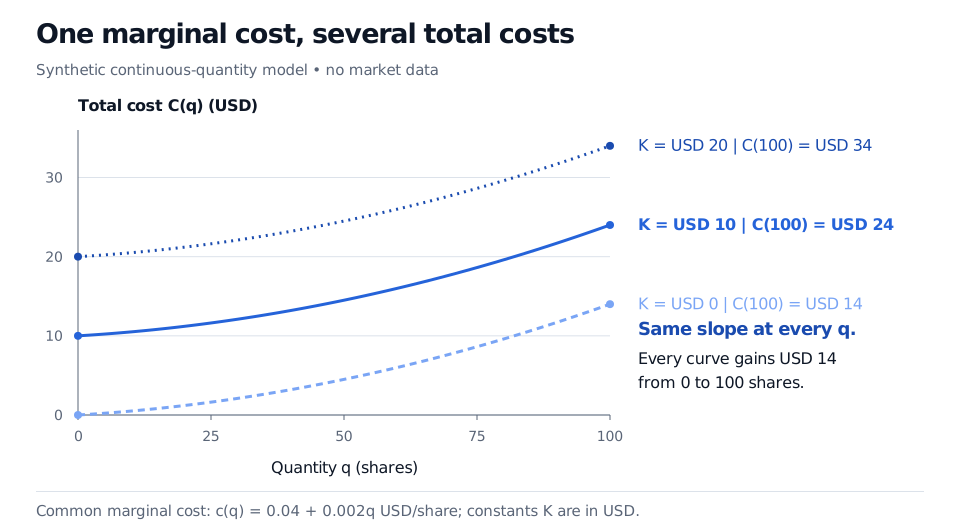
Why the family has just one free constant
The interval matters. For , the domain excludes zero and splits into two intervals. Its antiderivatives may be
There is no requirement that . A known value on the positive side cannot determine the negative side's constant. One starting value fixes one member of the family on a connected interval.
A function, a family, or an accumulated change?
These closely related objects answer different questions:
| Object | What it tells you in the cost model |
|---|---|
| An antiderivative | One function whose derivative is the specified marginal cost |
| The indefinite integral | The complete family |
| The definite integral | The accumulated increase, USD 14 |
| The initial-value condition | The extra information selecting the actual total-cost curve in this model |
Here is the integration variable. The integral supplies the change from zero shares to shares; supplies the starting level. Any arbitrary constant cancels when subtracting endpoints. Adding a further arbitrary constant to a definite integral would change its answer.
Sources
- James Stewart, Single Variable Calculus: Early Transcendentals, 6th edition (Thomson Brooks/Cole, 2008), §4.9, “Antiderivatives,” and §§5.3–5.4 on the fundamental theorem, indefinite integrals and net change.
- OpenStax, Calculus Volume 1, §4.10, “Antiderivatives”, especially Theorem 4.14 and initial-value problems.
- MIT, Calculus for Beginners, §12.1, “The Anti-derivative”, on reversing differentiation, constants and verification.