An indefinite integral denotes a family of antiderivatives. Read the constant, distinguish fixed and variable bounds, and recover a cash balance from net flows.
Indefinite integral
An indefinite integral is notation for a family of antiderivatives:
∫f(x)dx=F(x)+C,F′(x)=f(x).
Here f(x) is the integrand, x is the variable of integration, and C is an arbitrary constant. There are no integration bounds. The answer describes functions whose derivative is f, rather than a single accumulated amount.
That distinction matters when a cashflow rate is known but an account balance is not. Integrating the rate recovers possible balance paths. A known balance supplies the missing information.
Read the answer before using it
Suppose a hypothetical cash account receives a continuous net inflow at rate
f(t)=100+20t,0≤t≤2,
where t is time in years and f(t) is in USD/year. The constant coefficient has units USD/year, and the coefficient of t has units USD/year². The account earns no interest or investment return; the flow already includes any deposits less withdrawals.
Its indefinite integral is
∫(100+20t)dt=100t+10t2+C.
Both terms depending on t, and the constant C, are in USD. Differentiating the whole expression gives 100+20t, regardless of C. The calculation therefore specifies a family of possible cash balances, not the account's starting cash.
If the account starts with W(0)=50 USD, substitute that information:
50=100(0)+10(0)2+C⇒C=50.
The selected balance is W(t)=50+100t+10t2, so
W(2)=50+200+40=290 USD.
At that instant the inflow rate is f(2)=140 USD/year. The rate, the accumulated USD 240 of net inflows, and the USD 290 balance are three different quantities. This balance increase is funded by cashflows; it is not evidence of investment performance.
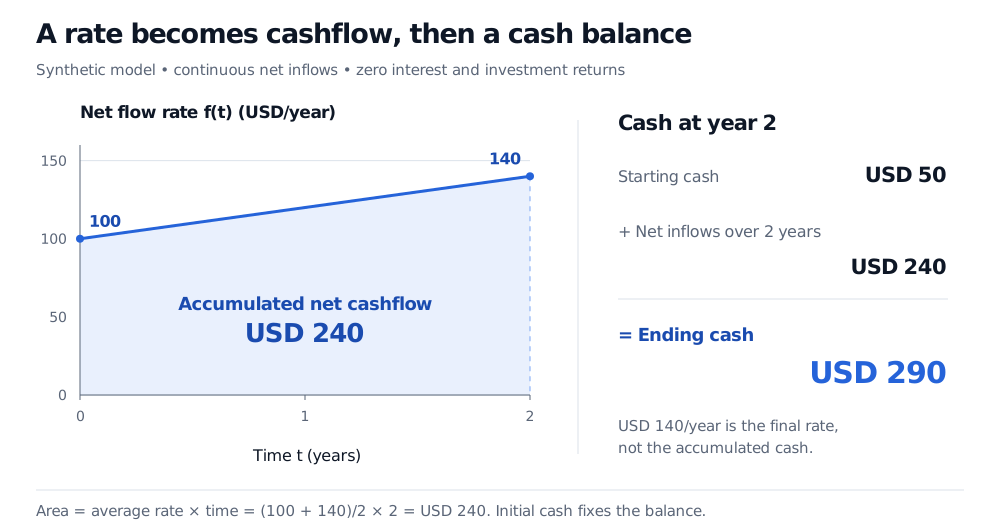
Synthetic continuous net cashflow rises from USD 100 per year to USD 140 per year over two years. The area under the rate is USD 240; adding starting cash of USD 50 gives a balance of USD 290.
Original synthetic cash-account model, with no interest or investment returns. Integration turns a rate into an amount; the starting balance then determines the ending balance.
The extra information need not arrive at time zero. Knowing W(1)=160 USD would also give 160=100+10+C, hence the same C=50. Check the derivative and the known balance separately: a derivative check cannot detect the wrong constant.
The arbitrary constant cancels in endpoint subtraction. There is no additional +C in this answer: USD 240 is the change over a specified interval, even if the starting balance is unknown.
A function-valued answer does not automatically mean an indefinite integral. A definite integral with a variable upper bound defines one particular accumulation function:
A(t)=∫0t(100+20u)du=100t+10t2.
The letter u is a dummy variable inside the integral; t specifies its upper bound. This function is anchored by A(0)=0. It is one antiderivative, whereas ∫f(t)dt denotes the entire family. In the account model, W(t)=50+A(t).
What the constant does—and does not—promise
The convention F+C describes all antiderivatives on an interval. On separate pieces of a disconnected domain, different constants may be needed; the antiderivative article develops that qualification. If several terms are integrated separately, their arbitrary constants combine into one constant on the interval.
An indefinite integral also does not promise a convenient elementary formula. Nor does integrating a percentage return rate automatically produce a dollar balance: a return rate acts on the balance itself, while this example specifies a cash amount per year. The model's units and account equation decide what is being reconstructed.
For standard integration rules and the connection to signed accumulation, see Integration. Its public page offers a preview; the full lesson requires membership.
Sources
James Stewart, Single Variable Calculus: Early Transcendentals, 6th edition (Thomson Brooks/Cole, 2008), §5.4, “Indefinite Integrals and the Net Change Theorem,” especially the indefinite-integral notation, interval convention and rate-to-change interpretation.