A hitting time records the first visit to a target set. See why exact hits, threshold crossings, time-zero visits and mean waiting times require different conventions.
Hitting time
A hitting time records the first visit of a stochastic process to a specified target set. In finance, the set might contain default states, a price barrier region, or states in which an exercise rule triggers. The target must be stated precisely: reaching exactly a price and reaching or exceeding it can produce different times.
For a discrete-time process X0,X1,… and a fixed measurable target set A, define
HA=inf{n≥0:Xn∈A},inf∅=∞.
Each sample path produces its own value of HA. The value ∞ means the target is never visited over the time domain being considered. It is a legitimate outcome, rather than a very large finite waiting time. A hit does not itself make the state absorbing: the process may leave A on the next step unless the model explicitly stops or freezes it there.
Choose the set before reading the clock
Consider these four synthetic observations of a cumulative gain, measured in USD:
Step n
0
1
2
3
Gain Xn (USD)
0
0
3
2
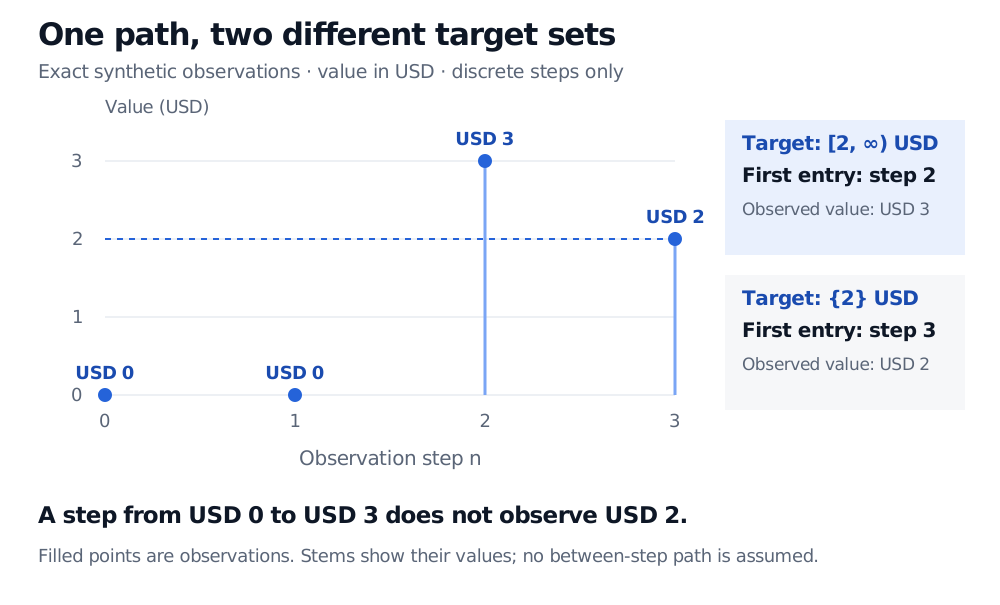
For the singleton target A={2}, the hitting time is step 3. For B=[2,∞), it is step 2. The process enters the threshold region at USD 3 before it visits exactly USD 2.
A discrete synthetic path has values USD 0, USD 0, USD 3 and USD 2 at steps 0, 1, 2 and 3. It first enters the region at least USD 2 at step 2 but first visits exactly USD 2 at step 3. Only observed points are shown.
Original exact synthetic path. The horizontal dashed line marks USD 2; filled points are observations and vertical stems indicate values. The path between steps is unspecified.
Connecting the points with straight lines would add a continuous interpolation that the observations do not supply. A discretely monitored barrier option checks its trigger on its monitoring dates; continuous monitoring asks a different path question. With jumps, a threshold can be crossed without an exact visit to the boundary even under continuous monitoring.
The term first-passage time is often used for a threshold-reaching time, and sometimes synonymously with hitting time. The defining set and inequality settle the meaning more reliably than the name.
Does the initial visit count?
Our definition includes n=0. If X0∈A, then HA=0: the target has already been reached. On the displayed path, H{0}=0.
A first positive visit uses a different clock:
HA+=inf{n≥1:Xn∈A}.
When starting in the target, this is a return time convention. In the example, H{0}+=1, because the gain is still zero at step 1. A positive-time return does not require having left the set first. A rule that waits for departure and then re-entry is another definition.
A deadline also changes what is recorded. Restricting the search to steps 0 through 3 gives no visit to {1} and hence an infinite hitting time on that finite domain. It does not establish what an extended process would do later. Capping a hitting time at a deadline produces a finite capped time even on paths that never hit; the deadline must not be reported as a successful hit.
When is it a stopping time?
A hitting rule should be recognisable from information already observed. If Xn is adapted to a filtration(Fn), meaning its value is known by step n, then the discrete-time hit of a fixed measurable set is a stopping time. Indeed,
{HA≤n}=k=0⋃n{Xk∈A}∈Fn.
The event says “at least one visit has occurred so far.” It uses no future observations. This argument needs neither independence nor the Markov property.
In continuous time, the analogous definition is HA=inf{t≥0:Xt∈A}. Process and set regularity matter: for a real-valued continuous adapted process and a closed set A, this is a stopping time. More general cases require appropriate measurability and filtration assumptions; the informal phrase “first hit” alone is insufficient. Obłój’s notes, §2.1 distinguish these cases.
An infimum also need not be an attained visit when the target is open. For the deterministic continuous path Xt=t and A=(1,∞), the infimum is 1, although X1∈/A. Closed targets and continuous paths avoid this particular boundary problem.
Where the hit occurs, and how long it takes
For a separate exact toy model, let a simple random walk start at USD 0. Each step independently changes the gain by USD 1 or minus USD 1 with equal probability. Stop at the target set A={−1,2}, with values in USD. There are two transient states, 0 and 1.
Let hi be the probability of hitting 2 before minus 1 when starting from i. Conditioning on the next step gives
h0=21h1,h1=21+21h0,h0=31.
Let mi=Ei[HA], measured in steps. The corresponding waiting-time equations are
m0=1+21m1,m1=1+21m0,m0=m1=2.
The extra 1 counts the step just taken. Starting on either boundary gives zero waiting time. From either transient state, the probability of surviving another two steps is 1/4, so eventual stopping and a finite mean are justified in this model. Thus the upper boundary is reached first with probability 1/3, while the mean time to reach either boundary is 2 steps. The latter is not the mean time conditional on reaching the upper boundary.
In other processes, a target may have a positive probability of never being reached; even almost-sure eventual hitting need not give a finite mean. Those are properties of the process and target, not consequences of the definition. Likewise, a valid stopping time does not by itself establish profitability or justify an optional stopping theorem calculation.
For the broader two-boundary calculation, Gambler’s Ruin and First Passage Times develops the first-step equations for exit probabilities and duration. Its public page is a preview; the full lesson requires membership.
Gregory F. Lawler, Stochastic Calculus: An Introduction with Applications, revised February 15, 2023, §1.3, especially Example 1.3.3, and §2.7 — stopping-time information and why almost-sure hitting does not ensure a finite mean. The four-observation path and figure are original; the two-boundary calculation uses the standard fair-walk model.