A simple random walk takes independent nearest-neighbour steps. Count the upward moves to obtain exact endpoint probabilities, and use parity to catch impossible outcomes.
Simple random walk
A one-dimensional simple random walk moves between neighbouring points of a lattice by taking independent steps of one unit up or one unit down. Starting from zero, its position after n steps is
S0=0,Sn=i=1∑nXi,P(Xi=1)=p,P(Xi=−1)=1−p.
The increments have the same probability law at every step. Here, simple describes the nearest-neighbour geometry; symmetric means p=1/2. A simple walk can therefore be biased. This terminology follows Grimmett and Stirzaker's treatment and Aldridge's university notes. A general random walk may use other step sizes or distributions.
For a quant, the useful trick is to turn a question about the terminal position into a count of upward moves. The resulting exact probabilities are a quick check on a small simulation or lattice calculation. The count also exposes positions a model cannot reach, however plausible they look on a smooth chart.
Count the ups, then recover the position
Let Kn be the number of upward steps. There are n−Kn downward steps, so
The binomial coefficient counts ordered paths, not different terminal positions. Changing the order of the same number of ups and downs changes the journey while preserving the endpoint.
Four trades of USD 1 up or down
Consider a hypothetical cumulative trading P&L that starts at USD 0. Each of four trades independently adds USD 1 or subtracts USD 1, each with probability 1/2. There are no costs, position changes or early stopping. This is a specified toy payoff law, not an estimate of a strategy's performance.
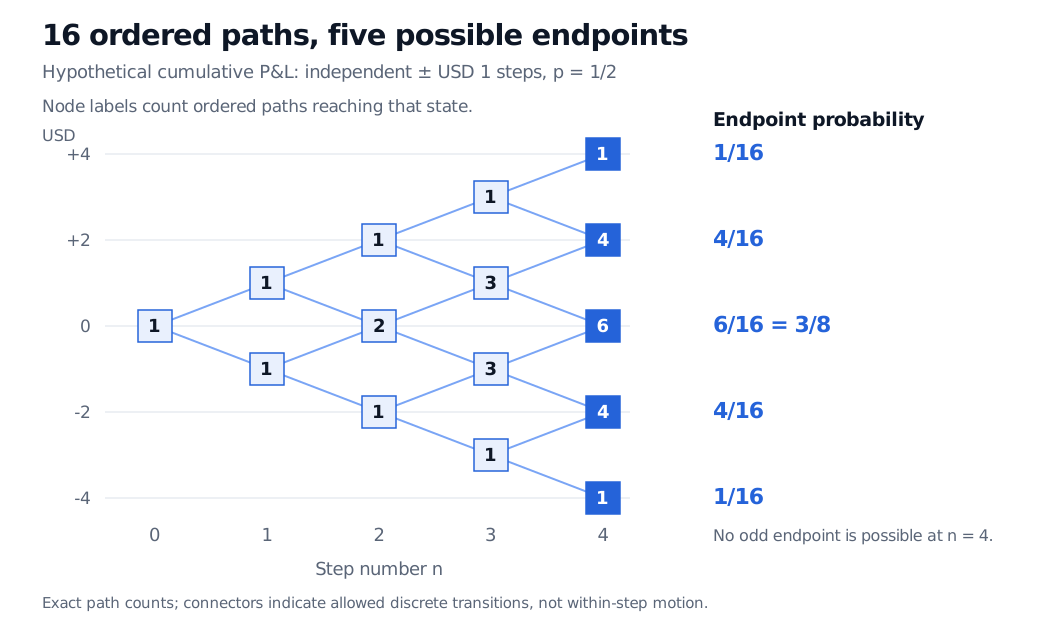
There are 24=16 ordered sequences, each with probability 1/16. Grouping them by the number of wins gives:
Upward steps k
Terminal P&L (USD)
Number of paths
Probability
0
−4
1
1/16
1
−2
4
4/16
2
0
6
6/16
3
+2
4
4/16
4
+4
1
1/16
Recombining lattice for four independent fair plus-or-minus-one USD steps from zero. Node labels count ordered paths; endpoints minus4, minus2, zero, plus2 and plus4 have counts1,4,6,4 and1 out of16.
Original hypothetical P&L model. Node labels count paths; final probabilities divide those counts by 16. The connectors show allowed discrete transitions.
The central node is reached by six sequences containing two ups and two downs, giving
P(S4=0)=16(24)=166=83.
This is the probability of being at zero at step four. It is not the probability of a first return at that step: the sequence up, down, up, down already visits zero at step two. An endpoint distribution discards that timing information.
The expected value is USD 0. The variance is 4 USD2, so the standard deviation is USD 2. A flat mean does not describe a flat realised path, and it supplies no guarantee about trading profits.
Parity is a model constraint
Because Sn=2Kn−n, the endpoint and the step count have the same parity. Four steps can end only at even integers; an odd number of steps cannot return this walk to zero. An output assigning positive probability to USD 1 after four of these trades has violated the model, rather than uncovered a rare event.
This restriction depends on the starting value and the unit convention. From a nonzero starting point, it applies to the displacement from that point. If a model permits a zero move, different step sizes or a boundary rule, rederive the support before reusing the binomial formula.
To develop the underlying step construction, Simple Random Walks — Symmetric and Asymmetric gives the moment calculations and the Markov property. The full lesson requires membership; the public page offers a preview.
Sources
Geoffrey Grimmett and David Stirzaker, Probability and Random Processes, 3rd edition, Oxford University Press, 2001, §3.9, pp. 71–72: the independent unit-step construction, symmetric convention and unconstrained walk.