A symmetric random walk is a random walk whose independent, identically distributed increments have the same distribution after their signs are reversed. Starting from zero, the entire path and its mirror image therefore have the same probability law. The familiar case takes equal-sized upward and downward steps, each with probability .
For a quant, symmetry provides a useful benchmark: gains and losses of the same magnitude receive equal probability under the model. It does not promise that a realised profit-and-loss path will look balanced, or that it will finish where it started.
Flip every sign
Write the equal-step model as
where and the steps are independent. Replacing every by leaves their joint distribution unchanged. It follows that
Here means equality in distribution, not equality of the two realised sequences. In particular, for every attainable endpoint ,
If the walk starts at a fixed instead, reflect its displacement about : the endpoint probabilities at and agree.
Terminology separates two choices. In the usual one-dimensional convention, a simple random walk uses nearest-neighbour unit steps; symmetric specifies their equal probabilities. A walk with steps becomes a unit-step walk when position is measured in units of . More general symmetric increment distributions need not have only two possible values.
Four fair half-dollar results
Consider a hypothetical gross P&L that starts at USD 0 and changes by USD 0.50 or USD −0.50, independently and equally likely, on each of four trades. There are no fees, position limits or early stopping rules. This is a stipulated model, not evidence about market returns.
The ordered sequence ends at USD 1. Its reflected sequence ends at USD −1. Each has probability . Neither sequence contains equal numbers of wins and losses; symmetry pairs their probabilities across the collection of possible histories.
Grouping all 16 histories gives:
| Gross result after four trades | Probability |
|---|---|
| USD −2 | |
| USD −1 | |
| USD 0 | |
| USD 1 | |
| USD 2 |
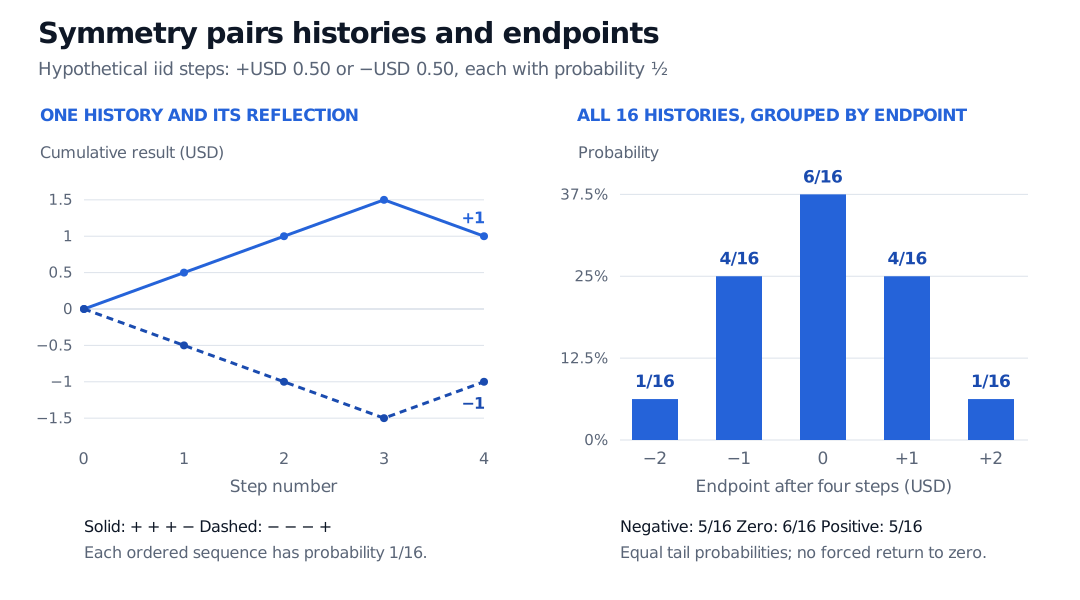
Original hypothetical model. Left: two ordered histories with filled observation markers; connectors guide the eye. Right: the exact endpoint law, not a simulated histogram.
Both a positive result and a negative result have probability . Returning to zero has probability , not certainty. After an odd number of these equal-sized steps, ending at zero is impossible: an odd count of signs cannot contain equal numbers of pluses and minuses.
More generally, if counts upward steps, then has a binomial distribution with parameters and , and . Hence
A flat mean still allows growing risk
For the equal-step model,
The four-trade example therefore has mean USD 0, variance and standard deviation USD 1. Opposite results cancel in the mean; their squared magnitudes accumulate in the variance.
Independence also makes the next increment's conditional mean zero. Thus this walk is a martingale with respect to its own observed history. The proof is developed in SelfMadeQuant's Discrete-Time Martingales, under “Symmetric random walk”; the full lesson requires membership and the linked page provides a public preview.
Zero mean alone is weaker than symmetry. A step of with probability and with probability has mean zero, but its law changes when every sign is reversed. Conversely, the broad definition of symmetry does not guarantee a finite mean or variance; the moment formulas above rely on the bounded increments. When using the model for financial risk, specify both the step distribution and its scale before drawing conclusions from the word symmetric.
Sources
- Geoffrey Grimmett and David Stirzaker, Probability and Random Processes, 3rd edition, Oxford University Press, 2001, §3.9, pp. 71–73: independent increments, simple-walk conventions and the symmetric case.
- Matthew Aldridge, MATH2750, Section 2: Random walk, §§2.1–2.3: iid construction, step moments and exact endpoint probabilities.