The first time a process enters a target set. Compare crossing with touching, compute a two-barrier exit probability and waiting time, and handle monitoring deadlines.
First-passage time
A first-passage time is the earliest time a stochastic process enters a specified target set, such as the region at or above a price barrier. It turns “will the price breach this level?” into a random time, which can determine a barrier option's activation, a risk limit's trigger or default in a structural credit model.
The target, observation schedule and treatment of equality belong in the definition. Without them, “time to the barrier” is incomplete.
Write the trigger before calculating its time
For a discrete-time process X0,X1,… and measurable target set A, define
τA=inf{n≥0:Xn∈A},inf∅=∞.
Thus τA=0 if the process starts inside A, and τA=∞ if it never enters. A first return convention instead searches over n≥1. These conventions answer different questions when the initial state is already in the target.
For an upper barrier b, an inclusive passage rule is
τb+=inf{n≥0:Xn≥b}.
This is a hitting time of the set [b,∞). Terminology varies: some authors reserve “hitting” for reaching the exact level b. Always check the set or inequality. A strict rule Xn>b excludes equality; a touch rule Xn≥b includes it.
If Xn is observed using the information in a filtration, then this first passage is a stopping time: whether τA≤n can be decided from the observations through step n. There is no need to inspect future prices.
A jump can pass the level without landing on it
Consider four synthetic observations:
Step n
0
1
2
3
Level Xn
0
0
3
2
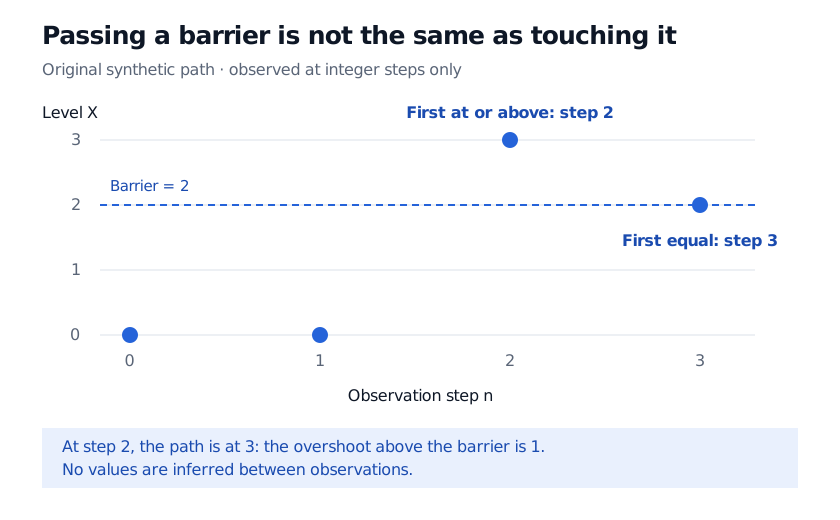
For barrier b=2, the first observation at or above the barrier is at step 2. The first observation equal to the barrier is at step 3. At passage, the overshoot is Xτb+−b=3−2=1.
Integer observations are 0, 0, 3 and 2 at steps 0 through 3. The first observation at or above barrier 2 is step 2 at level 3; the first observation equal to 2 is step 3.
Original synthetic discrete path. Filled dots are the observed states; no path is inferred between them. Crossing the inclusive upper barrier occurs one observation before an exact-level hit.
For a continuously observed continuous path starting below b, first entry into b,∞), when finite, occurs at b: continuity prevents an overshoot. With jumps, or with prices recorded only on a grid, that reasoning fails. Even an underlying continuous price can cross and return between two monitoring dates. A daily observation rule and a continuously monitored [barrier option therefore need different passage events.
A trigger also does not specify the eventual execution price. A stop rule needs an execution model to translate its passage time into realised trading proceeds.
Which barrier first, and how long to wait?
Take an exact synthetic fair random walk: X0=0, with independent increments of +1 or −1, each with probability 1/2. Stop at either −1 or 2:
τ=inf{n≥0:Xn∈{−1,2}}.
There are two interior states, 0 and 1. Let hx be the probability of exiting at 2, and mx the expected number of steps to exit, starting at x. Conditioning on the next move gives
The missing terms are the boundary conditions: the lower boundary has upper-exit probability zero, the upper boundary has probability one, and either boundary has zero remaining waiting time. Solving yields
P0(Xτ=2)=31,P0(Xτ=−1)=32,E0[τ]=2 steps.
The upper target is farther away, so its eventual probability is smaller. The mean waiting time is two steps, even though some paths last arbitrarily long. In fact, the only way to remain inside after two moves is 0→1→0, with probability 1/4. Each such cycle restarts the same problem; survival after 2k steps has probability (1/4)k, which tends to zero. Exit is therefore almost sure, rather than guaranteed by a fixed deadline.
The stopped walk stays in −1,2]. Applying bounded-time optional stopping at τ∧n, then taking a dominated limit, gives E[Xτ]=0: indeed 2(1/3)−1(2/3)=0. This use of the [optional stopping theorem is justified by bounded stopped values and almost-sure exit. An arbitrary unbounded passage rule does not inherit that guarantee.
For the general two-barrier calculation, Gambler's Ruin and First Passage Times develops the probability and duration recursions. Its public preview is open; the full lesson requires membership.
A deadline changes what you report
For a fixed monitoring horizon N, P(τ≤N) is the probability of passage by the deadline. Failure to observe passage by N means τ>N, not necessarily τ=∞. If you replace the rule by τ∧N, you have capped the waiting time; the paths ending at N include both triggered and untriggered cases, so keep a separate trigger indicator.
Likewise, distinguish eventual passage probability, the distribution of passage time and its expectation. Eventual passage with probability one does not, by itself, imply a finite expected waiting time.
Sources
Richard Durrett, Essentials of Stochastic Processes, 3rd ed., Springer, 2016, §§1.9–1.10. The author's Version 3.9 notes, May 2021 also develop exit probabilities and expected exit times.
James Norris, Advanced Probability, §§2.2 and 7.6: stopping times, optional stopping and continuous Brownian passage.