A government bond is a debt security issued by a national government to borrow money against promised future payments. It is also called a sovereign bond. Governments use borrowing to finance expenditure and refinance debt; investors use the securities for income, liquidity, liability matching and interest-rate exposure. For a quant, the issuer's name is only the beginning: currency, payment rules and remaining maturity determine which cash flows and risks are being valued.
Here, “government” means the national government. Debt issued by states, provinces or municipalities belongs to a separate subsovereign category. A government-owned company's bond is also a different legal claim from a direct obligation of the government.
Read the payment promise before the label
A government bond can have different payment structures. The distinctions below describe separate features: an inflation-indexed bond still has a maturity, and a nominal bond need not have a fixed coupon.
| Feature | What to establish |
|---|---|
| Nominal fixed-coupon debt | Scheduled coupons and principal are specified in money amounts. Their purchasing power is not fixed. |
| Inflation-indexed debt | Principal, coupons or both follow a stated inflation-index formula. The index, adjustment timing and any repayment floor are contractual details. |
| Floating-rate debt | The coupon resets under a reference-rate rule rather than remaining fixed for the whole term. |
| Maturity | The date principal falls due, and the time remaining from today's valuation date. Original issue maturity and remaining maturity are different. |
| Currency | The currency of the government's payment obligation, which may differ from the investor's spending currency. |
Country-specific names can be narrower than this general term. In the United States, newly issued Treasury notes have terms of 2, 3, 5, 7 or 10 years, while Treasury bonds are issued for 20 or 30 years; both pay fixed interest every six months. A bond originally issued for 30 years can later have only two years left. These are U.S. Treasury conventions, not a universal maturity definition for government bonds.
U.S. Treasury Inflation-Protected Securities illustrate the indexed case: their coupon rate stays fixed, but it applies to inflation-adjusted principal, so the coupon amount varies. At maturity, Treasury pays the greater of adjusted principal and original principal. That floor concerns the original principal, not every investor's purchase price.
A government promise still needs a price
Consider a synthetic nominal government bond with face value of 100 currency units, a 3% annual coupon rate and two years remaining. For this illustration only, it pays annually. Assume full payment, no embedded option and zero accrued interest, tax or trading cost.
It pays 3 in one year and 103 in two years. At a 4% annual effective yield to maturity, its value per 100 face value is
The coupon rate is below the required yield, so the price is below face value. The government owes the contracted principal at maturity; it does not promise that a secondary-market buyer will pay or later receive a sale price of 100. A sale transfers the remaining claim between investors rather than providing new funding to the issuer.
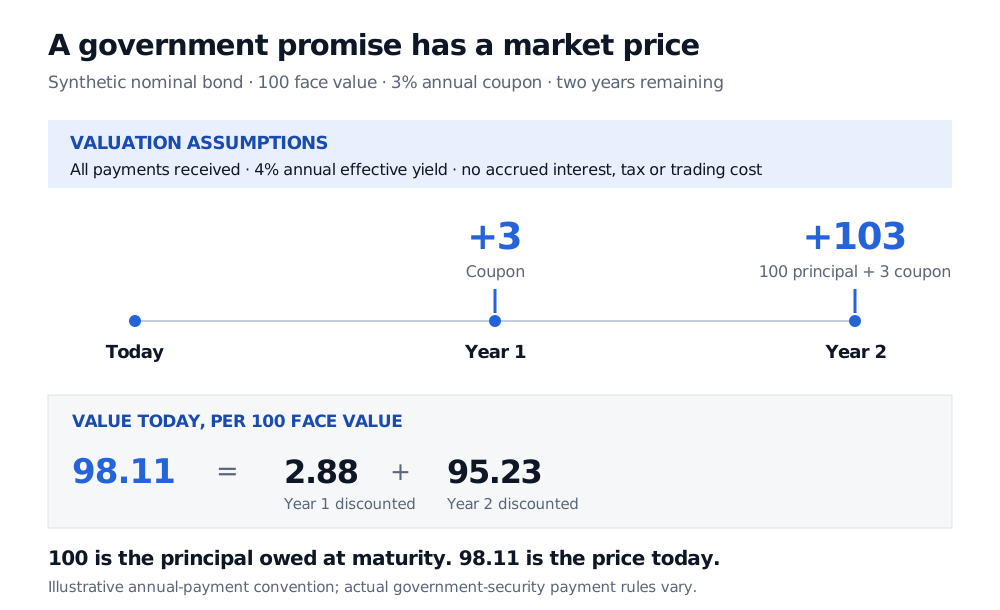
Original synthetic example: all promised payments are received, with annual coupon dates and an annual effective yield. Amounts are currency units per 100 face value; present values are rounded to two decimals. These are teaching conventions, not an actual Treasury quote.
A single yield summarises this bond's price. Curve valuation instead applies date-specific discount factors to its payments. SelfMadeQuant's Bonds and Yields lesson develops the coupon, price and yield distinction and introduces that curve approach. Its public page is a preview; the full lesson requires membership.
What “government” does not guarantee
Low expected default risk does not mean a stable market value. A rise in required yields reduces the value of unchanged positive fixed payments. A longer payment horizon usually increases price sensitivity, other things equal; duration measures that sensitivity under specified yield-change assumptions. Holding a bond to maturity avoids having to realise an interim sale price, but it does not remove the other risks below.
- Credit risk: governments can miss payments or restructure debt. Ability and willingness to pay, debt currency and legal terms matter. The IMF's sovereign-debt explainer describes repayment difficulties and negotiated restructurings. “Sovereign” is an issuer category, not a universal exemption from credit risk.
- Inflation risk: full repayment of a nominal amount can buy fewer goods. Indexed debt addresses its specified price index; it does not guarantee every investor's personal purchasing power or an unchanged resale value.
- Currency risk: a bond paid in a foreign currency can lose value in the investor's home currency even if every promised payment arrives. This investor exposure is distinct from the issuer's difficulty funding debt denominated in a currency it does not issue.
- Liquidity risk: the cost and ease of selling differ across sovereigns and individual issues. A government label alone does not guarantee a ready buyer at a tight spread.
High-quality government securities often serve as inputs to a yield curve and as benchmarks for other borrowing costs. The RBA's bond and yield-curve explainer describes that role. Using a government yield as a risk-free-rate proxy still requires a stated currency, horizon and valuation purpose; there is no single sovereign yield that fits every cash flow.
Sources
- Frank J. Fabozzi, Bond Markets, Analysis, and Strategies, 9th ed., Pearson, 2016, Chapter 9, pp. 191–192 and 200–201: sovereign versus subsovereign issuers, government-bond structures and local- versus foreign-currency credit assessment. Read from the local textbook.
- U.S. Treasury, Treasury Notes and Treasury Bonds: issue terms and semiannual fixed-interest payments.
- U.S. Treasury, Treasury Inflation-Protected Securities: adjusted principal, varying coupon amounts and the original-principal floor at maturity.
- IMF, What Is Sovereign Debt?, December 2022: government financing, currency choice and sovereign repayment difficulties.
- Reserve Bank of Australia, Bonds and the Yield Curve: government borrowing, secondary trading, price–yield direction and benchmark yield curves.