One important form combines existing instruments to create a different exposure. A structured product, for example, can combine debt with options. But the field also includes building valuation software, choosing hedges and designing financing arrangements. A complicated formula is useful only if its inputs, cash flows and trading assumptions fit the problem.
Start with the promise
Imagine a dealer is asked to deliver the upside of one share above USD 100 at a future date, without requiring the client to buy the share. Write the promise before choosing a model:
Now adopt a deliberately small model. The stock costs USD 100 today and can finish only at USD 120 or USD 80, with both outcomes possible. Borrowing and lending earn zero interest over the period. There are no dividends, fees or trading restrictions, and fractional shares are allowed. All obligations are honoured.
The promised payments are USD 20 and zero. Can traded assets deliver them?
Build it, then fund it
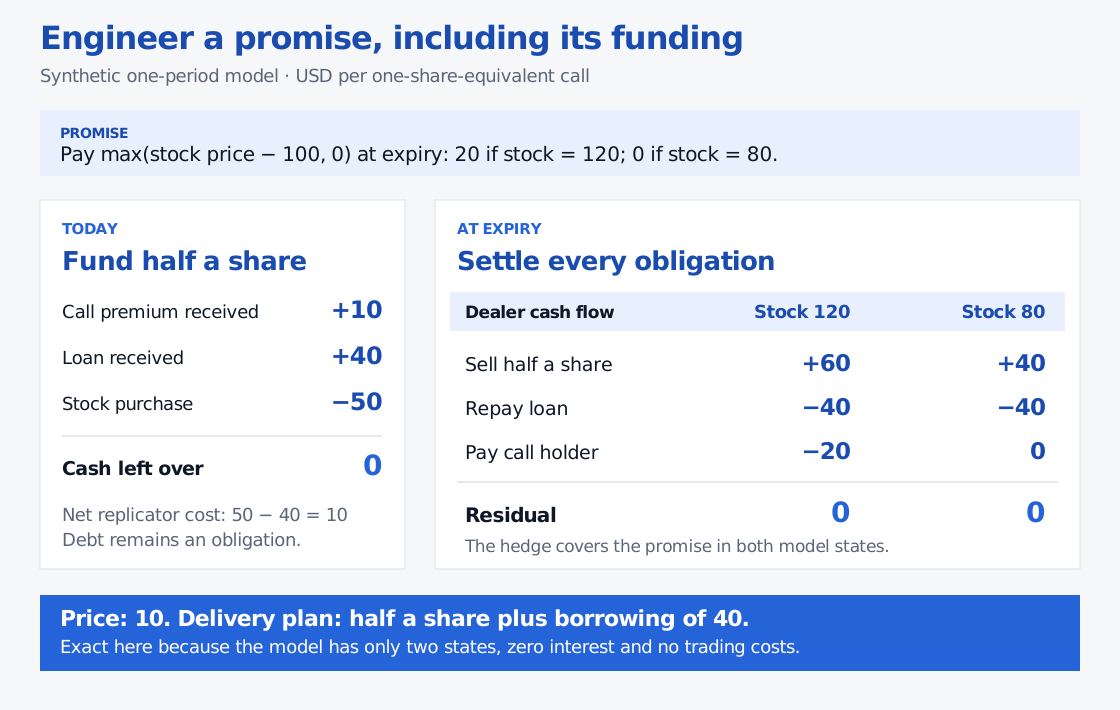
From the dealer's side, the USD 10 premium plus the loan funds the share purchase. Selling the shares at expiry funds both the loan repayment and the client's payment. The zero residual shows that the liability is covered in either model state. The premium is not free profit, and borrowing does not eliminate a funding obligation.
The engineering continues after the price
The example joins three outputs: a contract, a valuation and a financed delivery plan. In practice, each needs its own checks:
- Contract design: do the payment dates, exercise rights and settlement rules express the client's objective? Similar-looking payoff charts can conceal different obligations.
- Model and calculation: are the market inputs appropriate, and does the implementation reproduce known cases? Model risk includes using an unsuitable model as well as calculating with one incorrectly.
- Execution and funding: can the required trades actually be completed, and can cash be supplied when due? Transaction costs and funding liquidity risk affect whether a theoretical construction is workable.
- Ongoing risk management: what happens when prices move outside the assumed scenarios? A multi-period hedge generally requires rebalancing; delta hedging with real trading intervals can leave hedging error.
The half-share strategy is exact only for the stated two-state model. It is a compact demonstration of financial engineering: specify a promise, construct the exposure, account for its financing, and test what would prevent delivery. A desk's executable quote must also reflect the actual contract and the costs and risks of carrying it.
Sources
- Columbia University IEOR, What is Financial Engineering?: the discipline's combination of finance, engineering methods, mathematics and programming.
- Cornell University ORIE, Financial Engineering: combining existing financial instruments to construct products.
- John C. Hull, Options, Futures, and Other Derivatives, 9th Global Edition, Pearson 2018, §§13.1–13.2 and §19.4: binomial replication, risk-neutral valuation and dynamic delta hedging.
- Clare Wallace, Mathematical Finance Lecture Notes 2024–25, Chapter 3, §§3.2 and 3.4: self-financing portfolios and equality of replication cost and claim price.