The expiry date ends an option’s exercise rights. Separate it from last trading, exercise instructions, the settlement fixing and the date cash or assets arrive.
Expiry date
An expiry date, also called an expiration date, is the contractual date on which an option’s exercise rights end, subject to its specified expiry time and procedures. It sets the end of the right you bought or wrote. It does not by itself tell you the last chance to trade the contract, the price used to calculate its payoff, or when the resulting money or assets will arrive.
That distinction matters in a hedge: an option can have stopped trading while its final payoff is still uncertain. Once it expires, an exercise or settlement obligation already created under the contract can remain outstanding.
Read the clocks separately
Contract field
What it tells you
Last trading date and time
The final opportunity to close or change the option position by trading that contract.
Exercise or instruction deadline
When a required exercise instruction or contrary instruction must reach the relevant intermediary. Customer and clearing deadlines can differ.
Expiry date and time
When the option’s exercise rights end under its terms.
Settlement fixing
The observation or calculation that determines the contract’s final reference value. This may be an opening value, closing value or average.
Settlement date
When the cash payment or asset delivery resulting from exercise or final settlement is due.
Several fields can fall on the same day without describing the same event. Record the time zone alongside each time, and use the product’s holiday calendar and adjustment rules. Your computer’s local date is not a substitute for the contract’s date and time.
European exercise restricts exercise to the specified expiry exercise window; American exercise allows exercise on permitted earlier dates as well. Neither label tells you the last trading time or settlement method. Selling an option to close a position is a trade; it is different from exercising the contractual right.
The Options lesson in the Finance Primer develops these exercise styles alongside call and put payoffs. Its preview is public; the full lesson requires a free signed-in account.
A Friday expiry, with money arriving later
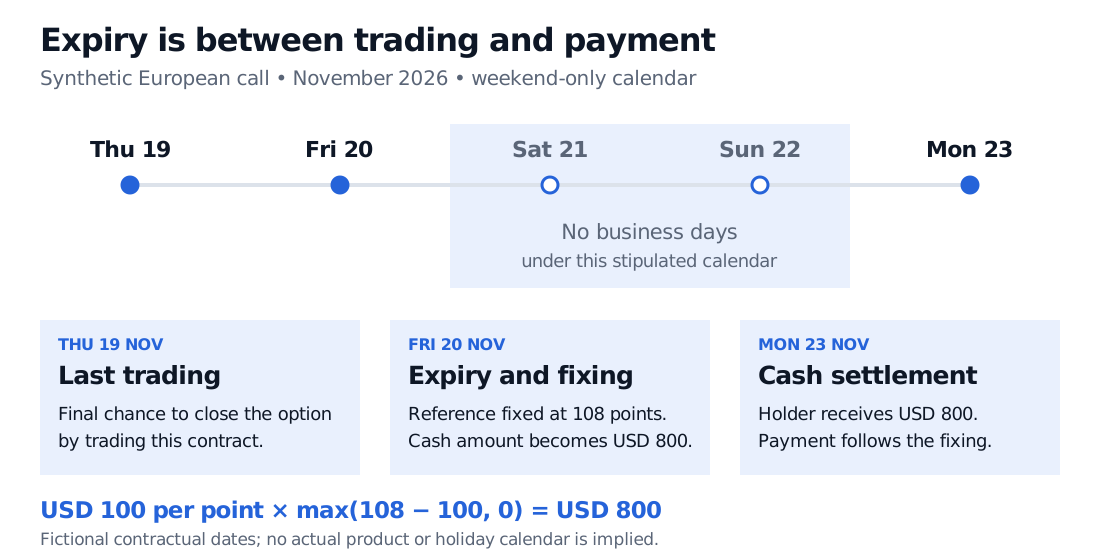
Consider one fictional European cash-settled call. Its terms stipulate a strike of 100 index points, a multiplier of USD 100 per point and automatic payment of its positive expiry payoff. The schedule is deliberately synthetic; it is not a specification for any exchange product.
Stipulated event
Date and outcome
Last trading day
Thursday 19 November 2026
Expiry and designated settlement fixing
Friday 20 November 2026; fixing of 108 index points
Cash settlement
Monday 23 November 2026
For this teaching contract, business days exclude only Saturday and Sunday, with no holidays. Monday is one business day after Friday, although three calendar days pass. Actual products can use different calendars and payment lags.
The strike price and fixing determine the amount; the multiplier converts points into dollars. The holder receives USD 800 on Monday, and the writer pays it. The earlier premium, funding, fees and tax are outside this payoff calculation, so USD 800 is not a profit figure.
Synthetic timeline: last trading Thursday 19 November 2026, expiry fixing Friday 20 November at 108 points, cash settlement Monday 23 November pays USD 800. Saturday 21 and Sunday 22 are excluded by the stipulated weekend-only calendar.
Original synthetic timeline for one European call, strike 100 index points and multiplier USD 100 per point. The fixing determines the USD 800 payment before the money moves. The dates and weekend-only calendar are fictional contractual teaching conventions, not an actual exchange schedule.
After Thursday’s trading cutoff, this option still has exposure to Friday’s fixing. After Friday’s fixing, the payoff amount is determined, but the cash has not yet arrived. Expiry has ended the option right; it has not cancelled the payment due.
This example stipulates automatic payment rather than a discretionary customer exercise instruction. In a real contract, identify any relevant instruction deadline separately instead of inferring it from the payment date.
Product rules beat a remembered weekday
Expiry is not universally “the third Friday.” OCC’s current equity-option specifications state third-Friday expiry for monthly equity options; that is a particular convention, not a rule for all derivatives. The exact series and holiday treatment still need checking. OCC equity specifications.
Cboe’s current SPX specifications give a useful contrast: trading in standard SPX options ordinarily stops on the business day preceding the expiry settlement calculation, whereas SPXW ordinarily stops trading on its expiration day. Those are distinct series conventions even within the same index family. Cboe SPX specifications.
A broker’s customer deadline is another field. OIC explains that brokerage firms can impose earlier exercise cutoffs to meet exchange deadlines, and that exercise-by-exception procedures between OCC and clearing members do not replace the customer’s need to understand their broker’s procedures. There is no single broker deadline to assume for every option. OIC options-exercise FAQ.
Which date belongs in a pricing model?
A model’s remaining time to expiry should correspond to the contract’s relevant payoff or exercise horizon, with a stated time convention. Do not extend an option’s price exposure merely because its payment is delayed. If fixing and payment occur at different times, the valuation must account for that payment timing too; writing a single terminal-payoff formula does not make the delay disappear.
For an option on a futures contract, also distinguish the option’s expiry from the underlying future’s maturity or delivery schedule. The two contracts need their own dates. A contract month, a date-only display and a number labelled “days to expiry” each omit information needed to reconstruct the full operational schedule.
Sources
John C. Hull, Options, Futures, and Other Derivatives, 9th Global Edition, Pearson, 2018, Chapter 10, §10.1, p. 235: expiration terminology and exercise styles. The local edition was checked; current exchange and clearing sources govern market-calendar conventions.