The cost of debt is the current market rate at which a company can raise comparable borrowed funds. In a weighted average cost of capital (WACC) calculation, the debt component reflects the return lenders require and the cash tax savings the borrower can use. When default risk is low, today's borrowing rate often gives a reasonable estimate of the pre-tax required return. Damodaran, The D in the DCF, slide 99
What would the next loan cost?
An existing fixed-rate bond's coupon rate sets the interest payments on that contract. A ratio of reported interest expense to book debt reflects the financing already on the books. Both can stay low even as higher benchmark rates or deteriorating credit make new debt more expensive. Damodaran, The D in the DCF, slide 99
Start with a current quote for the financing the company needs, or use the yield to maturity (YTM) of a liquid, option-free bond with comparable currency, maturity and repayment priority. A secured bond can price differently from unsecured debt issued by the same company. If a comparable bond is unavailable, one estimate adds a credit spread from similar borrowers and debt terms to a benchmark rate in the relevant currency and maturity. For valuation, use the forecast currency and a compounding convention consistent with the discounting periods. Damodaran, Estimating the Cost of Debt, slide 192
For a specific offer, calculate the annualised internal rate of return from the net cash the company receives and the dated payments it owes. An upfront fee reduces the cash received today, so the same scheduled payments imply a higher all-in borrowing rate. The SelfMadeQuant Finance Primer works through the same price-to-payment relationship using a bond that trades below face value. World Bank, Roadmap to International Bond Issuance, slides 6 and 17 · Bonds and Yields, full lesson for members
From 6% before tax to 4.5% after tax
A fictional company can borrow USD 1 million at 6% for one year, with no fees and all interest and principal due at year-end. Its interest bill is USD 60,000. Suppose it can use the entire interest deduction as it arises at a 25% marginal corporate tax rate. Its cash tax bill falls by USD 15,000, so the net financing cost is USD 45,000 over the year.
With a contemporaneous interest tax shield proportional to interest, the usual rate adjustment is
Here is the pre-tax interest rate and is the cash tax saving per dollar of incremental interest. The lender still receives USD 60,000 of interest. A deduction limit or insufficient taxable income can shrink the current saving. If the company can use a deduction only later, an adjusted present value model can value that saving on the date it is expected to reduce cash taxes. Graham, How Big Are the Tax Benefits of Debt?, §I.A
When the promised yield runs ahead of expected return
YTM discounts promised cash flows. Consider a fictional one-year zero-coupon bond priced at USD 80 that promises USD 100 at maturity. Its annual YTM is . Suppose the estimated real-world default probability is 20%, with USD 40 of recovery at year-end in default. Ignoring taxes and trading costs for the investor, the expected payment is USD 88 and the expected one-year return is . Damodaran, Dealing with Distress in Valuation, “Estimating Discount Rates”
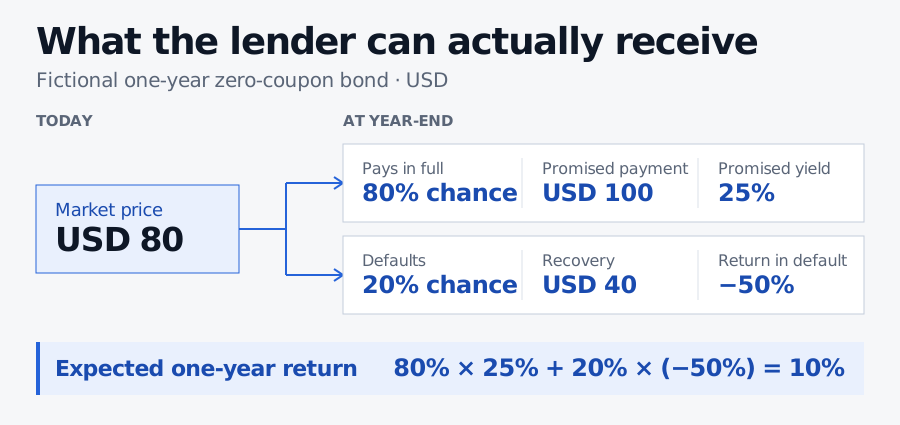
Weight the returns in both repayment states to get the lender's expected return.
For WACC, estimate the required return on the debt the company expects to carry, with default and recovery assumptions consistent with the valuation. For a funding decision, check which terms the company can actually obtain. A distressed bond can trade even when the issuer has lost access to new credit. Damodaran, Dealing with Distress in Valuation, “Estimating Discount Rates”
Sources
- Aswath Damodaran (NYU Stern), The D in the DCF, slide 99
- Aswath Damodaran (NYU Stern), Corporate Finance, “Estimating the Cost of Debt”
- Aswath Damodaran (NYU Stern), Dealing with Distress in Valuation
- John R. Graham (2000), How Big Are the Tax Benefits of Debt?
- Patrick van der Wansem (World Bank, 2020), Roadmap to International Bond Issuance