A certificate of deposit (CD) is an interest-bearing deposit with a specified term. A bank owes the principal at the maturity date and pays interest on the schedule set out in the contract. A fixed-rate CD gives the depositor a known interest rate for the term and gives the bank funding with a scheduled repayment date. That date matters when you are matching cash receipts to future payments. CFPB guide to CDs
A six-month rate quote in dollars
Suppose a fictional CD takes USD 10,000 for six months at a 4% annual simple interest rate. Treat six months as exactly half a year. Assume the bank pays all interest at maturity, the depositor holds to maturity, and there are no fees or taxes. The interest is
At maturity the bank pays USD 10,200, so the holding-period return is 2%. Annual percentage yield (APY) expresses interest over the term as an effective annual rate and reflects any compounding in the account. Under the toy half-year convention, the 2% term return annualises to . That calculation assumes the same growth factor for a second half-year. The CD pays only for its own term, and renewal terms can differ. For U.S. consumer disclosures, Regulation DD specifies a day-based APY calculation and generally assumes principal and interest stay on deposit for the term, with an exception for required interest withdrawals. CFPB Regulation DD, Appendix A
Who pays if you leave early?
For a conventional retail CD bought directly from a bank, the contract determines whether the bank permits early withdrawal and what penalty applies. A brokered CD is distributed through an intermediary. A holder who needs cash early typically tries to sell it to another investor on the secondary market. The buyer takes over the claim on the issuing bank and pays the seller the market price. If comparable rates rise, buyers generally offer less for the existing fixed-rate CD. There may be a selling fee or no available buyer. Some brokered CDs are callable, which lets the issuer redeem early under the contract. SEC investor bulletin on brokered CDs
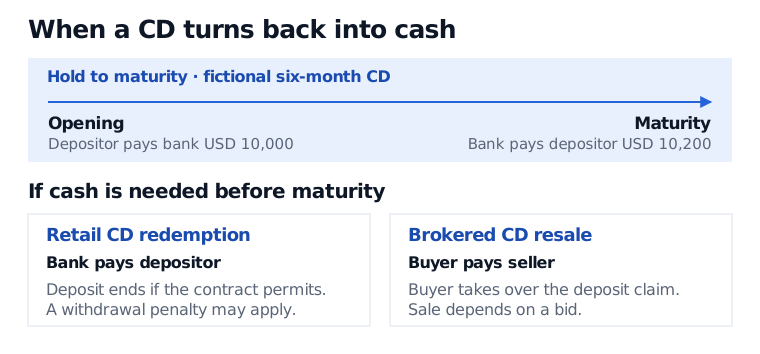
The fictional maturity payment follows the deposit terms. An early exit depends on who provides the cash and on what terms.
Negotiable describes the ability to transfer ownership. Banks issue short-term negotiable CDs for wholesale funding in the money market. The holder can sell if there is a buyer, leaving the deposit outstanding at the bank. Brokered describes how the CD was distributed. BIS primer on commercial paper and CD markets
What U.S. deposit insurance covers
At an FDIC-insured U.S. bank, eligible deposits in the same ownership category are added together. The standard limit is USD 250,000 per depositor, per insured bank, per ownership category, including principal and accrued interest through the date of bank failure. A brokered CD can qualify for coverage through to the actual owner if the FDIC's ownership and recordkeeping requirements are met. This coverage applies to bank failure. A resale loss caused by a fall in the market price is borne by the seller. OCC guide to FDIC insurance · FDIC pass-through coverage guide
The SelfMadeQuant Money Markets lesson has a worked Treasury bill quote. It shows why a rate calculated on a bill's face value differs from a return on the cash invested. The preview is public and the full lesson requires membership.