The money market is the set of markets where cash is borrowed, lent and invested for short periods, commonly overnight to one year. It helps a company bridge a cash shortfall, a bank manage daily payments and a trading desk finance securities. For a quant, these funding terms can turn an apparently profitable trade into a loss after financing costs.
The one-year boundary is a common market and statistical convention, rather than a universal legal definition. The Bundesbank's explanation uses maturities up to and including one year. Particular reporting frameworks and products have their own scope. The contrasting capital market supplies longer-term finance.
Different claims on the same short horizon
There is no single money-market instrument or interest rate. A borrower can raise cash in several ways:
| Instrument | What the cash provider holds | What needs checking |
|---|---|---|
| Treasury bill | A short-term government debt claim, usually with one payment at maturity | Sovereign issuer, currency, maturity and quotation basis |
| Commercial paper | A short-term corporate or financial-institution debt claim; ordinary unsecured paper has no pledged collateral | Issuer creditworthiness and ability to refinance |
| Certificate of deposit or term deposit | A bank's promise to repay a deposit under specified terms | Bank risk, transferability, withdrawal terms and any applicable deposit protection |
| Repurchase agreement (repo) | Securities bought with an agreement to sell them back; economically, secured cash lending | Counterparty, collateral value, haircut and settlement arrangements |
Some instruments are actively traded; others are bilateral loans or deposits. Many participants seek highly liquid, high-quality claims, but those characteristics are not guaranteed by the label “money market.” A repo can finance a long-dated bond: the short maturity of the funding agreement does not make the underlying bond short-dated.
Start with the cash, then read the yield
Consider a synthetic discount claim bought for USD 99,000, with USD 100,000 payable exactly 90 actual days later at maturity. Assume it pays in full, the investor holds it to maturity, and there are no fees or taxes. This is an illustrative claim, not a market quote or a specific Treasury issue.
The investor's cash ledger is straightforward:
| Date | Investor's cash flow |
|---|---|
| Purchase | −USD 99,000 |
| After 90 actual days | +USD 100,000 |
| Net gain | USD 1,000 |
The holding-period return measures gain relative to cash invested:
To annualise it, stipulate simple interest and an Actual/360 day-count convention: actual elapsed days divided by 360. The resulting simple investment yield is
A bank-discount yield uses the promised face value in its denominator instead:
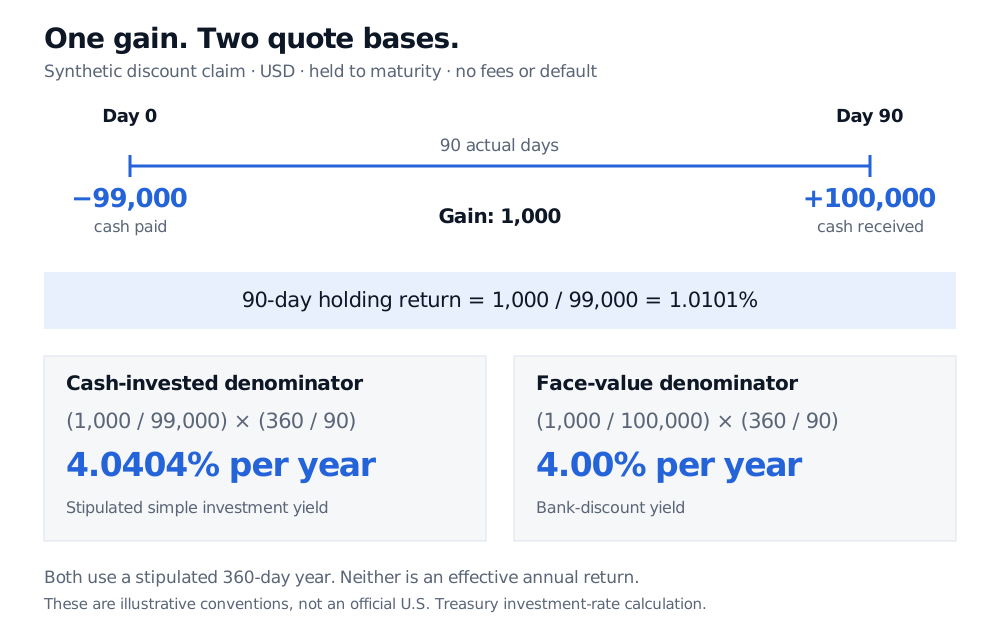
Original synthetic cash ledger. Both annualised quotes use a stipulated 360-day year and the same USD 1,000 gain; their denominators differ. This is not an official U.S. Treasury investment-rate calculation.
The 4.00% quote is not the investor's return on the USD 99,000 outlay. Nor is 4.0404% an effective annual rate: it scales one period's return linearly, without assuming a year's compounding. Reinvesting at maturity would require a new investment at a rate that is not yet known.
The distinction between face-value and cash-invested denominators is developed in Fabozzi and Fabozzi's Bond Markets, Analysis, and Strategies, Chapter 7, “Price Quotes for Treasury Bills.” Actual instrument conventions must still be checked. For example, TreasuryDirect explains its bill price formula using a discount rate and a 360-day year; that does not make every reported Treasury yield an Actual/360 investment yield.
SelfMadeQuant's Money Markets lesson takes the next step from bill quotations to the two cash legs of repo and its financing payment. The public page is a preview; the full lesson requires membership.
Short funding can still become scarce
Short maturity reduces the time until repayment. It does not remove credit risk or ensure that a security can always be sold quickly at a fair price. A lender who needs cash before maturity faces liquidity risk; a borrower repeatedly replacing maturing debt faces rollover risk if lenders refuse the next loan or demand a higher rate.
Collateral helps a repo lender, but falling collateral prices, a counterparty default or failed settlement can still cause losses or delays. A trading desk that funds a long-lived position overnight must therefore assess access to funding as well as its quoted cost. The Federal Reserve's account of the 2007–08 stress explains how withdrawal of short-term funding can spread pressure through financial markets.
The market, a fund and a deposit account
A money-market fund is an investment vehicle that buys short-term assets. It is a participant in the market, not the market itself. Owning fund shares also differs from holding an individual bill until its contractual maturity: the fund has a changing portfolio, expenses and its own redemption terms.
A product called a money-market deposit account is a bank deposit, subject to the relevant jurisdiction's deposit rules. The similar name does not give a mutual fund the same protection. In the United States, the SEC's Investor.gov guide states that money-market funds are not FDIC-guaranteed and can lose value. A target stable share price is not a guarantee. Fund regulation and deposit protection differ across jurisdictions and products.
When evaluating a short-term cash position, identify the claim, the cash dates, the quote convention and who bears a loss. “Money market” alone answers none of those completely.
Sources
- Frank J. Fabozzi and Francesco A. Fabozzi, Bond Markets, Analysis, and Strategies, 10th edition, MIT Press, 2021, Chapter 7, “Price Quotes for Treasury Bills” (local PDF pages 239–241). Grounding for discount quotation versus return on invested cash; all figures and example numbers here are original.
- Deutsche Bundesbank — Money market rates: definition, common maturity boundary and interbank context.
- TreasuryDirect — Understanding Pricing and Interest Rates: U.S. Treasury bill discount-price mechanics.
- Federal Reserve — Money Markets and Financial Stability, 29 May 2008: funding rollover and liquidity stress.
- SEC Investor.gov — Money Market Funds: fund structure, expenses, loss risk and the U.S. FDIC distinction.