A capital market is a market for equity and longer-term debt securities, through which issuers can raise finance and investors can trade claims on future income. Its central instruments are stocks and longer-term bonds. For a quant, the distinction between financing and trading is essential: a busy market in a company's shares does not mean the company receives the value of those trades.
The term describes a part of the financial system, rather than a particular exchange or building. The World Bank's account of long-term finance explains how capital markets mobilise savings for investment by companies and other borrowers.
Follow the cash, then the claim
Imagine a fictional company issuing 1,000,000 new ordinary shares at USD 20 each. Investors collectively pay USD 20,000,000 to acquire the new shares. That is gross finance raised for the company; underwriting charges and other issuance costs would reduce its net proceeds. The example excludes those costs and taxes.
Later, one investor sells 2,000 existing shares at USD 22 each to another investor. The buyer pays USD 44,000 to the seller. The company receives USD 0 from that trade. Its shares outstanding increase in the initial issue, but do not change when the existing shares move between investors.
| Transaction | Cash recipient | What happens to the securities? |
|---|---|---|
| New share issue: 1,000,000 × USD 20 | Company: USD 20,000,000 gross | 1,000,000 shares are added to shares outstanding |
| Later resale: 2,000 × USD 22 | Selling investor: USD 44,000 | Existing shares change owners; no new shares are created |
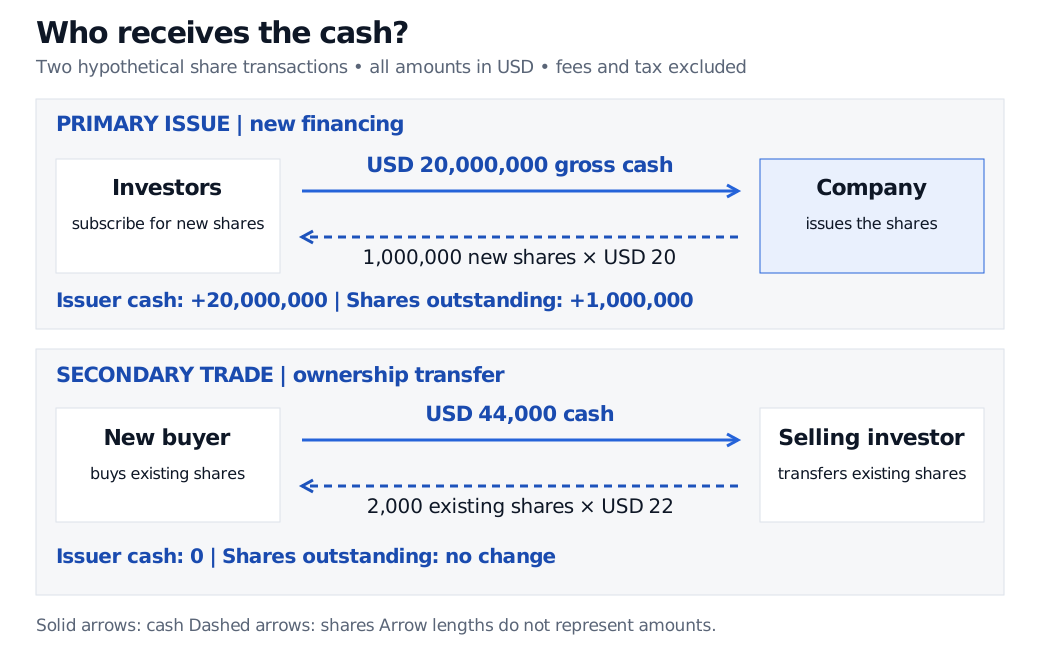
Original hypothetical USD ledger, excluding fees and taxes. Solid arrows show cash; dashed arrows show shares. Arrow lengths do not represent amounts.
The first transaction belongs to the primary market, where newly issued securities raise funds for the issuer. The later trade belongs to the secondary market, where existing securities are resold. These are two functions within capital markets, not competing definitions of the term. The SEC provides concise definitions of primary and secondary markets.
An initial public offering can contain newly issued shares, shares sold by existing shareholders, or a combination. The offering's headline value therefore need not equal the cash raised by the company. The SEC's IPO investor bulletin explains that selling-shareholder proceeds go to those shareholders. Read the allocation of shares and the use-of-proceeds disclosure before treating an offering as new corporate funding.
What makes it a capital-market instrument?
A common introductory convention places debt with an original maturity of more than one year in the capital market, while the money market covers short-term debt, commonly one year or less at issue. Ordinary shares have no scheduled repayment date, so their inclusion does not depend on a debt-maturity threshold.
This is a classification convention, not a promise about an investor's holding period or a universal legal boundary. Someone can buy a long-term bond and sell it tomorrow. Nor does every instrument called “debt” belong to the capital market: short-term Treasury bills and commercial paper are standard money-market examples. Definitions in a dataset or regulatory framework may use different maturity measures, including remaining maturity; check the stated classification rather than silently switching between them.
Within capital markets, equity and debt give different rights. An ordinary shareholder holds a residual ownership claim. A bondholder holds contractual creditor rights whose payments, priority and maturity depend on the instrument. Neither label guarantees a return or easy resale. SelfMadeQuant's Equities lesson develops ownership rights and the difference between dividends, price changes and total return. Its public page is a preview; the full lesson requires membership.
Why secondary trading still matters for funding
A secondary trade does not directly finance the issuer, but the market can still influence its future financing conditions. Buyers care about whether they can later exit a position, what information is available and what price they can obtain. Liquidity and observable trading prices help investors assess a new offering; weak demand or costly resale can make new funding harder or more expensive.
Keep the quantities separate when reading market data:
- Issuance proceeds measure cash raised in a specified offering, distinguishing gross from net proceeds and issuer sales from shareholder sales.
- Trading volume measures activity in existing claims over a period; it is not fresh finance raised by the issuer.
- Market capitalisation values outstanding equity at a market price; it is not the cash balance created by past issuance.
The useful question is always: which claim changed hands, and whose cash account changed? That question keeps financing flows, investor transactions and market valuations from being mistaken for one another.
Sources
- Edwin J. Elton, Martin J. Gruber, Stephen J. Brown and William N. Goetzmann, Modern Portfolio Theory and Investment Analysis, 9th ed., Wiley, 2014: Chapter 2, pp. 12–14, money-market and capital-market instruments; Chapter 3, pp. 31 and 35, primary and secondary markets.
- SEC Investor.gov, Primary Market and Secondary Market: issuance and resale definitions.
- SEC Investor.gov, Updated Investor Bulletin: Investing in an IPO: selling shareholders, proceeds and prospectus disclosures.
- World Bank, Long-term Finance: mobilising savings through capital markets.