A cash-secured put reserves cash to buy shares if assigned. Track the strike payment, premium and share value to distinguish funding cover from downside protection.
Cash-secured put
A cash-secured put is a short put option backed by cash set aside to buy the underlying shares if the writer is assigned. The reserve funds the promised purchase at the strike price. It does not protect the shares against falling in value.
An investor may use the strategy when willing to acquire a stock at the strike while collecting an option premium for accepting that obligation. Two outcomes can disappoint: the stock collapses and must be bought above its market price, or it rises and the investor never acquires the shares. A premium receipt alone does not establish that the trade has earned a profit.
Follow the reserve through assignment
Consider a fictional, physically settledEuropean put covering 100 shares. The investor sells one contract with a strike of USD 50 per share, receives USD 2 per share, and holds it until expiry. Set aside USD 5,000 of the investor’s capital, independently of the USD 200 premium. Assume zero interest, a nonnegative stock price, and no fees, taxes, default or price movement during settlement. For this example, exercise occurs below the strike and not at or above it.
Moving USD 5,000 into a reserve is a transfer within the account, not a trading expense. Releasing that reserve later is not trading income either. The premium is another cash item; while the put remains open, the writer also has an option liability.
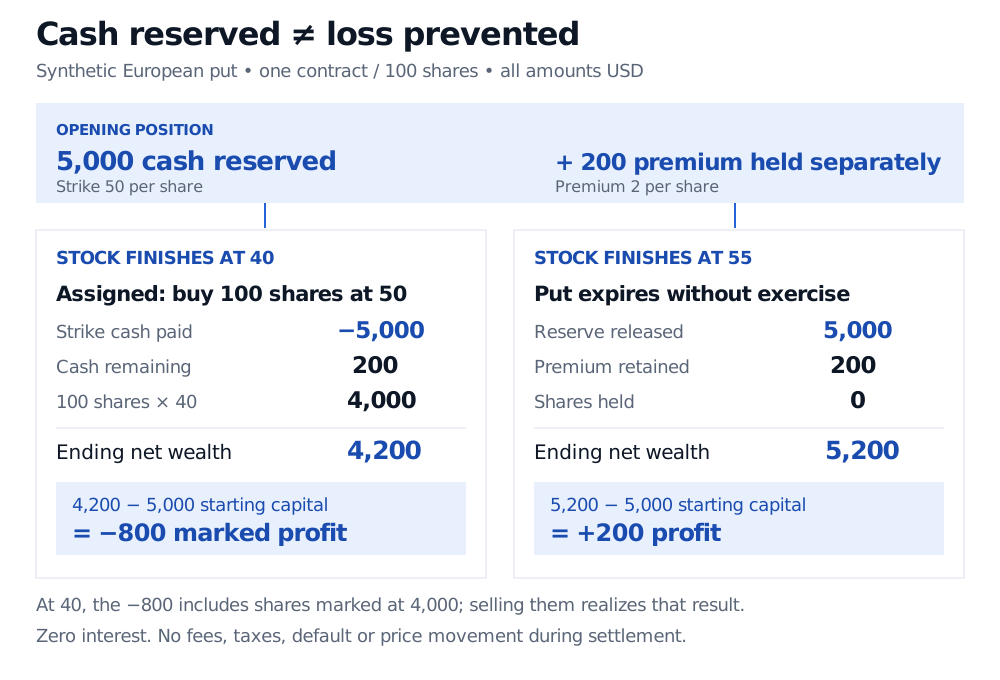
If the stock finishes at 40, assignment requires paying USD 5,000 for 100 shares. Those shares are now worth USD 4,000. The premium leaves USD 200 cash, so ending net wealth is USD 4,200, compared with the USD 5,000 starting capital: a USD 800 loss.
The USD 5,000 strike payment is a gross purchase outflow, not the loss. The investor receives shares in return. Nor is there an additional USD 1,000 option payment on top of buying those shares: the USD 1,000 difference between their strike cost and market value already represents the put’s adverse expiry outcome.
Reserve and assignment ledger for one put covering 100 shares at strike 50 and premium 2 per share. At stock price 40, assignment spends the 5,000 reserve, leaving 200 cash and shares worth 4,000: net wealth 4,200 and marked profit minus 800. At stock price 55, the unspent reserve plus premium gives 5,200 cash and profit 200.
Original synthetic ledger in USD. The USD 5,000 reserve and USD 200 premium are separate at entry. At 40, profit includes shares marked at their expiry value; at 55, the reserve is released without a share purchase. Zero interest; fees, taxes and default excluded.
If the investor keeps the assigned shares, the USD 800 is the combined marked loss at that moment; subsequent share-price changes alter the investment’s result. If the investor immediately sells all 100 shares at 40 under the example’s assumptions, the full cash ledger is
200−5,000+4,000=−800 USD.
That sale converts the marked result into a realized cash trading loss. This is an economic ledger, not a jurisdiction-specific tax calculation.
The premium caps the expiry gain
Let ST be the stock’s expiry price in USD per share. Including the premium, the position’s profit relative to the initial USD 5,000 capital is
ΠT=200−100max(50−ST,0).
The reserve earns no interest here, so funding it does not add a separate profit term.
Stock price at expiry, USD/share
Cash after settlement
Shares held
Shares’ market value, USD
Ending net wealth, USD
Profit, USD
0
200
100
0
200
−4,800
40
200
100
4,000
4,200
−800
48
200
100
4,800
5,000
0
55
5,200
0
0
5,200
200
The expiry break-even is 48 per share, the strike less the premium. The maximum expiry gain is USD 200; the maximum loss is USD 4,800, reached if the stock becomes worthless. These limits describe the original trade through expiry, marking any assigned shares then. After assignment, any retained shares participate in subsequent stock-price changes; the USD 200 gain cap applies through expiry.
Calling 48 the “effective purchase price” accounts for the premium economically. The contractual purchase still occurs at 50. Cash security changes how that purchase is funded; a less fully funded short put with the same contract and entry premium has the same option expiry profit but a different funding problem.
Assignment timing still matters
The European exercise convention isolates one expiry ledger. For US listed American-style options, assignment can occur before expiry; OIC’s assignment guidance also explains why an expiry price alone does not guarantee whether assignment occurs. The example’s exercise convention should not be read as an operating rule for an actual account.
Check the contract’s deliverable and exercise terms, and the broker’s current requirements for eligible collateral, reserve treatment and settlement funding. The USD 5,000 separate-cash convention above is an explicit modeling choice, not a universal broker rule. Spending or withdrawing the purchase funds defeats the funding arrangement. Holding sufficient cash also does not guarantee an executable early exit: repurchasing the put can cost more than its original premium.
Inspect the option result, then keep a separate cash ledger
The free public Option strategy designer can reproduce the short put’s expiry profit. Set Underlying price to 50, click Clear, add a put, select Sell, and use one contract, strike 50, entry premium 2. Under Profit & loss, the At expiry result is −800 at stock price 40, zero at 48, and +200 at 55. Keep the entry premium fixed; Use current model prices replaces it.
The tool’s option contract represents 100 shares. It does not track a cash reserve, broker margin or physical assignment. Its separate Scenario curve uses European Black–Scholes valuation, with fees and early exercise excluded. Use the ledger above alongside it to distinguish an option’s profit curve from the cash needed to honor the purchase.
Sources
John C. Hull, Options, Futures, and Other Derivatives, ninth Global Edition, Pearson, 2018, §10.2, pp. 237–239, for the writer’s liability and the distinction between option payoff and profit including the premium.