A bond discount is the amount by which a bond’s price is below its face value, or par value. A bond with face value 100 priced at 98.1406 has a discount of 1.8594. That price can be entirely consistent with the return the market requires: “below par” does not by itself mean underpriced or likely to default.
For an ordinary fixed-coupon bond, a lower purchase price lets the buyer earn a higher yield from the same promised payments. It does not increase the coupon.
Follow the money, not the price label
Consider a synthetic, non-callable bond with 100 USD face value, a 4% annual coupon rate and two years remaining. It pays 4 USD after one year and 104 USD after two years, including principal. Purchase occurs immediately after a coupon payment, with zero accrued interest. Assume every payment arrives as promised, with no taxes or trading costs.
At an annual-effective yield to maturity of 5%, its price is the present value of those payments:
The discount is therefore
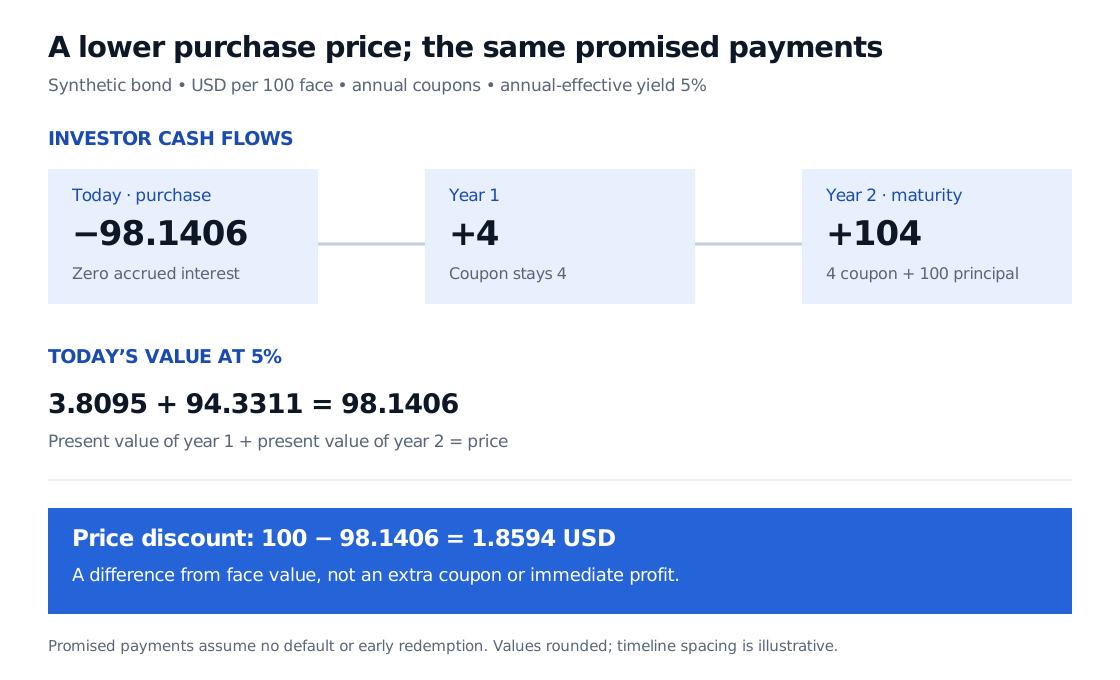
Original synthetic cash-flow ledger. Annual coupon payments and annual-effective discounting; zero accrued interest. Values are rounded to four decimals. Payments assume no default or early redemption.
The coupon rate is below the required yield. A buyer paying 100 would receive only a 4% yield under these conventions. Paying 98.1406 instead makes the same payments consistent with a 5% yield. The 1.8594 difference is part of the buyer’s eventual cash gain if principal is repaid in full; it is not cash received on purchase day.
A separate check moves everything to maturity. If the first coupon can be reinvested for one year at 5%, terminal wealth is
This confirms the 5% annual compound return under that reinvestment assumption. YTM itself is the cash-flow internal rate of return; actual compound growth also depends on what happens to the first coupon. Neither the discount amount nor the coupon rate alone measures that growth.
The Bonds and Yields lesson develops the dated-payment calculation and the distinction between a single yield and maturity-specific discount factors. Its public preview is open; the full lesson requires membership.
What “below par” leaves out
Which price? Many coupon bonds are quoted using a clean price, excluding accrued interest. Settlement can require the dirty price: clean price plus accrued interest. A below-par clean quote does not guarantee a below-par settlement amount. In the example they coincide because accrued interest is zero. Bond quotes are often expressed per 100 face; that is a quotation basis, not a requirement to buy exactly 100 USD of principal. FINRA’s bond-pricing explanation covers quotes and accrued interest.
Why the discount? A bond may be issued below par or later trade below par. Higher required market yields, weaker issuer credit and less liquidity can all reduce its price. The discount alone does not identify the cause. Nor does it guarantee a gain: selling before maturity exposes the holder to the future market price, and credit risk can prevent full repayment.
Which contract? The simple coupon-versus-yield comparison assumes fixed payments, par redemption, regular coupon dates and matching rate conventions. Floating coupons, inflation-linked principal, amortisation and embedded options require their actual payment rules. For a zero-coupon bond, a positive yield implies a below-par price under ordinary compound discounting; a zero yield gives par and a negative yield can give a price above par. “Zero coupon” describes the payment structure, not a universal price condition.
Which meaning of discount? A price discount is a currency amount or a percentage of face value. A bank-discount yield is a separate annualised quotation convention. For U.S. Treasury bills, TreasuryDirect’s pricing formula uses the price reduction relative to face value and a 360-day year. That quoted rate is not this bond’s annual-effective 5% YTM. Always identify the denominator, time basis and compounding before comparing rates.
Sources
- Frank J. Fabozzi and Francesco A. Fabozzi, Bond Markets, Analysis, and Strategies, 10th edition, MIT Press, 2021, Chapter 2, “Relationship between Coupon Rate, Required Yield, and Price” and “Relationship between Bond Price and Time If Interest Rates Are Unchanged” (local ebook PDF pages 61–62). The unchanged-yield condition is essential to the latter discussion.
- FINRA: Bonds, especially Bond Pricing, accrued interest and risk factors.
- FINRA: Understanding Bond Yield and Return, for coupon yield, YTM, reinvestment and total return.
- TreasuryDirect: Understanding Pricing and Interest Rates, for Treasury price/par relationships and the bill discount-rate convention.