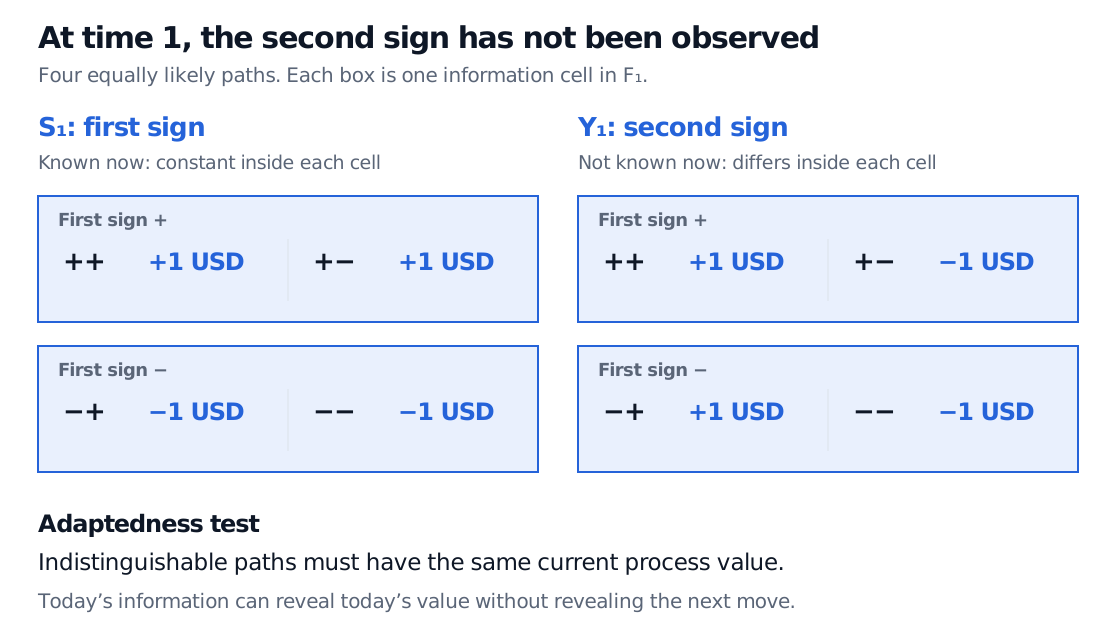
An adapted process uses information available by the current time. Compare four possible paths and see why adaptation differs from predictability and martingale fairness.
Adapted process
An adapted process is a stochastic process whose value at each time can be determined from the information available by that time. In a trading model, this separates a rule based on observed prices from one that quietly reads a future price. It is an information constraint, not a profitability claim.
The information is specified by a filtration(Ft). A real-valued process (Xt) is adapted to that filtration if Xt is Ft-measurable for every t. More explicitly,
{Xt≤a}∈Ftfor every real a and every t.
Measurability says that today's information answers questions about today's value. The sigma-algebra formalism makes “available information” precise. On a finite model, there is a particularly useful test: the current value must be constant on each group of outcomes that the observer cannot yet distinguish.
Same information, same current value
Consider two independent fair signs ξ1,ξ2∈{−1,+1}. Each complete path ++,+−,−+,−− has probability 1/4. The first sign arrives at time 1 and the second at time 2. Before either sign, F0 is trivial; F1 reveals only ξ1; F2 reveals both.
Let St record cumulative moves in USD, starting at zero:
S0=0,S1=ξ1 USD,S2=(ξ1+ξ2) USD.
This is a synthetic random walk, not a fitted asset-price model; its negative values represent cumulative moves, not negative stock prices.
Complete path
S0 (USD)
S1 (USD)
S2 (USD)
Y1=ξ2 USD
++
0
1
2
1
+−
0
1
0
−1
−+
0
−1
0
1
−−
0
−1
−2
−1
At time 1, the observer distinguishes the two information cells {++,+−} and {−+,−−}. Within the first cell, S1 is always USD 1; within the second, it is always USD −1. At time 0, S0 is constant; at time 2, each complete path is distinguishable. Thus (St) is adapted.
By contrast, the proposed time-1 value Y1=ξ2 USD differs between ++ and +−, even though the observer cannot distinguish them yet. Its value also differs inside the other time-1 cell. It is not F1-measurable. One failing time is enough to rule out adaptation of a proposed process.
At time 1, the paths ++ and +- form one information cell and -+ and -- form the other. S1 has values 1,1,-1,-1 USD and is constant within each cell. Y1 has values 1,-1,1,-1 USD and varies within both cells.
Original exact four-path example. Each path has probability 1/4. The boxes show available information; constancy inside a box determines measurability, regardless of how likely that box is.
The complete future path can be written down as an element of the sample space without being known to the observer. Confusing the analyst's table of possible outcomes with the trader's actual information is a route to look-ahead bias.
Today is allowed; tomorrow is not
Adapted does not mean known before the current time. Here S1 becomes known when the first sign arrives; it was not known at time 0. Consequently, (St) is adapted but is not a discrete-time predictable process, whose time-t value, for t≥1, must already be Ft−1-measurable.
For trading, make the holding interval explicit. If Ht denotes the number of units chosen after observing time t, to be held from t to t+1, the information requirement and gain are
Ht is Ft-measurable,Gt+1=Ht(St+1−St).
For instance, choose H1=1 after a first positive sign and H1=0 after a first negative sign. The next gains on ++,+−,−+,−− are USD 1,−1,0,0. The rule uses available information, yet it can lose money. Their mean is zero in this fair-sign model.
Choosing H1=ξ2 would instead manufacture USD 1 on every path, because ξ22=1. That calculation uses a sign not yet observed when the holding must be selected. It fails the information requirement rather than discovering an executable trading opportunity. These gain calculations omit costs and funding.
Some texts call the holding for the interval (t,t+1]Kt+1, rather than Ht. Then Kt+1=Ht must be Ft-measurable, and (Kt) is predictable. The subscripts change; the observation clock does not.
Adaptation answers only the information question
A martingale must be adapted and integrable, and must also satisfy a conditional expectation restriction. Adaptation alone imposes no such average-change condition. The deterministic process Dt=t USD is adapted to this filtration but is not a martingale: its next value exceeds its current value by USD 1 with certainty.
Adaptation is always relative to a filtration. Every process is adapted to its own natural filtration, generated by its observed history. The same proposed Y1 would be measurable if the second sign were genuinely revealed by time 1. Enlarging the information set on paper, however, does not establish that a historical trader had that information.
In continuous time, the definition still checks measurability at each fixed time. Defining stochastic integrals also requires suitable measurability and integrability conditions; adaptedness alone is not a complete licence to integrate an arbitrary process.
To study the underlying measurability test more formally, see Conditional Expectation and σ-Algebras, particularly its information and measurability definitions. The public page is a preview; the full lesson requires membership.
Steven E. Shreve, Stochastic Calculus and Finance, CMU lecture notes prepared by Prasad Chalasani and Somesh Jha, 25 July 1997, §§2.4 and 3.3.1: adaptation and holdings indexed by the start of their holding interval. These are the 1997 notes, not the later Volume I textbook.