A sample space specifies the possible outcomes of an experiment. Build a two-venue fill model and distinguish outcomes, probability weights, numerical readouts and observed samples.
Sample space
A sample space, written Ω, is the set of all possible outcomes of a specified random experiment. One realised outcome ω∈Ω describes what happened. For an execution model, defining this set fixes what counts as a fill, which orders are being considered and when their status is measured—before any probability is calculated.
The outcomes must be distinct, mutually exclusive and collectively exhaustive at the chosen level of detail: every run of the experiment produces exactly one outcome in the set. A sample space lists possibilities; it does not say they are equally likely.
Two venues, one deadline
Consider two hypothetical orders, one sent to venue A and one to venue B. Observe both one second after submission. For each order, record F if it has fully filled by that deadline and N otherwise. Partial fills, cancellations and orders that fill later all count as N. This binary abstraction deliberately discards their differences.
An outcome is the ordered pair (A status, B status), so
Ω={(F,F),(F,N),(N,F),(N,N)}.
Ordering matters: (F,N) means A fully filled and B did not; (N,F) means the reverse. Merely writing “one order filled” loses the venue identity.
Now add a probability law. Stipulate that A's full-fill probability is 0.80, B's is 0.70, and the two full-fill events are independent. These are synthetic assumptions, not observed execution rates.
Outcome (A, B)
Probability
Number fully filled
(F,F)
0.80×0.70=0.56
2
(F,N)
0.80×0.30=0.24
1
(N,F)
0.20×0.70=0.14
1
(N,N)
0.20×0.30=0.06
0
The weights sum to one. The four-outcome sample space alone would not justify those products: independence supplies the factorisation. Shared liquidity or a common market move could create dependence, requiring different joint weights on the same four outcomes.
One set supports several questions
An event selects outcomes from the space. “At least one order fully fills” selects the first three rows:
E={(F,F),(F,N),(N,F)},P(E)=0.56+0.24+0.14=0.94.
Counting three outcomes out of four would give 0.75, which is wrong here because the outcomes have different weights.
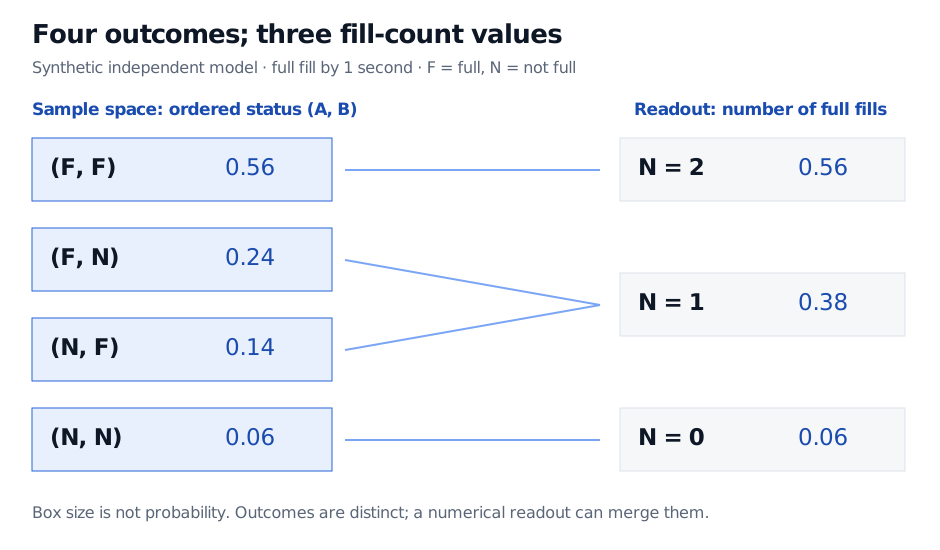
Four ordered venue-status outcomes have probabilities 0.56, 0.24, 0.14 and 0.06. Mapping them to the number of full fills merges the two one-fill outcomes, giving count probabilities 0.06 at zero, 0.38 at one and 0.56 at two.
Original synthetic independent model. Full fill is measured at one second; equal-sized boxes do not imply equal probabilities.
If fill count is the only question, {0,1,2} can itself serve as a coarser sample space with these induced weights. It cannot answer which venue filled when the count is one. Choosing a space is therefore a modelling decision about which distinctions to retain.
Possible outcomes are not the collected sample
An observed sample might contain many repeated (F,F) outcomes and no (N,N) outcomes. That record does not remove (N,N) from the model's sample space. “Not observed” and “excluded from the model” are different claims.
Nor must a sample space be finite. A model of an execution time can use nonnegative real values, with an additional outcome if non-execution is possible. A model of a price path may use entire paths as outcomes. Beyond finite models, the full probability setup also specifies which subsets are measurable events; it is commonly written (Ω,F,P).
The practical test is whether the chosen outcomes retain enough information for the intended question. Our binary model can answer a deadline full-fill question. It cannot calculate partial-fill quantities, execution prices or exact waiting times. Those require richer outcomes and an appropriate probability law.
Probability Fundamentals develops outcomes, events and probability rules further. A public preview is available; the full lesson is free with a signed-in account.