An event selects outcomes from a sample space. Use a four-state market model to distinguish events from outcomes and random variables, and calculate unions, intersections and complements.
Event
An event is a set of possible outcomes to which a probability is assigned. It occurs when the realised outcome belongs to that set. In a trading model, “the return is negative” is an event; its probability says how likely that condition is to hold over the stated horizon.
The sample spaceΩ contains the model's possible outcomes. Formally, an event A belongs to the collection of measurable sets F in a probability space (Ω,F,P). We write A∈F and A⊆Ω. In a finite model we can take every subset as measurable. In general probability models, the measurable-set requirement matters: probability is defined on F, rather than automatically on every conceivable subset.
One period, four weighted outcomes
Suppose a desk uses a deliberately simplified model of tomorrow's market regime and stock-return direction. Exactly one of the following outcomes occurs. These are stipulated model probabilities, not market estimates.
An event's probability is the sum of its constituent outcome weights:
P(A)=0.20+0.20=0.40,P(B)=0.10+0.20=0.30.
Both events contain two of the four outcomes, yet their probabilities differ. Counting outcomes and dividing by four would be valid only if the four outcomes were equally likely.
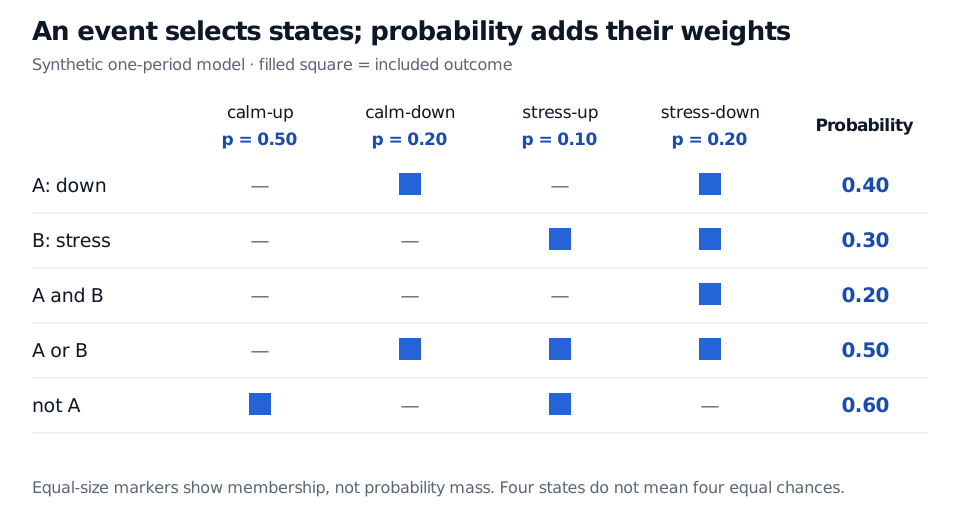
Event membership matrix: down includes calm-down and stress-down with total probability 0.40; stress includes stress-up and stress-down with total 0.30; their intersection is stress-down with 0.20; their union has 0.50; the complement of down includes both up states with 0.60.
Original synthetic one-period model. Filled squares identify included states; marker size does not represent probability.
“And”, “or”, and “not” are set operations
The intersectionA∩B means both conditions hold: only stress-down qualifies, with joint probability0.20.
The unionA∪B means at least one condition holds, including both. Here it contains calm-down, stress-up and stress-down. Adding P(A) and P(B) counts stress-down twice, so subtract the overlap:
P(A∪B)=P(A)+P(B)−P(A∩B)=0.40+0.30−0.20=0.50.
The complementary eventAc=Ω∖A means down does not occur. It includes calm-up and stress-up, giving 0.50+0.10=0.60=1−0.40. Up is the complement of down in this model, because the model has no flat-return state. A model allowing an unchanged price would have to include that outcome in “not down” too.
The empty set is the impossible event; the whole sample space is the certain event. Their probabilities are zero and one, respectively.
Outcome, event, and numerical value
These objects play different roles:
Outcome: stress-down is one element ω∈Ω.
Event: down is a set of elements, A⊆Ω. A singleton such as {stress-down} is also an event; the braces distinguish the set from its element.
Random variable: a measurable numerical function X(ω), such as a return or payoff assigned to each outcome.
For example, assign return X=+1% to each up outcome and X=−1% to each down outcome. The number −1% is a possible return value; {X<0} is the event consisting of the two down outcomes. Knowing the return is negative does not identify which regime occurred. A random variable can map several different outcomes to the same value.
This distinction keeps risk questions precise: first specify the instrument, horizon and condition, then identify the outcomes satisfying it, then add their probabilities. The event describes what counts; the probability law supplies how much weight it receives.
For more worked foundations, Probability Fundamentals develops event operations, conditioning and independence. A public preview is available; the full lesson is free with a signed-in account.
Shreve, S. E., with Chalasani, P., and Jha, S. (25 July 1997). Stochastic Calculus and Finance, CMU lecture notes, §1.4, Definition 1.13: general probability spaces.