The complementary event of an event is the event that does not occur. Written , it contains every outcome in the fixed sample space that is outside :
The first statement defines a set; the second gives its probability. As Stark's probability text explains, the rule follows because and cannot occur together and jointly cover the entire sample space. Their probabilities therefore sum to one. No independence assumption is needed.
Missing a fill deadline
Suppose a desk tracks a synthetic, complete cohort of 100 submitted orders. Define precisely: the order is fully filled at or before 1 second after submission. A fill exactly at 1 second qualifies; a partial fill does not. Tracking continues through a specified follow-up window, yielding these exhaustive categories:
| Outcome | Orders | Share of all 100 orders |
|---|---|---|
| Fully filled by the 1-second deadline | 70 | 70% |
| Fully filled later during follow-up | 20 | 20% |
| Cancelled without a full fill, or still incomplete at follow-up end | 10 | 10% |
Select one of these 100 orders uniformly at random. Then
“Filled later” is only part of the complement. It leaves out the 10 orders that never fully fill within follow-up. The exact negation of “fully filled by the deadline” is “not fully filled by the deadline,” covering both groups. The 30% is exact for this constructed cohort; it is not a forecast of another venue's execution quality.
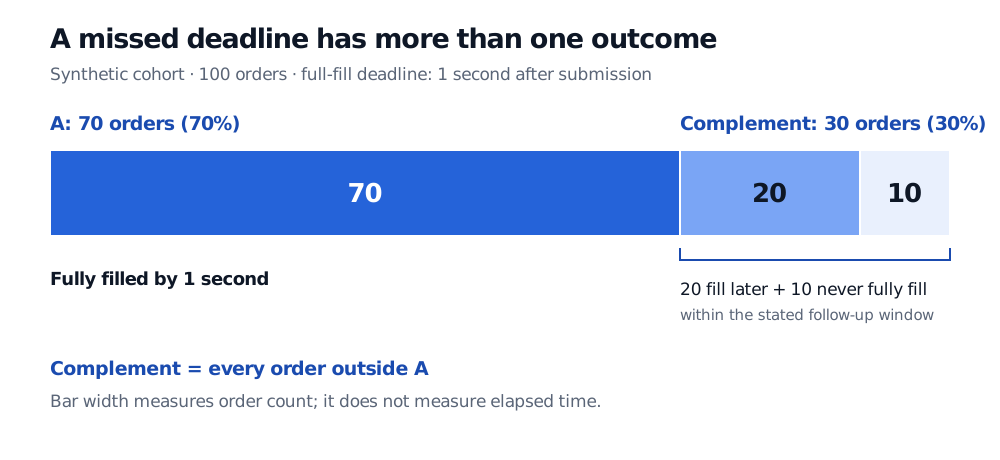
Original synthetic complete cohort. Bar width measures order count, not time. Full-fill deadline: 1 second after submission; outcomes tracked through a stated follow-up window.
Keep the universe and the boundary fixed
Dropping the 10 incomplete orders changes the question. Among the 90 orders that eventually fully fill during follow-up, the timely share is , about 77.78%. That is a conditional probability, with a different denominator. You cannot combine its complement with the original 100-order cohort rate. For any conditioning event with , keep the same condition on both sides:
The boundary matters too. The complement of “return is positive” is “return is zero or negative,” rather than “return is negative.” More generally, the complement of is . Do not discard equality unless you have justified that it has zero probability in the model; rounded observations can give it positive mass.
Mutually exclusive events need not be complements. Timely and late full fills are mutually exclusive, yet they leave the incomplete orders uncovered. Complementary events must be both disjoint and exhaustive. At the extremes, and .
This makes complements useful for risk questions: “at least one default by year-end” is the complement of “no defaults by year-end.” The subtraction always works on the same defined portfolio, horizon and probability model. Computing the no-default probability by multiplying individual survival probabilities needs a separate dependence assumption.
For a broader introduction, Probability Fundamentals develops event operations and conditioning. The full lesson is available with a free signed-in account; the public page provides a preview.
Sources
- Dimitri P. Bertsekas and John N. Tsitsiklis, Introduction to Probability, 2nd ed. (2008), §§1.1–1.2: set complements, sample spaces and probability axioms.
- Philip B. Stark, SticiGui, “Probability: Axioms and Fundaments,” The Complement Rule: the complement identity and its derivation from additivity and normalization.