Mutually exclusive events share no outcome. Use return categories to distinguish disjointness from complements and independence, including the zero-probability exception.
Mutually exclusive events
Mutually exclusive events, also called disjoint events, have no outcome in common: if one occurs, the other cannot occur in the same experiment. For eventsA and B in a stated sample space,
A∩B=∅.
This is a statement about which outcomes belong to the events. It immediately implies P(A∩B)=0. In risk reporting, it tells you when scenario probabilities can be added without counting any outcome twice.
Up and down leave room for flat
Fix one instrument and one return period, measured from the same opening and closing prices. Let R be that period's return. Suppose an illustrative model assigns:
Event
Definition
Model probability
Up, A
R>0
0.50
Down, B
R<0
0.35
Flat, C
R=0
0.15
These are stipulated probabilities, not estimates from market data. Every outcome belongs to exactly one category, so the three events are disjoint and collectively exhaustive. A realised return cannot be both positive and negative.
The general addition rule subtracts the shared mass:
P(A∪B)=P(A)+P(B)−P(A∩B).
Here the intersection is empty, giving
P(A∪B)=0.50+0.35=0.85.
Thus the model puts an 85% probability on a nonzero return. It leaves 15% on flat.
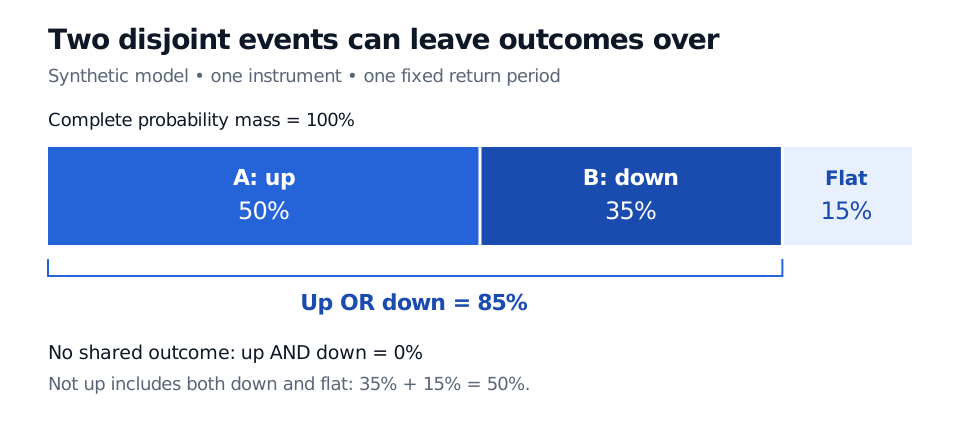
Synthetic one-period return categories: up 50%, down 35%, flat 15%. Up and down share no outcome and together have probability 85%; not-up includes down and flat, totalling 50%.
Original hypothetical model for one instrument and one fixed period. Segment widths represent probability mass, not return magnitude.
Up and down are not complements in this model. The complement of up is everything that is not up, including flat:
Ac=B∪C,P(Ac)=0.35+0.15=0.50.
Complements must both exclude one another and cover the entire sample space. Disjoint events need satisfy only the first condition. This matters when classifying an order as filled, cancelled or still pending at a deadline: two incompatible statuses need not cover every possible status.
For the up and down events, the left side is zero while the product is
0.50×0.35=0.175.
They are therefore dependent. Learning that the return is down reduces the conditional probability of up from 50% to zero. The 17.5% product is what independence would require for their joint probability; it is not a valid joint probability for these incompatible categories.
The precise rule is: two mutually exclusive events with positive probabilities cannot be independent. There is a zero-probability exception. If either marginal probability is zero, both sides of the independence equation are zero, so disjointness and independence coexist. For instance, the empty event is disjoint from and independent of every event. Conditioning on a zero-probability event is not defined by the elementary ratio formula; the product definition avoids that division.
Check the event definitions before adding
“Stock up today” and “stock down tomorrow” can both occur. So can “asset X up” and “asset Y down.” Exclusivity depends on the same instrument, horizon and measurement convention, not the words up and down alone. Threshold buckets also need explicit boundaries: “return at least zero” overlaps “return at most zero” at zero.
For a collection of events, mutually exclusive means every pair is disjoint. It is insufficient that all three cannot happen together: some pairs might still overlap. Finite or countably many pairwise disjoint events have union probability equal to the sum of their probabilities. Their sum is one only when their union has probability one; to form a partition of the sample space they must cover every outcome.
Finally, zero intersection probability does not always prove literal disjointness. In a continuous uniform model on [0,1], the events [0,1/2] and [1/2,1] share the endpoint 1/2, yet that singleton has probability zero. They overlap as sets while being disjoint up to a probability-zero event. The finite return model above has strictly positive mass in every category, so there is no hidden zero-mass overlap.
For a fuller progression through event algebra and conditioning, Probability Fundamentals has a public preview and is available in full with a free signed-in account.
Sources
Joseph K. Blitzstein and Jessica Hwang, Introduction to Probability, 2nd edition, §1.6 (general probability and disjoint additivity) and §2.5, especially warning 2.5.2 (disjointness versus independence and its zero-probability exception).