A triple integral accumulates over three coordinates. Build a three-position loss probability from changing bounds, shrinking slices and a joint density.
Triple integral
A triple integral adds up a quantity over a region with three coordinates. Written ∭Dh(x,y,z)dV, it weights each tiny volume element by the value of h there. In finance, the coordinates can represent three uncertain loss factors rather than physical distances: integrating their joint density over a loss event gives its probability.
The third integral introduces another dimension to the region, not a third probability assumption. A double integral accumulates over pairs of coordinates; a triple integral accumulates over triples.
What is being added?
Think of dividing a solid D into small boxes. A box with side lengths Δx, Δy and Δz contributes approximately
h(x,y,z)ΔxΔyΔz.
The integral is the limit of these sums as the boxes become arbitrarily small, when that limit exists. In Cartesian coordinates, dV=dxdydz. Three choices of integrand have different meanings:
Integrand
What the triple integral measures
1
The coordinate volume of D
Joint density f(x,y,z)
The probability that (X,Y,Z) lies in D
Payoff times joint density, g(x,y,z)f(x,y,z)
The expected payoff contributed by states in D
A probability density is a weight per unit of coordinate volume. Its integral over the full support must be one. A region's volume equals its probability only in special cases, including a unit-density model below. A density value at one point is not itself a probability.
Three loss factors, one shared budget
Suppose a hypothetical desk has three positions. Over the same fixed horizon, each loses between USD 0 and USD 100, with no gains in this deliberately simple model. Write their losses as 100X, 100Y and 100Z USD, where X,Y,Z are independent Uniform(0,1) variables. The coordinates are dimensionless loss fractions.
The independence assumption makes the joint density the product of three unit densities: f(x,y,z)=1 on the unit cube and zero outside. This is a modelling assumption, not something justified by the ability to integrate three times. Real positions exposed to common shocks can require a very different joint density.
What is the probability that total loss is at most USD 100? The event is
D={(x,y,z):x,y,z≥0,x+y+z≤1}.
This is a tetrahedron, also called a three-dimensional simplex. It occupies only part of the possible-outcome cube. If one position consumes more of the budget, less remains for the other two.
To integrate in the order dzdydx, work from the outside limits inward:
The first loss fraction can range from x=0 to x=1.
With x fixed, the second can range from y=0 to y=1−x.
With both fixed, the third can range from z=0 to z=1−x−y.
Then calculate in the opposite direction, starting with the innermost integral:
The probability is dimensionless; the USD amounts merely set the loss scale and threshold. Giving all three integrals bounds from zero to one would count every outcome, including budget breaches, and return one.
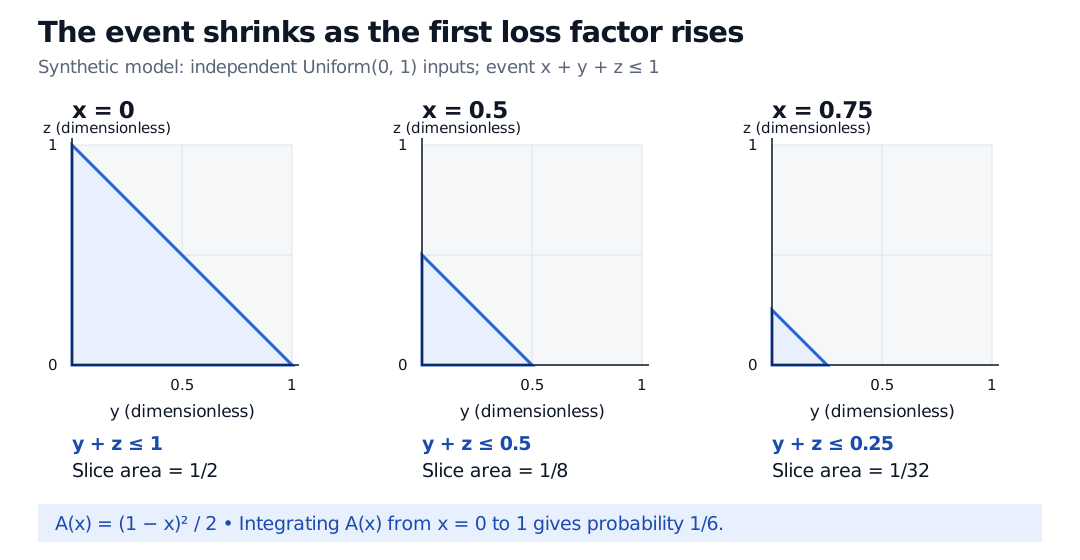
Equal-scale y,z slices of the event x+y+z at most 1. At x=0, 0.5 and 0.75, shaded right triangles have areas 1/2, 1/8 and 1/32. All coordinates are dimensionless; the shrinking areas integrate to probability 1/6 under unit joint density.
Original synthetic model. Each panel uses the same dimensionless y,z axes. The slice at fixed x has two perpendicular sides of length 1−x and area (1−x)²/2; integrating those areas adds the slices into a volume.
A geometric check reaches the same answer: the tetrahedron has a right-triangle base of area 1/2 and perpendicular height 1, so its volume is (1/3)(1/2)(1)=1/6. Because the joint density is one, that volume is also the event probability. The result says nothing about the probability of losses in an actual portfolio without a defensible model for the inputs.
Change the order, preserve the region
Triple integrals can often be evaluated as three successive definite integrals. For a continuous integrand on a box, Fubini's theorem permits any of the six integration orders. More generally, absolute integrability supports order changes; nonnegative integrands have the corresponding Tonelli result. These conditions matter for unbounded regions or singular integrands.
Changing order does not mean retaining the same written bounds. Describe the same solid again in the new order. Here symmetry makes z an equally convenient outer variable:
∫01∫01−z∫01−y−z1dxdydz=61.
For a more complicated loss constraint, one order may require splitting the region while another gives simple bounds. MIT's notes on limits in triple integrals explain this through vertical lines entering and leaving a solid and its projection onto a coordinate plane.
For an expected value, replace the event's integrand by the payoff times the joint density and integrate over the relevant support. The geometry selects the states; the density weights their likelihood; the payoff determines their financial contribution. Changing to cylindrical or spherical coordinates also changes the volume element: its Jacobian factor must accompany the new bounds.
For a fuller treatment of setup, order choice and probability calculations, see §§1–2 and 5 of Triple Integrals over General Regions. The full lesson requires membership; its introduction and outline have a public preview.
Sources
Steven G. Krantz and Harold Parks, Vector Calculus (2024), §4.6.1, Theorem 4.6.1 and Definition 4.6.3 — triple Riemann integrals, iterated integrals over simple solids and volume.