A symmetric matrix equals its transpose. Learn what real symmetry guarantees, why it does not ensure nonnegative variance, and how covariance checks expose the difference.
Symmetric matrix
A symmetric matrix is a square matrix that equals its transpose:
A=A⊤,aij=aji for every i,j.
Entries reflected across the main diagonal must match. The diagonal entries need not equal one another. For example,
A=(2113)is symmetric, whereasC=(2013)is not.
In portfolio risk, symmetry expresses a basic consistency requirement: the covariance of asset 1 with asset 2 must equal the covariance of asset 2 with asset 1. But symmetry is only one requirement for a valid risk matrix. A symmetric matrix can still assign a negative number to a supposed variance.
What real symmetry buys you
Every real symmetric n×n matrix has real eigenvalues and a complete orthonormal eigenbasis. Its eigenvectors can be chosen to have length one and be mutually perpendicular. The resulting eigenvalue decomposition is
A=QΛQ⊤,Q⊤Q=I,
where the columns of Q are those eigenvectors, I is the identity matrix, and Λ is a real diagonal matrix. This is the real spectral theorem. MIT's lecture summary explains its connection to perpendicular principal directions.
“Can be chosen” matters when eigenvalues repeat. Vectors within one repeated-eigenvalue eigenspace are not automatically perpendicular; an orthonormal basis can be selected there. Neither repeated nor zero eigenvalues prevent this decomposition.
The theorem separates a matrix's directional effects, but it makes no promise about their signs. Consider
B=(1221).
It is symmetric, and every entry is positive. Nevertheless,
B(11)=3(11),B(1−1)=−(1−1).
Its eigenvalues are 3 and −1. The common direction is stretched by three; the spread direction reverses. Symmetry guarantees real eigenvalues, while positive semidefiniteness additionally requires all of them to be nonnegative.
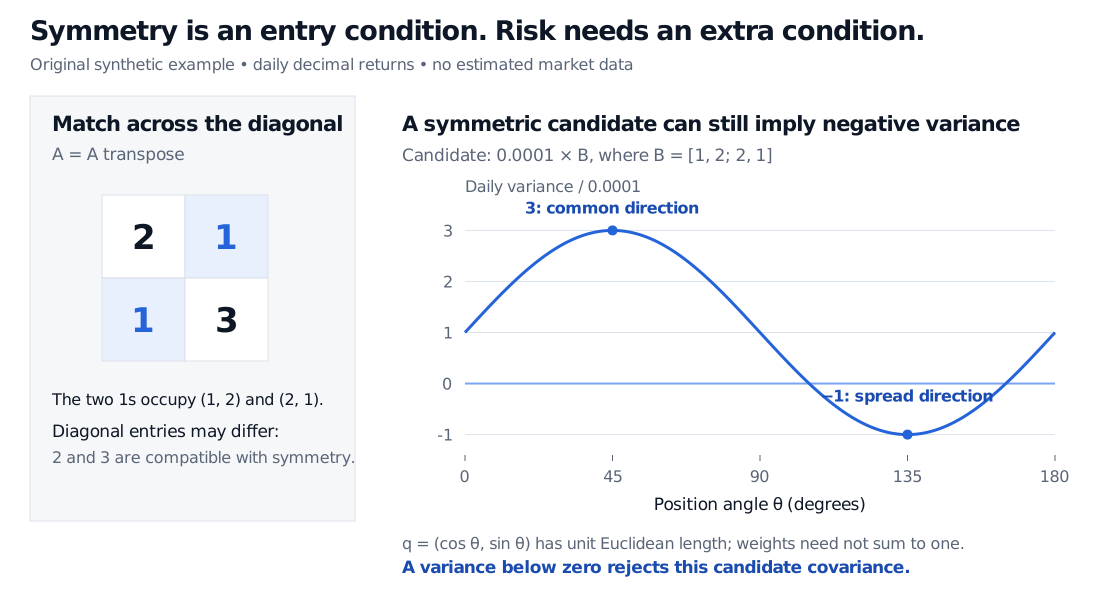
The off-diagonal entries of A, with rows (2, 1) and (1, 3), match across the main diagonal. A different symmetric matrix B, with rows (1, 2) and (2, 1), is scaled by 0.0001 as a candidate daily-return covariance. Its quadratic form over unit directions reaches daily variance 0.0003 at 45 degrees and minus 0.0001 at 135 degrees.
Original synthetic matrices. The curve evaluates the candidate variance for unit-length signed positions; these are not required to be fully invested portfolio weights. Matching entries do not prevent a negative direction.
A covariance check that fails despite perfect symmetry
Suppose an analyst proposes Σ=10−4B for two assets' daily decimal returns. The tilde marks a candidate, rather than an established covariance matrix. Its diagonal entries imply daily volatility of 1% for each asset, but the off-diagonal entry implies correlation
0.0001×0.00010.0002=2,
which is impossible. The same failure appears through a portfolio quadratic form. With signed exposures w=(1,−1)⊤ relative to a common capital base,
w⊤Σw=10−4(1−2−2+1)=−0.0002.
A negative variance rejects the candidate; it does not describe a risk-free spread or an arbitrage profit. For an actual return vector R with finite second moments,
Σij=Cov(Ri,Rj)=Cov(Rj,Ri),w⊤Σw=Var(w⊤R)≥0.
The first identity gives symmetry, the second positive semidefiniteness. Higham's discussion of correlation matrices explains why inconsistent inputs can violate the second condition even when individual entries look plausible.
For more on the risk interpretation, Eigenvalues and Covariance Matrices derives portfolio variance in an orthogonal eigenbasis. The full lesson requires membership; its outline and introduction have a public preview.
Symmetrising is a limited repair
Rounding, transcription or separate calculations can leave a supposedly symmetric numerical matrix M with slightly different entries across its diagonal. Averaging the two sides gives
S=2M+M⊤,
which is symmetric. The identity S⊤=S follows directly by transposing this expression.
That step fixes symmetry alone. Applying it to B leaves B unchanged, including its negative eigenvalue. A materially negative eigenvalue requires investigating the data or model, and any subsequent repair needs a stated objective and constraints. A tiny negative computed eigenvalue calls for comparison with the matrix's scale and numerical tolerance. Higham describes the separate problem of finding a nearby positive semidefinite matrix.
Finally, the word real in the spectral theorem is essential. For complex entries, plain symmetry still means A=A⊤, but the corresponding real-spectrum guarantee belongs to Hermitian matrices, satisfying A=A⊤ with conjugation as well as transposition. For example, iI equals its transpose yet has eigenvalue i. It is symmetric over the complex numbers and is not Hermitian.
Sources
Gilbert Strang, Introduction to Linear Algebra, 5th edition, Wellesley–Cambridge Press, 2016, §6.4 (symmetric matrices and the spectral theorem), §6.5 (positive definiteness), and §9.2 (Hermitian matrices).