A supermartingale has nonpositive conditional expected changes. A fair bet after fees shows why winning paths can coexist with falling conditional means.
Supermartingale
A supermartingale is an integrable, adapted process whose conditional expected future value is no greater than its current value. Given what is known now, its next expected change is nonpositive. A fair bet with a fee illustrates the idea: the fee lowers the conditional mean even though a winning outcome still raises wealth.
The word describes a conditional-average property, not a requirement that every path keeps falling. The probability measure and the available information are part of the claim.
The inequality, with its conditions
Let Fn be the information available at time n, forming a filtration. Under a specified probability measure P, a real-valued process (Xn) is a supermartingale when:
Xn is Fn-measurable: its current value can be determined from current information.
EP[∣Xn∣]<∞ at every time: its magnitude has finite expectation.
The last qualifier allows exceptions on events of probability zero. Repeated conditioning gives the same inequality between any two fixed times m<n:
EP[Xn∣Fm]≤Xm.
Equality is allowed. A martingale is therefore also a supermartingale. Reversing the inequality gives a submartingale; equivalently, −X is a submartingale whenever X is a supermartingale. The naming convention does not imply that “super” means superior returns.
A fair gross bet, after fees
Consider a synthetic two-step model, at times n=0,1,2. Start with wealth W0=USD 100. At each step, a new independent fair sign produces a gross gain of USD 1 or a gross loss of USD 1. Participating costs USD 0.20 per step. There is no interest, external cash flow or other cost in this example.
Let ξn+1 be the gross dollar change, taking values +1 and −1 with probability 1/2 each. Information reveals each sign when that step ends. Wealth evolves as
Wn+1=Wn+ξn+1−0.20,n=0,1,
with all amounts in USD. Independence and fairness give E[ξn+1∣Fn]=0, hence
E[Wn+1∣Fn]=Wn−0.20<Wn.
Wealth is observable at each step and takes only finitely many values, so adaptation and integrability also hold. This is a supermartingale under the stipulated fair-sign probability law and information flow.
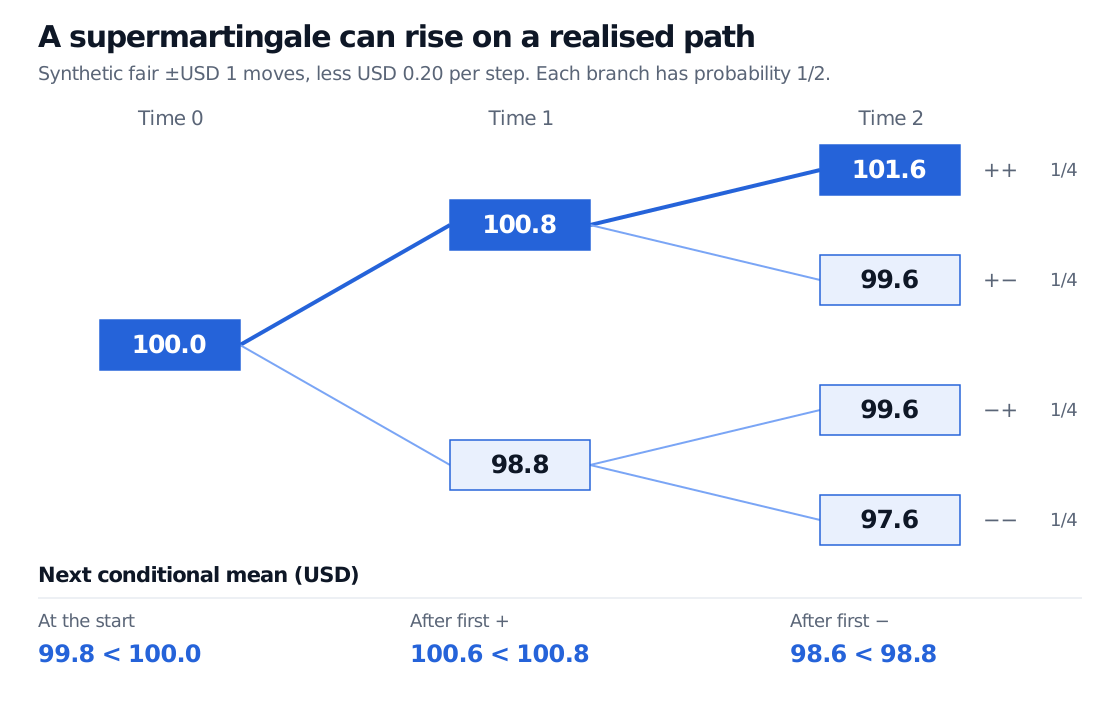
A synthetic wealth tree in USD starts at 100, moves to 100.8 or 98.8, then reaches 101.6, 99.6, 99.6 or 97.6 on four equally likely paths. The next conditional means are 99.8 at the start, 100.6 after the first plus and 98.6 after the first minus; each is 0.2 below current wealth.
Original exact two-step model, in USD. Each branch has probability 1/2. The dark blue path rises twice while every node's next conditional mean sits USD 0.20 below its current value.
After the first winning move, wealth is USD 100.80, above its starting value. From there, the two terminal possibilities average to
2101.60+99.60=100.60<100.80.
After a first losing move, the corresponding average is (99.60+97.60)/2=98.60<98.80. The terminal distribution combines the two middle paths:
Terminal wealth (USD)
Probability
101.60
1/4
99.60
1/2
97.60
1/4
Its expected value is USD 99.60: two fees below the initial USD 100. Some paths profit; the conditional expected change remains negative at every step. This small model does not establish that an arbitrary market strategy has fair gross gains or the same cost structure.
Adding the cumulative fees back reveals the fair component. The process Mn=Wn+0.20n is a martingale on these three times. More generally, subtracting an integrable, adapted, nondecreasing cost process from a martingale produces a supermartingale. This is an expectation statement; a particular realised gain can exceed its cost.
What the property buys you
Taking expectations gives E[Xn+1]≤E[Xn]. Falling unconditional means are a consequence, but they are not enough to verify the definition: a process can have a declining overall average while one observable state predicts an increase.
The conditional test also constrains when to exit. For an integrable discrete-time supermartingale and a stopping timeτ bounded by a fixed finite horizon, optional stopping gives
E[Xτ]≤E[X0].
Thus a rule that chooses when to stop the fee-paying model, using revealed signs and stopping by time 2, cannot raise expected exit wealth above USD 100. That does not prohibit a profitable exit on an individual path. Unbounded waiting requires additional conditions; the finite-horizon inequality supplies no unrestricted “wait until ahead” guarantee.
In option pricing, the unit of value matters too. In a finite-horizon discrete pricing model, the cash-discounted American-option value is a supermartingale under the model's pricing measure: current value covers both immediate exercise and the conditional value of continuing. The undiscounted value need not be a supermartingale when cash earns interest. This is a different financial mechanism from fees, with the same conditional inequality.
To practise the averaging operation behind the node tests, Conditional Expectation develops conditional means and the tower property. The public page is a preview; the full lesson requires membership.
James Norris, Advanced Probability, §§2.1–2.2, especially Theorem 2.2.3 — adaptedness, integrability and bounded optional stopping for supermartingales.
Steven E. Shreve, Stochastic Calculus and Finance, CMU lecture notes by Prasad Chalasani and Somesh Jha, July 25, 1997, §5.2 — discounted supermartingale values in American-option hedging. This is the lecture-note source, rather than the later textbook. The fee model, figure and practice question are original.